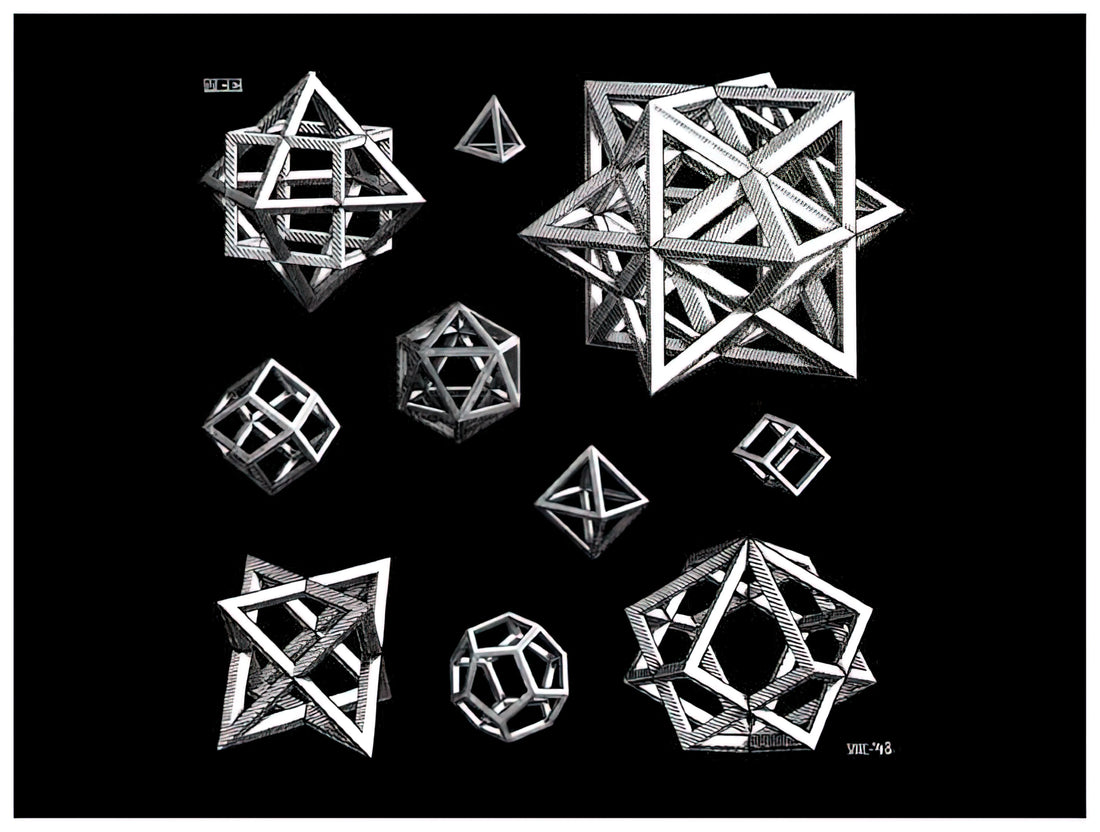
MC Escher Woodcuts: The Mathematical Precision Behind Impossible Worlds
MC Escher Woodcuts: The Mathematical Precision Behind Impossible Worlds
When art historians discuss the 20th century's most distinctive printmakers, Maurits Cornelis Escher invariably commands attention. His woodcuts—meticulously carved and printed—represent not merely decorative works but profound explorations of geometry, perception, and infinity. For collectors and enthusiasts, understanding Escher's woodcut technique reveals why his prints continue to captivate audiences decades after their creation. At RedKalion, we specialize in museum-quality reproductions that honor the technical mastery and conceptual depth of artists like Escher, whose work bridges art, mathematics, and philosophy.
The Technical Foundation of Escher's Woodcut Process
Escher's approach to woodcuts was methodical and precise, reflecting his background in graphic arts rather than traditional fine art training. Born in 1898 in the Netherlands, he studied at the School for Architecture and Decorative Arts in Haarlem, where he initially focused on architecture before shifting to graphic arts under Samuel Jessurun de Mesquita. This education instilled a disciplined, almost architectural approach to composition that would define his woodcut technique.
Woodcut printing involves carving a design into a wooden block, applying ink to the raised surfaces, and pressing it onto paper. Escher typically worked with end-grain woodblocks, often using pearwood or boxwood, which allowed for finer detail than plank-grain alternatives. His process was labor-intensive: he would first create detailed pencil sketches, transfer them to the block, then carve with surgical precision using gouges and knives. The resulting prints showcase crisp lines and stark contrasts, with black-and-white domains that create optical tension.
What distinguishes Escher's woodcuts from those of his contemporaries is their mathematical underpinning. He frequently employed tessellations—repeating geometric patterns that fill a plane without gaps—and impossible constructions that challenge Euclidean space. Works like "Sky and Water I" (1938) demonstrate this, where fish and birds morph seamlessly into one another through careful carving that balances positive and negative space.
Artistic Evolution and Key Woodcut Works
Escher's woodcut oeuvre evolved significantly over his career, moving from early naturalistic studies to the mind-bending illusions for which he is best known. In the 1920s and early 1930s, his prints often depicted Italian landscapes and architecture, influenced by his travels. These early works, such as "Castrovalva" (1930), reveal a growing interest in perspective and spatial complexity, though they remain grounded in observable reality.
By the mid-1930s, Escher's focus shifted toward mathematical themes, spurred by his visit to the Alhambra in Spain, where he studied Moorish tessellations. This period produced iconic woodcuts like "Metamorphosis II" (1939-1940), a continuous transformation of shapes across a seven-meter-long print. The technical challenge of carving such a complex, seamless design required not only artistic skill but also a deep understanding of symmetry and progression.
Later works, such as "Relativity" (1953) and "Bond of Union" (1956), pushed the boundaries of woodcut printing into surreal, impossible spaces. In "Relativity," multiple gravitational perspectives coexist in a single image, achieved through meticulous carving that defines staircases and figures with exacting clarity. These prints are not mere illustrations but visual paradoxes that engage viewers in active interpretation.

For those seeking to bring Escher's architectural precision into their spaces, our PORTA MARIA DELL OSPIDALE acrylic print captures the intricate detail of his early Italian period. This reproduction maintains the sharp contrasts and fine lines characteristic of his woodcut technique, offering a museum-quality piece that honors his graphic mastery.
The Cultural and Scientific Significance of Escher's Woodcuts
Escher's work transcends the art world, influencing fields as diverse as mathematics, psychology, and computer science. His woodcuts have been cited by mathematicians like Roger Penrose for their exploration of non-Euclidean geometry and infinity. In psychology, they serve as tools to study visual perception and cognitive dissonance, as seen in prints like "Concave and Convex" (1955), where perspective shifts create ambiguous spaces.
This interdisciplinary appeal stems from Escher's unique position as an artist deeply engaged with scientific ideas. He corresponded with mathematicians and read extensively on crystallography and topology, integrating these concepts into his woodcuts. Unlike many artists who use abstraction to evoke emotion, Escher used precision to provoke intellectual curiosity. His prints invite viewers to question the nature of reality, making them enduring subjects of study and admiration.
In popular culture, Escher's woodcuts have inspired filmmakers, musicians, and designers. The impossible staircases in "Relativity" famously influenced scenes in movies like "Labyrinth" and "Inception," while his tessellations appear in graphic design and textile patterns. This widespread relevance underscores the timeless quality of his work, which continues to resonate in an age dominated by digital imagery.
Collecting and Displaying Escher Woodcut Prints
For collectors, Escher's woodcuts represent both aesthetic and intellectual investments. Original prints from his lifetime are rare and command high prices at auction, often exceeding $10,000 for key works. However, high-quality reproductions, like those offered by RedKalion, provide accessible alternatives that preserve the integrity of his designs. When selecting a print, consider factors such as paper quality, ink fidelity, and scale to ensure it reflects Escher's meticulous standards.
Displaying Escher woodcuts requires thoughtful placement to enhance their visual impact. Given their geometric complexity, they work well in minimalist settings where they can serve as focal points. Lighting should be even to avoid glare, especially for black-and-white prints where contrast is crucial. Framing choices—such as simple black or white mats—can accentuate the precision of the carving without distracting from the artwork itself.

For enthusiasts looking to share Escher's genius, our ESCHER (15) postcard set features a curated selection of his woodcuts in a portable format. These reproductions maintain the clarity of his original prints, making them ideal for study or gifting.
At RedKalion, we prioritize authenticity in our reproductions, using archival materials and precise color matching to honor artists like Escher. Our expertise ensures that each print captures the subtle nuances of his woodcut technique, from the depth of line to the balance of light and shadow. This commitment to quality allows collectors to engage with his work in a meaningful way, whether for decorative, educational, or inspirational purposes.
Escher's Legacy in Contemporary Art and Printmaking
Escher's influence on contemporary art is evident in the work of artists who explore optical illusions, geometric patterns, and conceptual depth. Printmakers today often cite his technical prowess as a benchmark, particularly in woodcut and lithography. His ability to merge art and science has also inspired digital artists, who use software to create impossible spaces reminiscent of his prints.
Despite advances in technology, the handmade quality of Escher's woodcuts remains unparalleled. Each print bears the imprint of his carving tools, a testament to the physical labor involved. This tactile dimension adds value for collectors, who appreciate the human touch in an increasingly digital world. As art historian J.L. Locher notes, Escher's work "challenges the viewer to see beyond the surface," a quality that ensures its enduring relevance.
For those new to Escher, starting with his woodcuts offers a comprehensive introduction to his themes and techniques. Prints like "Day and Night" (1938) exemplify his mastery of duality and transformation, while later works delve into more abstract mathematical concepts. Engaging with these pieces requires patience and curiosity, but the rewards—a deeper understanding of visual perception and artistic innovation—are substantial.

Our SENGELA MALTA postcard set highlights Escher's early travel-inspired woodcuts, showcasing his skill in capturing architectural detail. These reproductions serve as both artistic pieces and historical documents, reflecting his journey from realism to abstraction.
Conclusion: The Enduring Allure of MC Escher Woodcuts
MC Escher's woodcuts stand as monuments to the intersection of art, mathematics, and philosophy. Through his precise carving and innovative compositions, he created worlds that defy conventional perception, inviting endless exploration. For collectors, educators, and art lovers, these prints offer more than visual pleasure—they provoke thought and inspire creativity.
At RedKalion, we are committed to preserving the legacy of artists like Escher through expert reproductions that meet museum standards. Whether you are seeking a statement piece for your home or a thoughtful gift, our collection of Escher woodcuts provides authentic access to his genius. Explore our curated selections to discover how his impossible worlds can transform your space and perspective.
Frequently Asked Questions About MC Escher Woodcuts
What materials did MC Escher use for his woodcuts?
Escher primarily used end-grain woodblocks, such as pearwood or boxwood, which allowed for fine detail. He carved with gouges and knives, then printed using oil-based inks on high-quality paper to achieve sharp contrasts.
How did Escher's background influence his woodcut technique?
His training in graphic arts and architecture instilled a disciplined, methodical approach. This foundation enabled him to execute complex geometric designs with precision, blending artistic vision with mathematical rigor.
What are some iconic woodcuts by MC Escher?
Key works include "Sky and Water I" (1938), "Metamorphosis II" (1939-1940), and "Relativity" (1953). These prints exemplify his themes of transformation, tessellation, and impossible spaces.
Why are Escher's woodcuts significant in art history?
They bridge art and science, influencing fields like mathematics and psychology. His exploration of perception and infinity expanded the possibilities of printmaking, making him a unique figure in 20th-century art.
How can I identify a high-quality reproduction of an Escher woodcut?
Look for prints that maintain sharp lines, clear contrasts, and accurate scaling. Archival materials and attention to detail, as offered by RedKalion, ensure the reproduction honors Escher's original technique.
Where can I view original Escher woodcuts?
Original prints are held in museums like the Escher Museum in The Hague and the National Gallery of Art in Washington, D.C. Exhibitions often tour globally, providing opportunities for in-person study.
How do Escher's woodcuts relate to his other printmaking techniques?
While he also worked in lithography and mezzotint, woodcuts were central to his oeuvre due to their precision and graphic clarity. They often served as the foundation for exploring his most complex ideas.


