

Discover Unlimited Art Possibilities
At RedKalion, you can find virtually any artwork from any artist, available in a wide range of sizes to perfectly match your space.
If you didn’t find what you’re looking for, contact us at support@redkalion.com . We will source any artwork and produce it in any size and format you need, including art prints, posters, canvas, framed pieces, framed canvas, and more.
For dedicated art enthusiasts, we also offer handcrafted replicas of any artwork, carefully painted by highly skilled artists using traditional techniques.
For custom requests, contact us at support@redkalion.com .
What printing technique is used for these Magritte postcards?
RedKalion utilizes 12-color fine art printing technology. This ensures the deep blues and ethereal whites of Magritte’s palette are rendered with stunning accuracy, far exceeding the depth and vibrancy of standard 4-color inkjet reproductions.
What is the quality and weight of the paper?
Each card is printed on premium 200 gsm (80 lb) paper with a thickness of 0.26 mm. The smooth matte finish provides a clean, glare-free aesthetic suitable for both mailing and sophisticated display.
Are these postcards environmentally friendly?
Yes. We prioritize sustainability by using FSC-certified paper and printing each pack of 10 on demand. This approach significantly reduces waste and ensures a smaller environmental footprint for your fine art purchase.
How long will these prints last without fading?
Our archival-grade materials and 12-color printing process are designed for longevity. These museum-quality reproductions offer exceptional color stability, ensuring Magritte's vision remains vibrant for years when kept under normal indoor lighting conditions.
When will my order be shipped?
These postcards are printed on demand to ensure the highest quality control. Orders are typically processed and ready for dispatch within 2-4 business days, arriving in pristine condition ready for use.
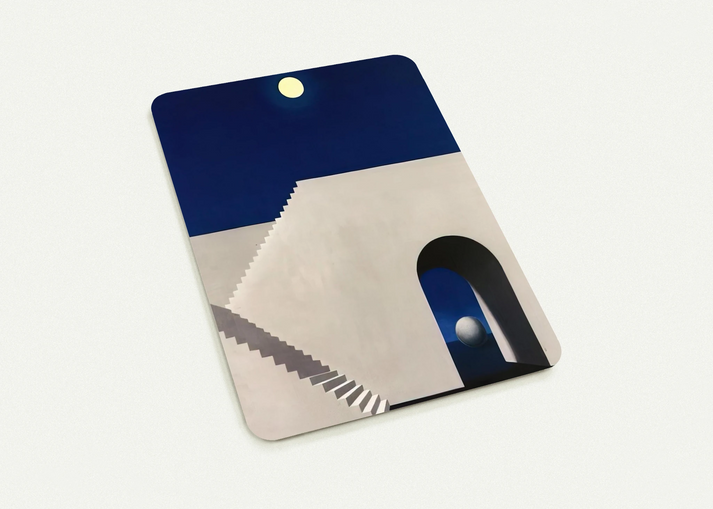
What is the significance of the moonlight in Architecture au Clair de Lune?
In this 1956 work, moonlight serves as a transformative force. Magritte uses it to challenge our perception of reality, turning cold architectural structures into poetic, dreamlike symbols that bridge the gap between the known and the unknown.
How does Magritte’s 1956 work differ from his earlier surrealist pieces?
By 1956, Magritte had refined his style toward the 'poetry of the object.' Unlike the chaotic juxtaposition of his earlier years, this period focuses on clear, precise execution to highlight the inherent mystery found in stillness.