RedKalion
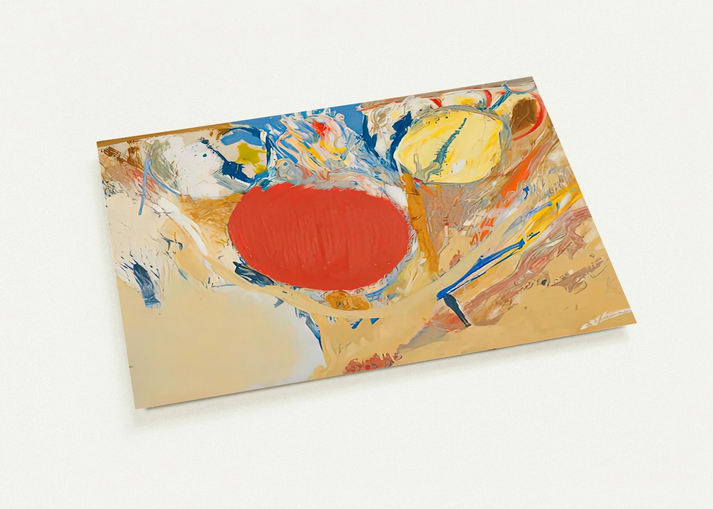
Break Through, 1956- By Helen Frankenthaler Pack of 10 Post Cards | Helen Frankenthaler Post Cards | A6 (10.5 x 14.8 cm) - 4.1 x 5.8 inches
Break Through, 1956- By Helen Frankenthaler Pack of 10 Post Cards | Helen Frankenthaler Post Cards | A6 (10.5 x 14.8 cm) - 4.1 x 5.8 inches
Couldn't load pickup availability
Elevate Your Correspondence with Helen Frankenthaler’s "Break Through" (1956)
Immerse yourself in the pioneering spirit of American Abstract Expressionism with this premium pack of 10 postcards featuring Helen Frankenthaler’s iconic 1956 masterpiece, "Break Through." As a seminal figure in the transition from Abstract Expressionism to Color Field painting, Frankenthaler’s work is characterized by its ethereal fluidity and luminous depth. At RedKalion, we have captured every subtle wash and vibrant hue of this historic work using state-of-the-art reproduction techniques.
The Artistry of the Soak-Stain Technique
In "Break Through," Frankenthaler utilizes her signature "soak-stain" technique—thinning oil paint with turpentine to create translucent washes that merge with the fibers of the substrate. This creates an atmospheric transparency that remains one of the most influential developments in 20th-century art. These postcards serve as a tribute to her innovation, allowing you to share a piece of museum-quality history with friends or display them as a curated mini-gallery in your own space.
Unrivaled Print Quality and Sustainability
Unlike standard mass-produced stationery, RedKalion postcards are crafted with 12-color fine art printing technology. This advanced process ensures vivid color accuracy and stunning depth that far exceeds standard 4-color inkjet alternatives. Printed on 200 gsm (80 lb) FSC-certified paper, each card offers a substantial, premium feel with a 0.26 mm thickness and a smooth matte finish for a sophisticated, glare-free display.
- Exquisite Detail: 12-color archival ink provides museum-grade color fidelity.
- Premium Substrate: 200 gsm smooth matte paper offers a heavy, professional weight.
- Eco-Conscious: Produced on demand using FSC-certified materials to ensure environmental responsibility.
- Standard A6 Size: Convenient 10.5 x 14.8 cm (4.1 x 5.8 inches) format, perfect for mailing or framing.
Whether you are sending a thoughtful note or adding to a fine art collection, these postcards represent the pinnacle of archival-grade reproduction. Experience the legacy of Helen Frankenthaler with a product designed to endure.

Discover Unlimited Art Possibilities
At RedKalion, you can find virtually any artwork from any artist, available in a wide range of sizes to perfectly match your space.
If you didn’t find what you’re looking for, contact us at support@redkalion.com . We will source any artwork and produce it in any size and format you need, including art prints, posters, canvas, framed pieces, framed canvas, and more.
For dedicated art enthusiasts, we also offer handcrafted replicas of any artwork, carefully painted by highly skilled artists using traditional techniques.
For custom requests, contact us at support@redkalion.com .
How many postcards are included in this set?
This product includes a pack of 10 individual postcards featuring Helen Frankenthaler’s "Break Through" (1956), perfect for personal correspondence or collection.
What makes RedKalion’s printing superior to standard postcards?
We use 12-color fine art printing technology, which captures the subtle gradients and vivid depth of the original artwork far more accurately than standard 4-color printing.
What is the weight and finish of the paper?
These postcards are printed on 200 gsm (80 lb) FSC-certified paper with a thickness of 0.26 mm and a smooth, glare-free matte finish.
Are these postcards environmentally friendly?
Yes, our postcards are printed on demand using FSC-certified paper from sustainably managed forests, significantly reducing waste compared to bulk manufacturing.
How long will these prints last without fading?
RedKalion utilizes archival-grade inks and acid-free paper, ensuring that the vibrancy of the colors is preserved for decades under normal display conditions.
What was Helen Frankenthaler's "soak-stain" technique?
Frankenthaler thinned oil paints with turpentine, allowing the pigment to soak directly into unprimed canvas, creating the translucent, ethereal effects seen in "Break Through."
What is the historical significance of "Break Through" (1956)?
Painted in 1956, it represents Frankenthaler's mastery of Color Field painting, bridging the gap between raw expressionism and modern atmospheric abstraction.