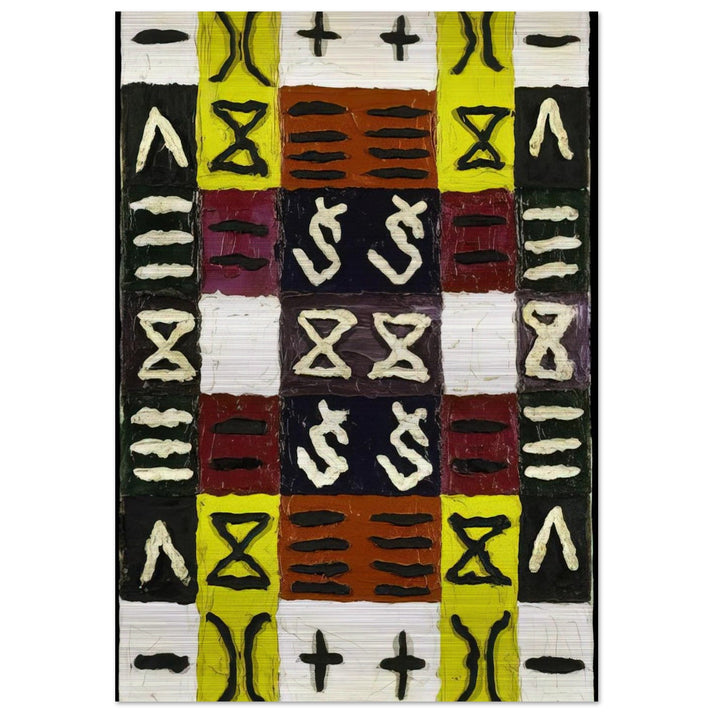


Discover Unlimited Art Possibilities
At RedKalion, you can find virtually any artwork from any artist, available in a wide range of sizes to perfectly match your space.
If you didn’t find what you’re looking for, contact us at support@redkalion.com . We will source any artwork and produce it in any size and format you need, including art prints, posters, canvas, framed pieces, framed canvas, and more.
For dedicated art enthusiasts, we also offer handcrafted replicas of any artwork, carefully painted by highly skilled artists using traditional techniques.
For custom requests, contact us at support@redkalion.com .
What material is used for this Alfred Jensen fine art print?
This print is crafted on 3mm (0.12") brushed silver Aluminum DIBOND®. It features a unique horizontal grain and a metallic finish, providing a durable and modern base for museum-quality reproductions.
How does the brushed aluminum finish affect the visual appearance?
The brushed silver effect allows white areas of the artwork to appear as raw metallic silver. The matte finish ensures a glare-free experience, highlighting the intricate details of Jensen’s geometric patterns.
Is the hanging hardware included with the print?
Yes, every Alfred Jensen aluminum print comes with a professional hanging kit. The specific type of kit varies depending on the country of fulfillment to ensure the best mounting experience.
How should I clean and maintain my aluminum fine art print?
Maintenance is simple. Use a soft, dry microfiber cloth to remove dust. The Aluminum DIBOND® is highly durable, but avoid abrasive chemicals to preserve the matte finish and vibrant ink layers.
What is the archival life of a direct print on AluDibond?
Direct prints on AluDibond are designed for longevity. Using UV-resistant inks and a rigid, non-warping aluminum base, these prints are archival-grade and built to withstand environmental changes without fading.
What inspired Alfred Jensen’s "A Perfect Equal Area I"?
Jensen was inspired by ancient numerical systems, the Mayan calendar, and the mathematical harmony of the universe. This 1960 piece explores the concept of 'equal area' through balanced, grid-like geometric compositions.
Why is Alfred Jensen's 1960 period significant in art history?
1960 marked Jensen's full transition into his signature 'diagrammatic' style. Moving away from Abstract Expressionism, he began creating complex, color-coded maps of philosophical and mathematical concepts that anticipated Minimalism and Conceptual art.