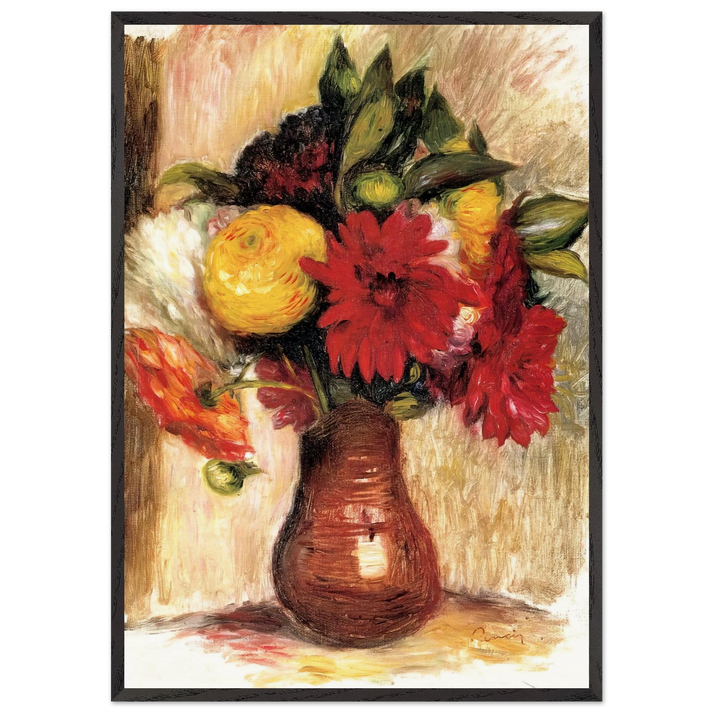

Discover Unlimited Art Possibilities
At RedKalion, you can find virtually any artwork from any artist, available in a wide range of sizes to perfectly match your space.
If you didn’t find what you’re looking for, contact us at support@redkalion.com . We will source any artwork and produce it in any size and format you need, including art prints, posters, canvas, framed pieces, framed canvas, and more.
For dedicated art enthusiasts, we also offer handcrafted replicas of any artwork, carefully painted by highly skilled artists using traditional techniques.
For custom requests, contact us at support@redkalion.com .
What materials are used for this Renoir fine art print?
We use archival, museum-quality 250 gsm (110 lb) natural white paper. This heavyweight, uncoated matte paper ensures the colors remain vibrant and the texture feels premium, offering a professional finish that resists aging.
How is the frame constructed?
Our frames are made from responsibly sourced oak and ash wood. They measure 20mm (0.79") thick and wide, providing a sturdier, more luxurious profile than standard thin frames, finished in a sophisticated black.
Is the artwork ready to hang upon delivery?
Yes, your framed print arrives ready-to-hang with a complete kit included. RedKalion ensures that you can elevate your wall space immediately without the need for additional hardware or professional installation.
How is the print protected from damage?
To ensure longevity and safety during shipping, we use shatterproof plexiglass. This provides the clarity of glass while offering superior protection against impacts and UV exposure, preserving your art for years to come.
Is this product environmentally friendly?
Absolutely. We use FSC-certified materials or equivalent sustainable paper and wood. Our commitment to sustainability ensures that your beautiful artwork supports responsible forestry practices and ethical production.
What is the significance of Renoir’s technique in this piece?
Renoir's early career as a porcelain painter heavily influenced his floral works. In this piece, he uses luminous, soft-edged brushstrokes to create a sense of movement and light, characteristic of his unique Impressionist vision.
Why was the earthenware pitcher a common subject for Renoir?
Renoir often used domestic objects like the earthenware pitcher to explore the interplay of light on different surfaces. It allowed him to contrast the rustic, solid texture of clay with the delicate, fleeting beauty of flowers.