


Discover Unlimited Art Possibilities
At RedKalion, you can find virtually any artwork from any artist, available in a wide range of sizes to perfectly match your space.
If you didn’t find what you’re looking for, contact us at support@redkalion.com . We will source any artwork and produce it in any size and format you need, including art prints, posters, canvas, framed pieces, framed canvas, and more.
For dedicated art enthusiasts, we also offer handcrafted replicas of any artwork, carefully painted by highly skilled artists using traditional techniques.
For custom requests, contact us at support@redkalion.com .
What printing technology is used for the Jasper Johns postcards?
We use advanced 12-color fine art printing technology. This ensures superior color vibrancy and depth compared to standard 4-color prints, accurately reflecting Jasper Johns’ original palette.
What is the weight and finish of the postcard paper?
The postcards are printed on 200 gsm (80 lb) paper with a thickness of 0.26 mm. They feature a smooth matte finish for a sophisticated, glare-free display.
Are these postcards environmentally friendly?
Yes. All RedKalion prints use FSC-certified paper from sustainably managed forests, ensuring that your art collection supports global conservation efforts.
How long will these prints last without fading?
Our postcards are produced using archival-grade inks and acid-free paper, designed to resist fading and maintain their visual integrity for decades under normal conditions.
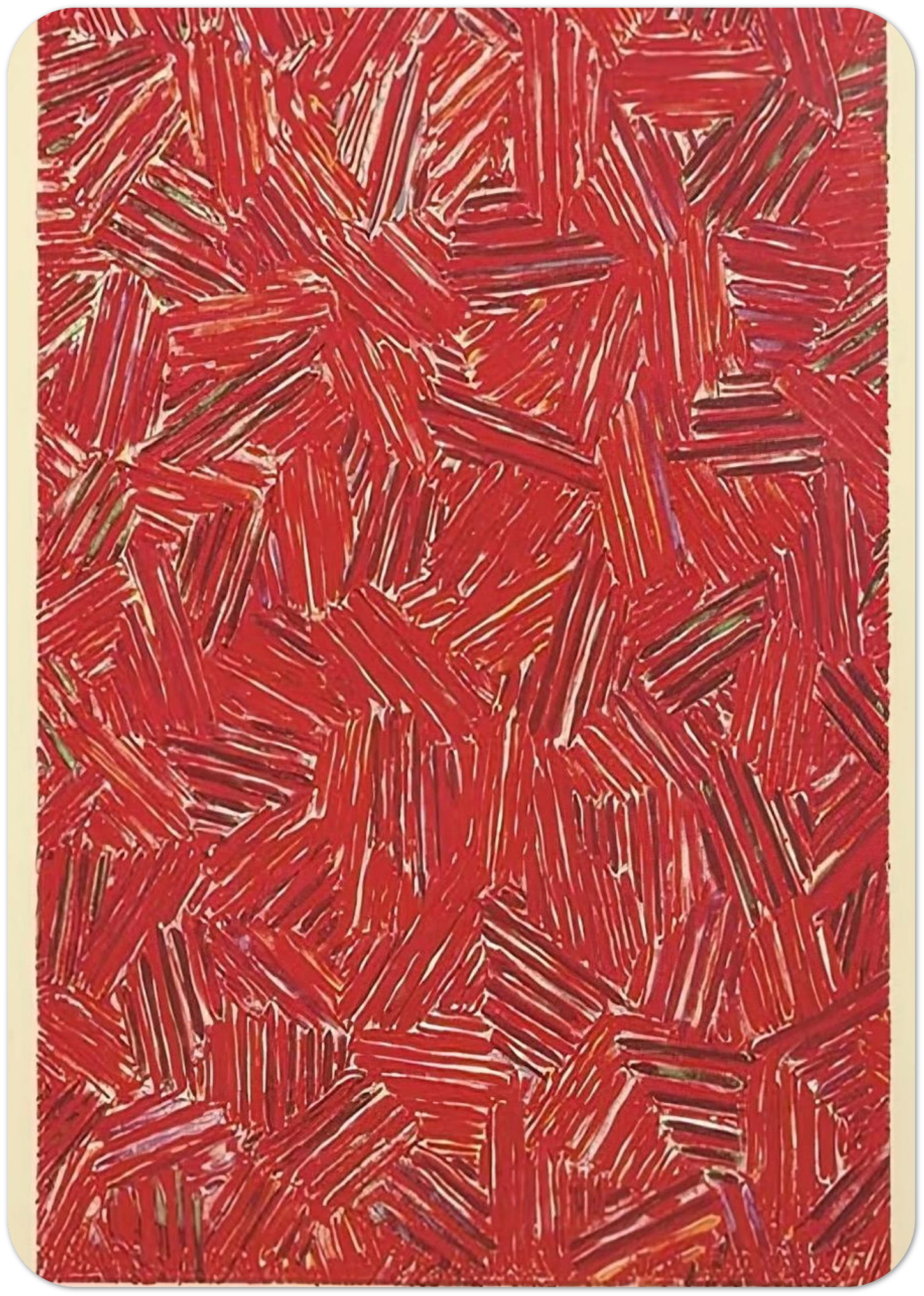
What size are the Cicada ULAE 219 postcards?
Each postcard is an A6 size, measuring 10.5 x 14.8 cm (approximately 4.1 x 5.8 inches), making them ideal for both mailing and small-scale framing.
What is the significance of the title ‘Cicada’ in Johns’ work?
Johns often titled his crosshatch works after nature; 'Cicada' refers to the insect's shell and metamorphosis, symbolizing the layered, cyclical nature of his artistic process.
Why is Jasper Johns’ crosshatch technique historically important?
The crosshatch pattern, seen in ULAE 219, marked Johns' transition from recognizable symbols to pure abstraction, influencing decades of post-modern and minimalist art theory.