

RedKalion
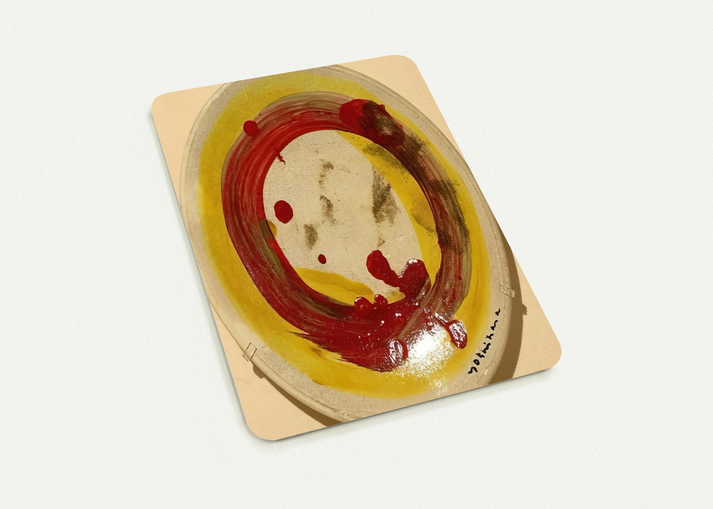
Circle - 1963 By Jiro Yoshihara Pack of 10 Post Cards | Jiro Yoshihara Post Cards | A6 (10.5 x 14.8 cm) - 4.1 x 5.8 inches
Circle - 1963 By Jiro Yoshihara Pack of 10 Post Cards | Jiro Yoshihara Post Cards | A6 (10.5 x 14.8 cm) - 4.1 x 5.8 inches
Не може да се зареди възможността за взимане
Embrace the Infinite: Jiro Yoshihara's Circle (1963)
Experience the profound simplicity of Japanese avant-garde art with this curated set of ten postcards featuring Jiro Yoshihara's 'Circle' (1963). As the visionary leader of the Gutai Art Association, Yoshihara spent the final decade of his life obsessively painting circles. This 1963 masterpiece is a definitive example of his Enso-inspired works, bridging the gap between traditional Zen calligraphy and modern abstract expressionism. Each card serves as a portable window into a movement that prioritized the physical act of creation and the raw expression of the human spirit.
Museum-Quality Reproduction for the Discerning Collector
At RedKalion, we believe that even a postcard should meet the standards of a fine art gallery. These postcards are produced using our proprietary 12-color fine art printing technology. Unlike standard 4-color inkjet processes, our method captures the subtle variations in ink density and the stark contrast of Yoshihara’s brushwork with breathtaking accuracy. Printed on 200 gsm (80 lb) FSC-certified paper, each card possesses a substantial weight and a smooth matte finish that eliminates glare, allowing the deep blacks and negative space of the artwork to resonate.
Specifications & Sustainable Elegance
- Quantity: Pack of 10 high-fidelity flat postcards.
- Dimensions: A6 format (10.5 x 14.8 cm / 4.1 x 5.8 inches).
- Paper Quality: 0.26 mm (10.3 mils) thickness for a premium, durable feel.
- Sustainability: Responsibly sourced, environmentally conscious materials.
- Technique: Archival-grade reproduction ensuring long-term color stability.
Whether used for sophisticated correspondence, a curated wall display, or as a thoughtful gift for an art historian, these Jiro Yoshihara fine art prints elevate the everyday into the extraordinary. RedKalion is proud to provide this archival-grade collection, ensuring that the legacy of the Gutai movement remains accessible to modern collectors who value both substance and style.


Discover Unlimited Art Possibilities
At RedKalion, you can find virtually any artwork from any artist, available in a wide range of sizes to perfectly match your space.
If you didn’t find what you’re looking for, contact us at support@redkalion.com . We will source any artwork and produce it in any size and format you need, including art prints, posters, canvas, framed pieces, framed canvas, and more.
For dedicated art enthusiasts, we also offer handcrafted replicas of any artwork, carefully painted by highly skilled artists using traditional techniques.
For custom requests, contact us at support@redkalion.com .
What is the printing quality of these Jiro Yoshihara postcards?
We utilize advanced 12-color fine art printing technology. This ensures vivid color accuracy and deep tonal range that far exceeds standard commercial 4-color printing, capturing every nuance of Yoshihara's original 1963 brushstrokes.
What type of paper is used for this fine art stationery?
Each postcard is printed on 200 gsm (80 lb) FSC-certified paper with a thickness of 0.26 mm. The smooth matte finish provides a clean, sophisticated, and glare-free aesthetic suitable for both writing and display.
How long will these museum-quality prints last?
RedKalion uses archival-grade materials and pigment-based inks. When kept away from direct sunlight, these museum-quality reproductions are designed to resist fading and maintain their visual integrity for decades.
Are the materials used for these postcards eco-friendly?
Yes. We prioritize environmental responsibility by using FSC-certified paper, which ensures the materials are sourced from sustainably managed forests. Our print-on-demand model also reduces unnecessary waste.
Can I frame these postcards as individual art pieces?
Absolutely. The A6 dimensions (4.1 x 5.8 inches) are a standard size, making them perfect for small frames. Their high paper weight and matte finish make them indistinguishable from miniature gallery prints.
What was the significance of the circle in Jiro Yoshihara’s work?
For Yoshihara, the circle represented the Zen 'Enso'—a symbol of the void, enlightenment, and the self. It became his primary focus in the 1960s, representing the culmination of his Gutai philosophy.
Is this reproduction faithful to the original 1963 painting?
Yes. RedKalion curators work meticulously to ensure that our reproductions honor the artist's original intent, maintaining the correct proportions, contrast, and atmospheric depth found in the 1963 original.