
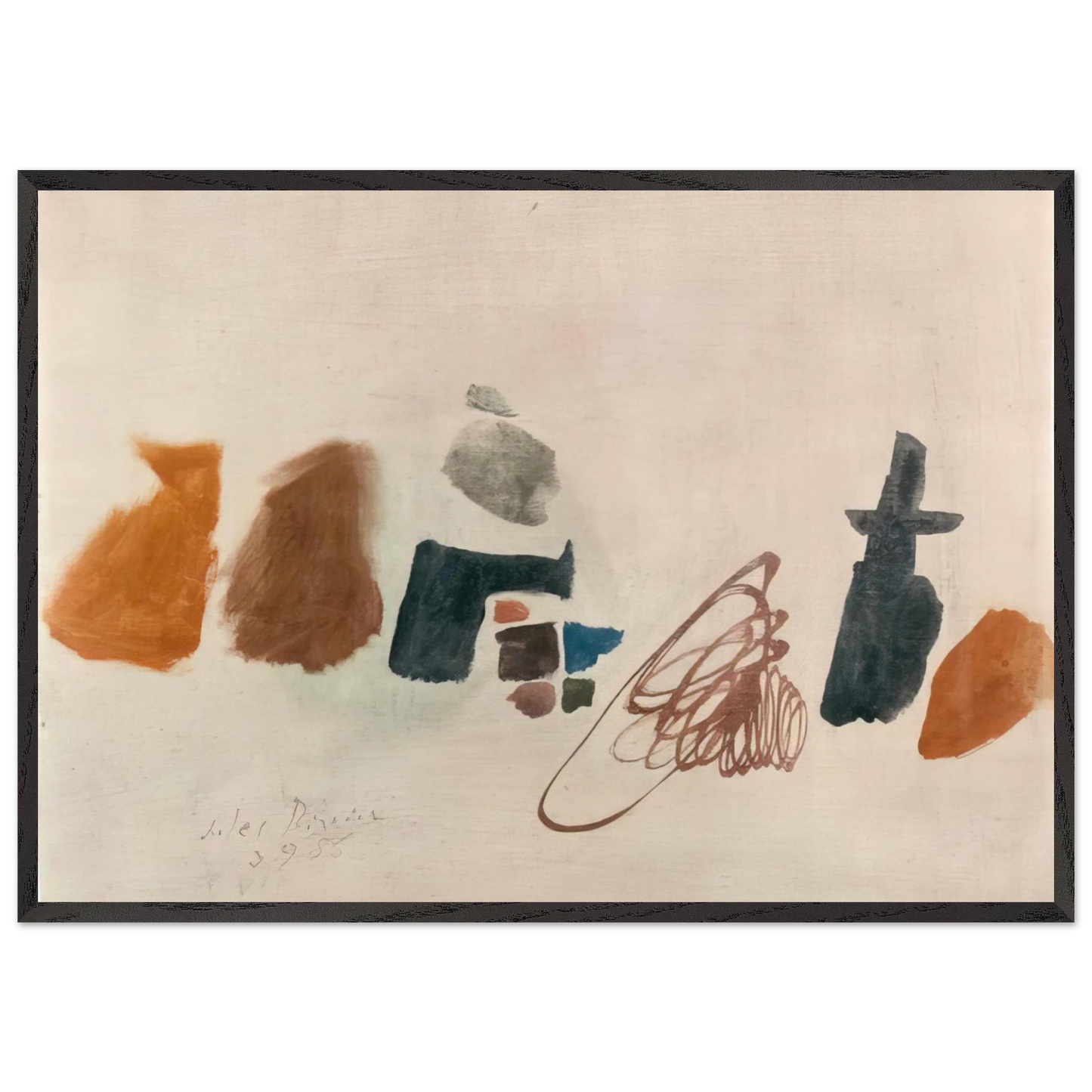
What is the significance of Julius Bissier’s '3956 II'?
Created in 1956, '3956 II' represents Bissier’s transition into lyrical abstraction. Heavily influenced by Zen Buddhism, the artwork uses calligraphic forms and soft geometries to evoke a sense of spiritual balance and inner reflection, making it a cornerstone of post-war European art.
What type of paper is used for this fine art print?
We use 250 gsm (110 lb) natural white paper. This museum-quality, archival-grade material is acid-free and has a matte, uncoated finish that eliminates glare while maintaining the depth and richness of the original work's pigments.
How is the artwork protected and framed?
The print is mounted in a 20mm thick black frame crafted from sustainably sourced oak or ash wood. It is protected by shatterproof plexiglass, ensuring the artwork remains safe from UV damage and physical impact during transit and display.
Is the frame ready to hang upon arrival?
Yes. Every RedKalion framed art print comes fully assembled with a hanging kit included. The 70x100 cm frame is designed for easy installation, allowing you to elevate your wall decor immediately upon unboxing.
What was Julius Bissier’s technique in the mid-1950s?
During this period, Bissier often utilized egg tempera and ink washes. His technique involved a meditative, rapid application of color to create translucent layers, a style that prioritized the 'inner necessity' of the form over literal representation.
How does RedKalion ensure archival longevity?
We use pH-neutral, FSC-certified paper and archival inks that resist yellowing and fading. Combined with a solid wood frame and protective plexiglass, our prints are engineered to maintain their museum-quality appearance for decades.
What are the exact dimensions of the frame?
The frame has a width and thickness of 20mm (0.79"), which is significantly sturdier than the 14mm industry standard. The total footprint for this print is 70x100 cm (28x40 inches), providing a bold, gallery-style aesthetic.