
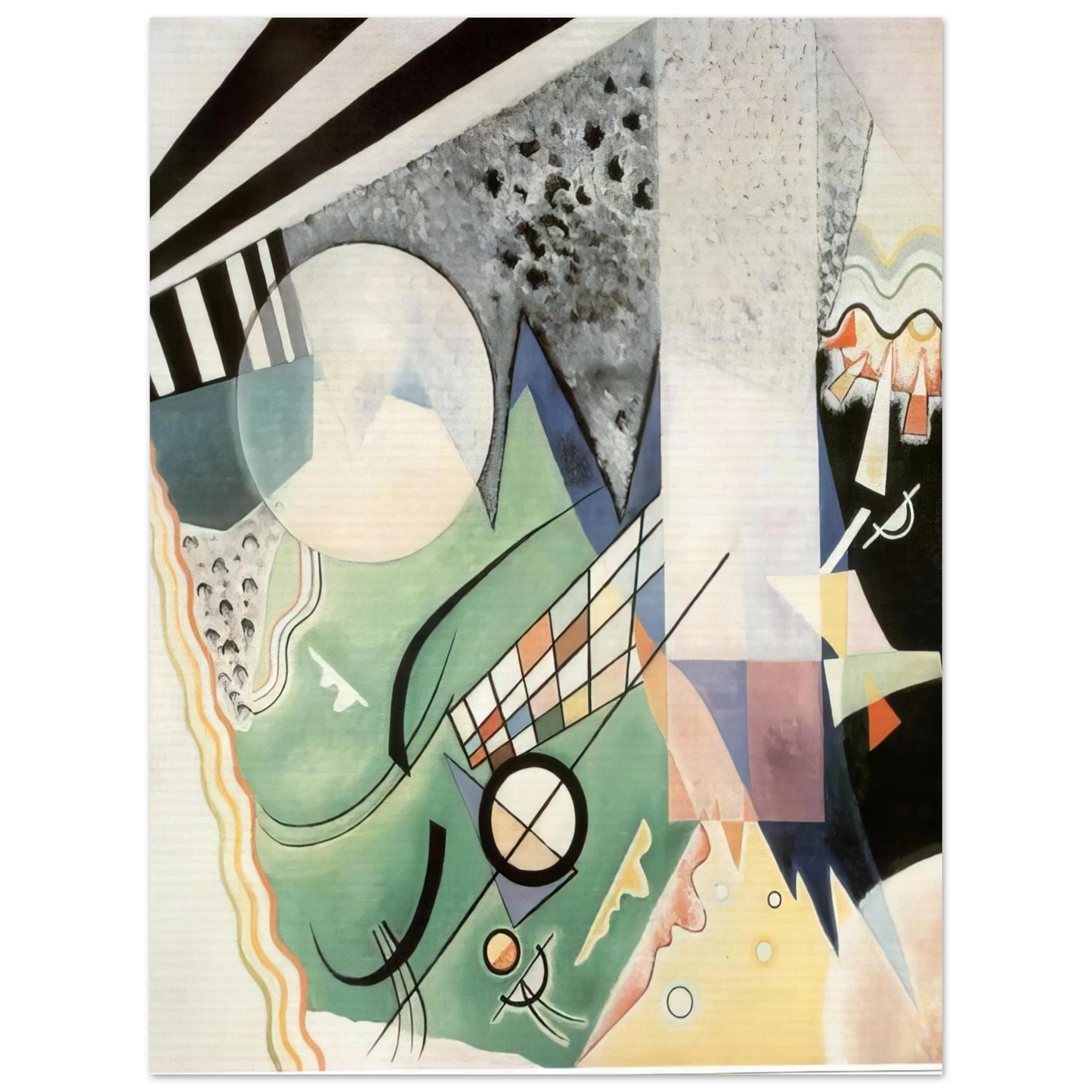
What is the historical significance of Wassily Kandinsky's "Green Composition 1923"?
"Green Composition 1923" is a key work from Kandinsky's Bauhaus era, showcasing his transition to pure abstraction where colors and geometric forms evoke spiritual emotions, reflecting his theories on art's inner necessity.
How does the green color dominate this Kandinsky composition?
The vibrant green hues in this composition create a harmonious yet dynamic focal point, symbolizing growth and balance while interacting with other geometric shapes to convey Kandinsky's exploration of color psychology.
What are the specifications of the paper used for this fine art print?
This museum-quality reproduction uses Master's Edition archival paper: matte, uncoated, natural white finish, 250 gsm weight (0.29 mm thickness), acid-free for longevity, and FSC-certified for sustainability.
How is this Kandinsky print shipped and what are the ordering options?
We print and ship on demand with no minimum orders, ensuring each fine art poster is carefully handled and delivered directly to you for convenience.
Will this archival print resist yellowing over time?
Yes, the acid-free paper (pH above 7) prevents yellowing, making this museum-quality reproduction a durable investment for long-term display.
What makes this a museum-quality reproduction of Kandinsky's work?
Our fine art print captures every detail with high fidelity on premium archival paper, mirroring the original's vibrancy and texture for an authentic gallery experience.
Can I use this print for framing in different interior styles?
Absolutely, the 75x100 cm (30x40 inches) size and elegant matte finish make it versatile for framing in modern, minimalist, or eclectic spaces, enhancing any room's aesthetic.