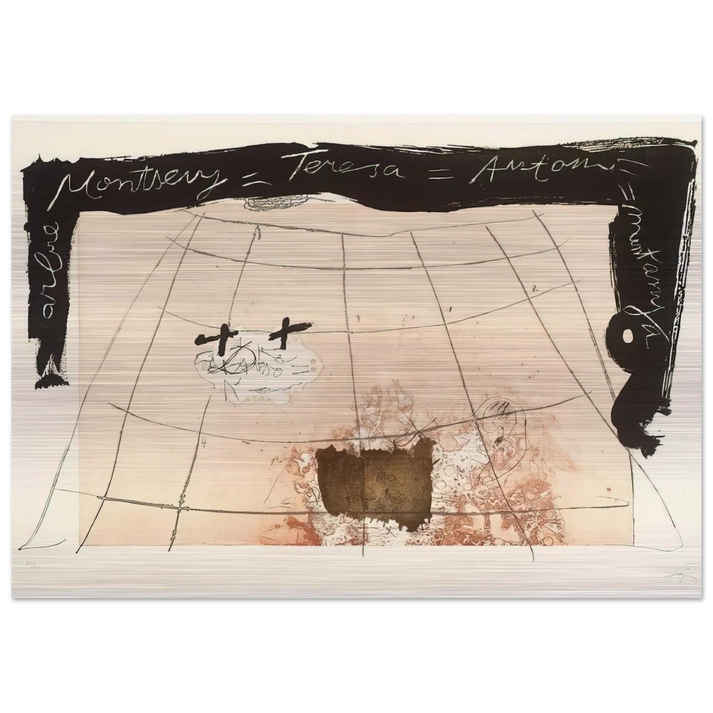


Discover Unlimited Art Possibilities
At RedKalion, you can find virtually any artwork from any artist, available in a wide range of sizes to perfectly match your space.
If you didn’t find what you’re looking for, contact us at support@redkalion.com . We will source any artwork and produce it in any size and format you need, including art prints, posters, canvas, framed pieces, framed canvas, and more.
For dedicated art enthusiasts, we also offer handcrafted replicas of any artwork, carefully painted by highly skilled artists using traditional techniques.
For custom requests, contact us at support@redkalion.com .
What defines the quality of this Antoni Tàpies print?
RedKalion utilizes 3mm Brushed Aluminum DIBOND® and direct-to-substrate printing. This ensures a museum-quality Antoni Tàpies Aluminum Print with vivid colors, archival durability, and a sophisticated matte finish that eliminates glare.
How does the brushed aluminum affect the artwork's appearance?
The horizontal grain of the brushed silver aluminum provides a dynamic, metallic look. White areas of the original design are left unprinted, allowing the silver finish to shine through for a striking visual effect.
Is the hanging hardware included with the print?
Yes, every Antoni Tàpies fine art print includes a professional hanging kit. The specific kit type varies by fulfillment country to ensure the most secure and aesthetic mounting for your 70x100 cm piece.
What are the shipping and fulfillment expectations for RedKalion prints?
We offer secure, global shipping with localized fulfillment to minimize transit time. Each aluminum print is carefully packaged in protective materials to ensure it arrives at your door in pristine condition.
How does this print ensure long-term archival durability?
The combination of a rigid 3mm aluminum base and UV-resistant inks ensures that the print will not warp or fade. This archival-grade construction makes it a lasting investment for any private collection.
What is the significance of the year 1976 in Tàpies' career?
By 1976, Tàpies was at the height of his conceptual maturity, blending political subtext with 'Matter Painting.' This era reflects his focus on the 'wall' as a site of memory and resistance.
What does "Cartography" represent in Tàpies' visual language?
In Tàpies' work, Cartography refers to the mapping of the unknown. He uses symbols and textures to navigate the physical world and the spiritual landscape, treating the artwork as a metaphysical map.