RedKalion
BLUE POLES NUMBER 11 1952 1 By Jackson Pollock Pack of 10 Post Cards | Jackson Pollock Post Cards | A6 (10.5 x 14.8 cm) - 4.1 x 5.8 inches
BLUE POLES NUMBER 11 1952 1 By Jackson Pollock Pack of 10 Post Cards | Jackson Pollock Post Cards | A6 (10.5 x 14.8 cm) - 4.1 x 5.8 inches
Δεν ήταν δυνατή η φόρτωση της διαθεσιμότητας παραλαβής
The Raw Energy of Blue Poles: A Masterpiece by Jackson Pollock
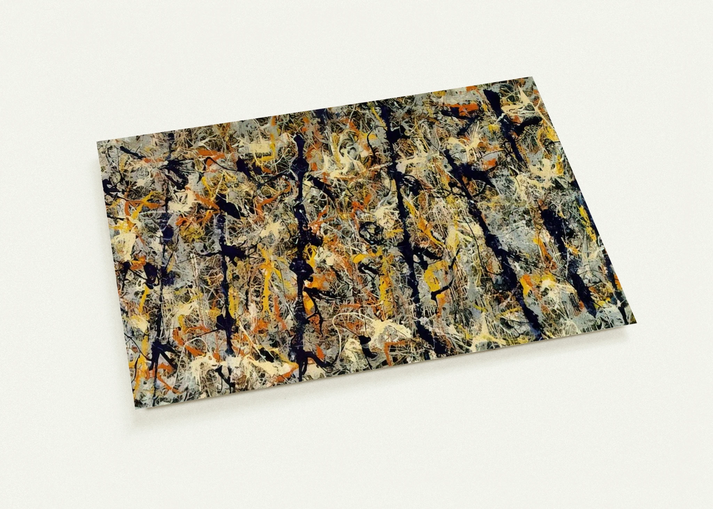
Jackson Pollock’s Blue Poles (Number 11, 1952) stands as a definitive monument of Abstract Expressionism. Originally titled simply Number 11, 1952, this work captures the height of Pollock’s 'drip' period, where the canvas became an arena for action. This set of 10 Jackson Pollock post cards allows you to share the rhythmic complexity and emotional intensity of a piece that redefined 20th-century art. RedKalion is proud to present these postcards as archival-grade reproductions that preserve every nuance of the artist's kinetic energy.
Museum-Quality Printing for the Discerning Collector
These postcards are not standard stationery; they are crafted with the same rigor as our larger fine art prints. Utilizing advanced 12-color fine art printing technology, we achieve a depth and vibrancy that far surpasses conventional inkjet methods. Each card is printed on 200 gsm (80 lb) FSC-certified paper with a thickness of 0.26 mm, ensuring a substantial, premium feel. The smooth matte finish provides a glare-free experience, allowing the intricate layers of paint to be appreciated from any angle.
A Sustainable Legacy
Our commitment to excellence extends to the environment. Every pack of 10 postcards is printed on demand using eco-conscious materials, ensuring no excess waste. Whether you are sending a thoughtful note or creating a miniature gallery wall, these museum-quality reproductions elevate the experience of art appreciation through sustainable, archival materials. Experience the visceral power of Pollock’s legacy with a fidelity that honors the original masterpiece.

Discover Unlimited Art Possibilities
At RedKalion, you can find virtually any artwork from any artist, available in a wide range of sizes to perfectly match your space.
If you didn’t find what you’re looking for, contact us at support@redkalion.com . We will source any artwork and produce it in any size and format you need, including art prints, posters, canvas, framed pieces, framed canvas, and more.
For dedicated art enthusiasts, we also offer handcrafted replicas of any artwork, carefully painted by highly skilled artists using traditional techniques.
For custom requests, contact us at support@redkalion.com .
What makes the printing quality of these Jackson Pollock post cards unique?
We use 12-color fine art printing technology, which provides superior color vibrancy and accuracy compared to standard 4-color printers, ensuring your Blue Poles postcards capture the depth of the original painting.
What is the weight and finish of the paper used for these postcards?
Each card is printed on premium 200 gsm (80 lb) FSC-certified paper with a smooth matte finish, offering a thickness of 0.26 mm for a durable, glare-free, and professional feel.
How many postcards are included in this set?
This item is a pack of 10 identical flat postcards, each measuring A6 size (10.5 x 14.8 cm or 4.1 x 5.8 inches), perfect for gifting or correspondence.
Are RedKalion art products environmentally friendly?
Yes. We use FSC-certified paper from responsibly managed forests and print every order on demand to minimize waste and ensure sustainable production practices.
How long will these postcards last without fading?
By using archival-grade inks and acid-free 200 gsm paper, these reproductions are designed to resist fading and maintain their vibrant colors for decades when kept out of direct sunlight.
What do the 'poles' in Blue Poles represent?
The eight vertical blue lines, or 'poles,' provide a structural rhythm to the chaotic drip layers. Art historians often view them as a means of creating order within the abstract landscape.
What is Jackson Pollock's 'drip' technique?
Pollock moved away from traditional brushwork, pouring and splashing paint directly onto canvases laid on the floor, a method known as 'Action Painting' that emphasizes the physical movement of the artist.