
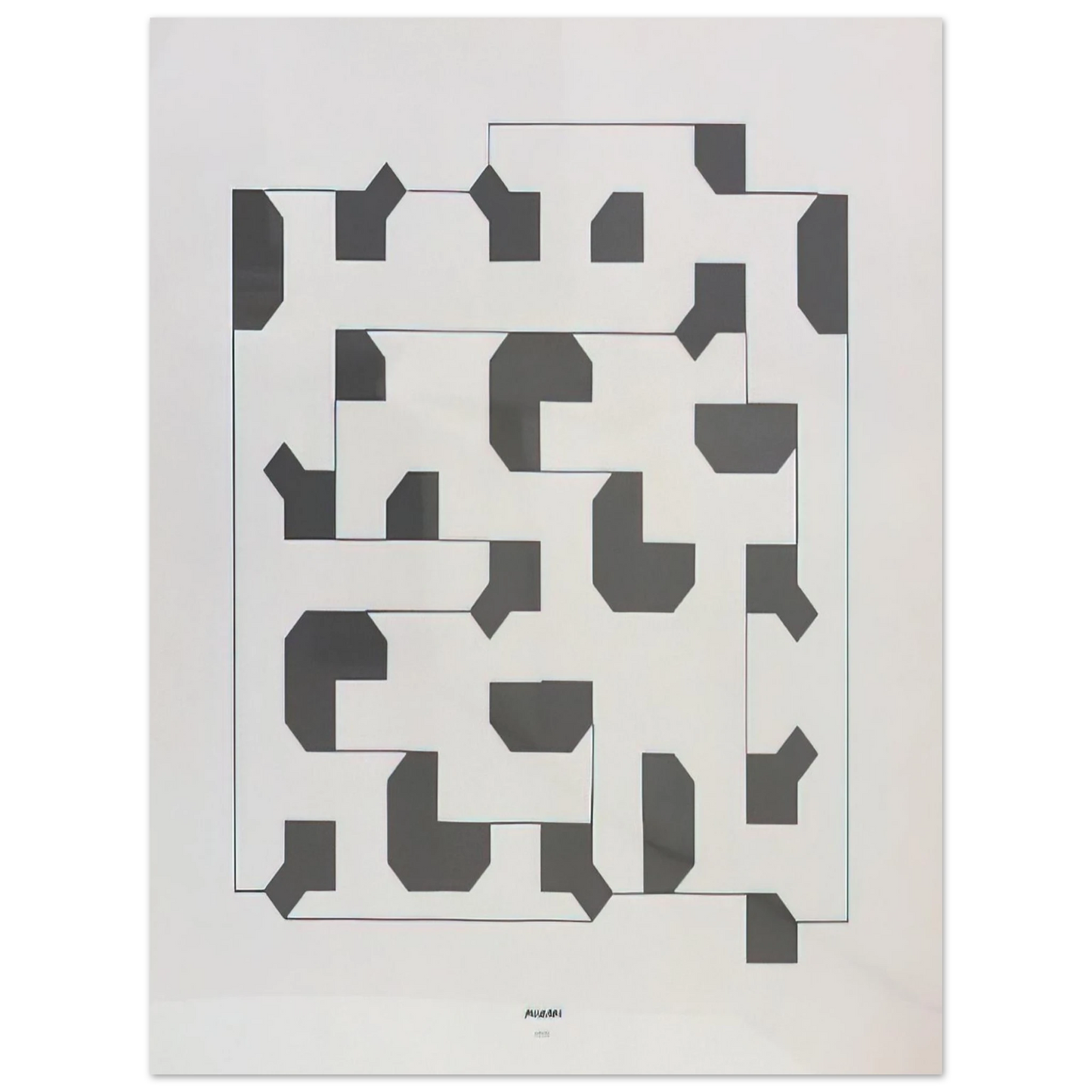
What is the historical significance of Munari's Curva di Peano?
Created in 1975, Curva di Peano explores the space-filling curve discovered by Giuseppe Peano. Bruno Munari used this mathematical logic to bridge the gap between science and art, making it a cornerstone of Italian Concrete Art and mid-century modernism.
What makes the Master's Edition paper archival quality?
Our Master's Edition paper is acid-free with a pH above 7, which prevents the paper from yellowing or deteriorating. With a 250 gsm weight and FSC certification, it provides the durability and luxury expected of museum-grade prints.
Will this fine art print yellow or fade over time?
No. Because we use acid-free archival paper and premium inks, the Curva di Peano print is designed to resist yellowing and degradation, ensuring the colors remain vibrant and the paper stays white for decades.
Is the paper used for this Munari print eco-friendly?
Yes, RedKalion is committed to sustainability. The paper used for this Curva di Peano reproduction is FSC-certified, ensuring it is sourced from responsibly managed forests that provide environmental, social, and economic benefits.
How is the Curva di Peano print fulfilled and shipped?
Each order is printed on demand to maintain the highest quality standards. We offer global shipping with no minimum order requirements, ensuring your 75x100 cm Munari poster arrives in perfect condition.
What was Munari's intention with the Curva di Peano series?
Munari aimed to demonstrate that mathematical rules could generate infinite aesthetic variations. He wanted to reveal the inherent beauty in logic, creating a visual rhythm that feels organic despite its geometric origin.
Does the print have a texture or a glossy finish?
The print features a luxurious matte, uncoated finish on natural white paper. This provides a sophisticated, non-reflective texture that emphasizes the artistic details of the 1975 composition without the distraction of a glossy glare.