
Discover Unlimited Art Possibilities
At RedKalion, you can find virtually any artwork from any artist, available in a wide range of sizes to perfectly match your space.
If you didn’t find what you’re looking for, contact us at support@redkalion.com . We will source any artwork and produce it in any size and format you need, including art prints, posters, canvas, framed pieces, framed canvas, and more.
For dedicated art enthusiasts, we also offer handcrafted replicas of any artwork, carefully painted by highly skilled artists using traditional techniques.
For custom requests, contact us at support@redkalion.com .
What are the dimensions of this Paul Klee fine art print?
This museum-quality reproduction measures 75x100 cm (30x40 inches), ideal for standard framing and creating a focal point in any room.
What type of paper is used for this archival print?
It's printed on Master's Edition archival paper, a matte, uncoated, natural white (off-white) sheet that offers a luxurious texture and prevents yellowing with its acid-free, pH above 7 composition.
How durable and sustainable is this art poster?
With a weight of 250 gsm (110 lb) and thickness of 0.29 mm (11.4 mils), it's highly durable. The FSC-certified paper ensures eco-friendly sustainability for long-term display.
How is this print shipped and are there minimum orders?
We offer no minimum orders; each print is produced on demand and shipped carefully to ensure it arrives in pristine condition, ready for framing.
Will this print last without fading or damage?
Yes, the acid-free, archival-quality materials resist yellowing and fading, making it a lasting investment for fine art collectors.
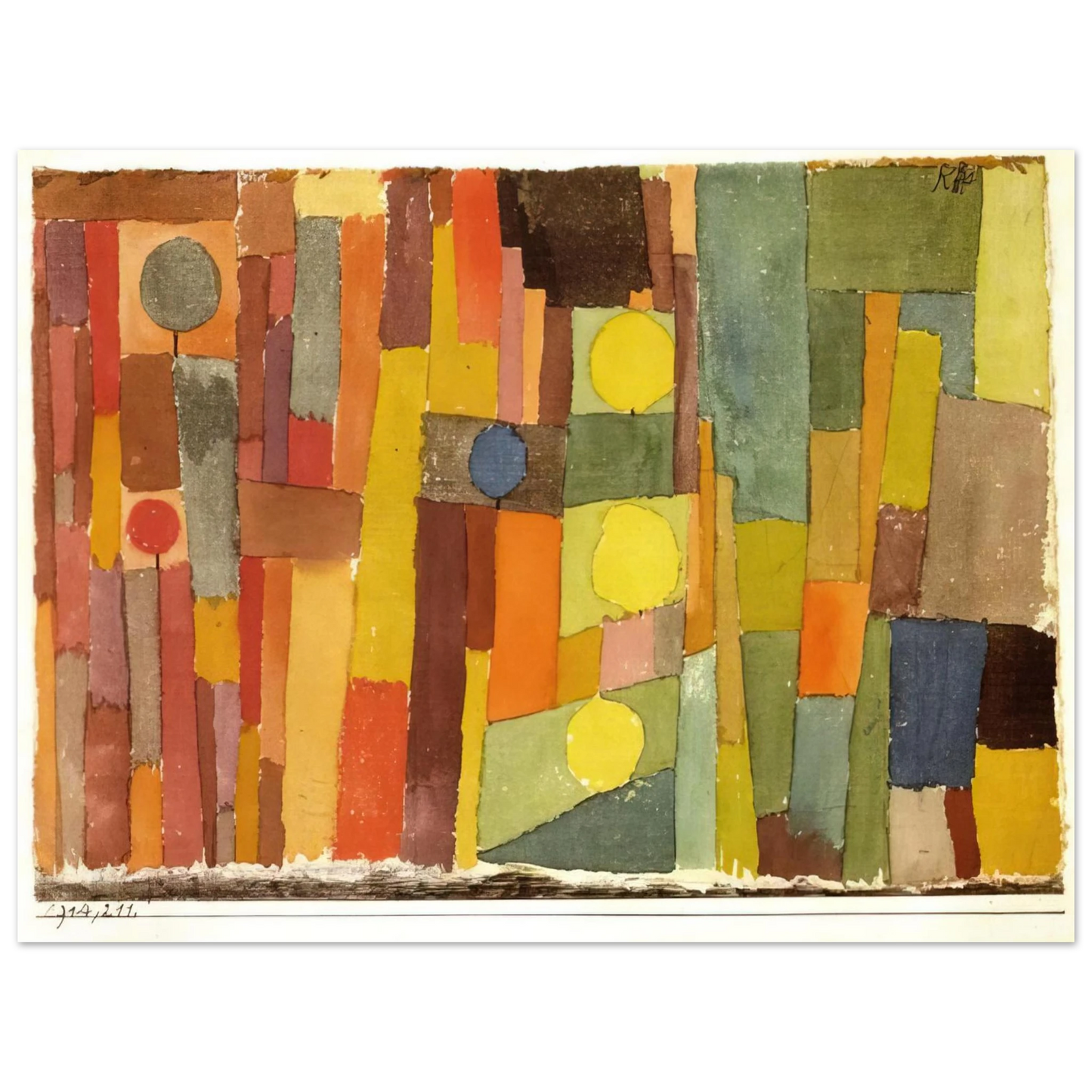
What inspired Paul Klee's "IN THE STYLE OF KAIROUAN 1914"?
Created after Klee's transformative trip to Tunisia in 1914, this work reflects his absorption of North African motifs and color theory, blending geometric abstraction with mystical elements from Kairouan's Islamic art.
How does this piece fit into Klee's artistic evolution?
This 1914 work marks a key moment in Klee's shift towards abstraction and color experimentation, influenced by his Bauhaus teachings and non-Western art, showcasing his unique style of symbolic modernism.