
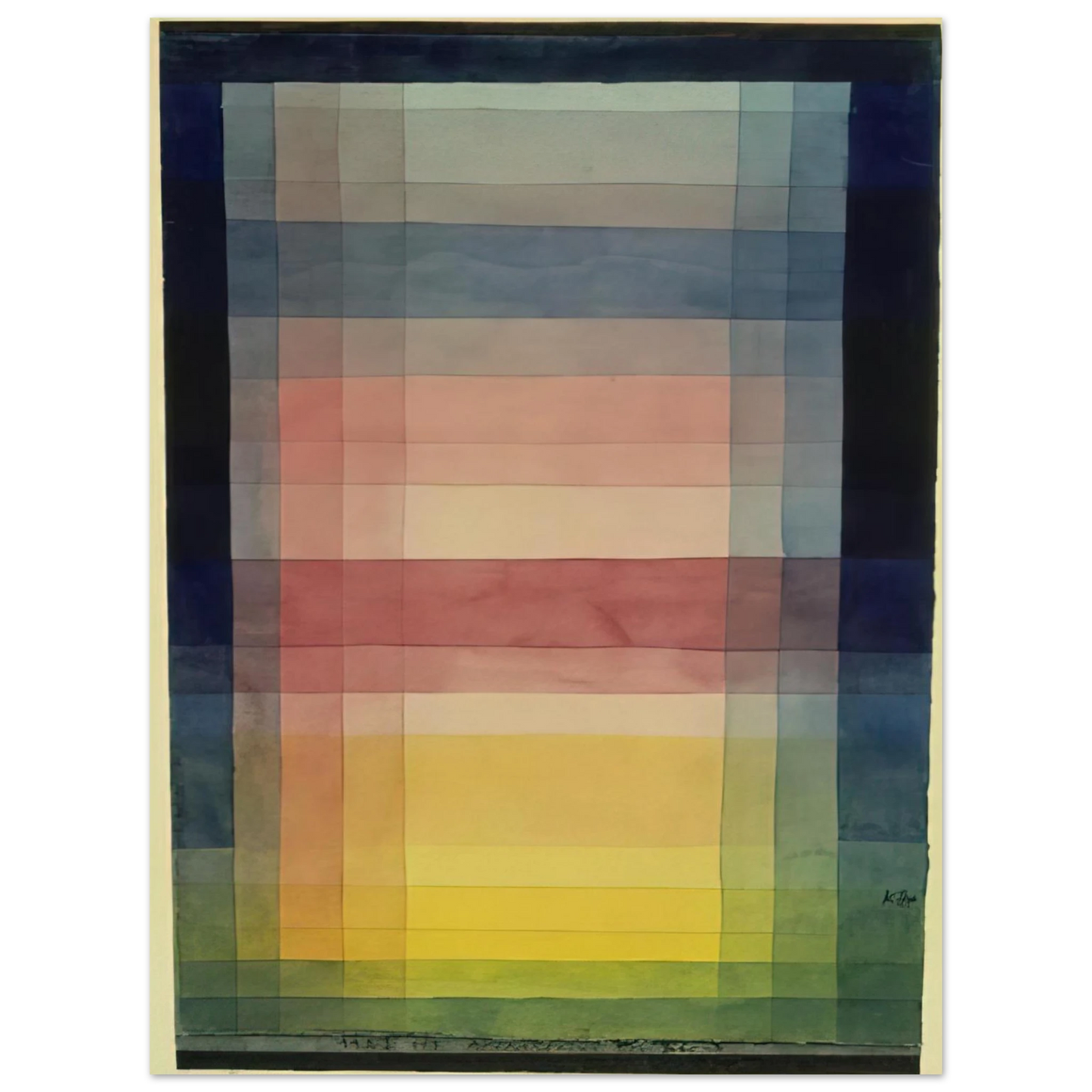
What is the historical significance of Paul Klee's ARCHITECTURE OF THE PLAIN 1923?
Created during Klee's Bauhaus tenure, this 1923 work exemplifies his abstract architectural studies, blending geometric forms with symbolic depth to explore modernist themes in a unique visual language.
How does the print capture the details of Klee's original artwork?
Our museum-quality reproduction uses high-resolution imaging to preserve Klee's delicate lines and earth-tone palette, ensuring every nuance of the 75x100 cm fine art print is accurately rendered.
What are the specifications of the archival paper used?
The print features Master's Edition archival paper with a matte, uncoated finish on natural white, 250 gsm weight, 0.29 mm thickness, and acid-free properties for long-lasting durability.
How is the print shipped and what is the fulfillment process?
Printed on demand with no minimum orders, each piece is carefully packaged and shipped directly to you, ensuring a pristine archival art print arrives ready for display.
What makes this print archival and resistant to yellowing?
Made from acid-free (pH above 7) and FSC-certified paper, this museum-quality reproduction prevents yellowing over time, offering a sustainable and enduring fine art poster.
What inspired Klee's architectural themes in this period?
Influenced by Bauhaus principles, Klee drew from cubism and his interest in structural harmony, using abstract forms to evoke imagined landscapes and architectural ideals.
Can this print be customized in size or framing?
This reproduction is fixed at 75x100 cm (30x40 inches) to maintain authenticity; we offer guidance on framing options to complement its archival quality and modernist aesthetic.