RedKalion
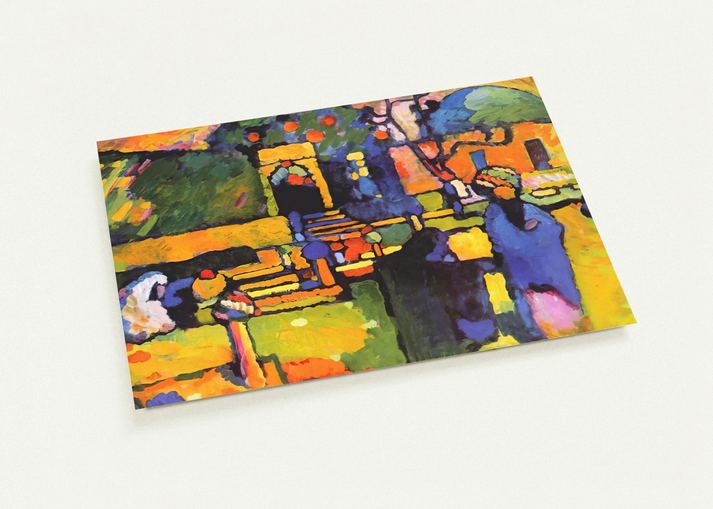
ARABS I CEMETERY 1909 By Wassily Kandinsky Pack of 10 Post Cards | Wassily Kandinsky Post Cards | A6 (10.5 x 14.8 cm) - 4.1 x 5.8 inches
ARABS I CEMETERY 1909 By Wassily Kandinsky Pack of 10 Post Cards | Wassily Kandinsky Post Cards | A6 (10.5 x 14.8 cm) - 4.1 x 5.8 inches
Couldn't load pickup availability
Immerse Yourself in the Spiritual Vibrancy of Wassily Kandinsky
Step into a pivotal moment of art history with this exquisite pack of 10 postcards featuring Wassily Kandinsky’s 'Arabs I (Cemetery)' (1909). This masterpiece hails from Kandinsky’s revolutionary period in Murnau, where he began to dismantle traditional representation in favor of a deeper, spiritual abstraction. By choosing these fine art prints, you are not merely purchasing stationery; you are acquiring a curated piece of the Expressionist movement, meticulously reproduced by RedKalion.
Museum-Quality Reproduction and Craftsmanship
At RedKalion, we believe that even the smallest formats deserve the highest standards of quality. Unlike standard 4-color commercial prints, our postcards utilize advanced 12-color fine art printing technology. This ensures that Kandinsky’s bold, evocative palette—saturated yellows, deep blues, and earthy reds—is rendered with breathtaking accuracy and depth. Each card features a smooth matte finish to eliminate glare, allowing the complex brushwork and historical texture to shine through.
Technical Specifications for the Discerning Collector
- Premium Paper: Printed on substantial 200 gsm (80 lb) archival-grade paper for a durable, high-end feel.
- FSC-Certified: Our commitment to the arts is matched by our commitment to the planet; all paper is environmentally conscious.
- Dimensions: Standard A6 size (10.5 x 14.8 cm / 4.1 x 5.8 inches), perfect for correspondence or framing.
- Thickness: 0.26 mm (10.3 mils) ensures a sturdy, museum-quality feel.
Whether you are sending a thoughtful note or creating a miniature gallery wall, these Wassily Kandinsky postcards serve as an enduring testament to the power of color and form. Elevate your collection with an archival masterpiece that captures the soul of modern art.

Discover Unlimited Art Possibilities
At RedKalion, you can find virtually any artwork from any artist, available in a wide range of sizes to perfectly match your space.
If you didn’t find what you’re looking for, contact us at support@redkalion.com . We will source any artwork and produce it in any size and format you need, including art prints, posters, canvas, framed pieces, framed canvas, and more.
For dedicated art enthusiasts, we also offer handcrafted replicas of any artwork, carefully painted by highly skilled artists using traditional techniques.
For custom requests, contact us at support@redkalion.com .
What are the dimensions of the Wassily Kandinsky postcards?
Each postcard in this pack of 10 is A6 size, measuring 10.5 x 14.8 cm (4.1 x 5.8 inches). This standard size is perfect for mailing or placing in small tabletop frames.
How is the print quality of these fine art postcards?
We use 12-color fine art printing technology, providing superior color vibrancy and depth compared to standard 4-color inkjet processes. This ensures a museum-quality reproduction of Kandinsky's original 1909 palette.
Is the paper used for these prints environmentally friendly?
Yes. All RedKalion prints are produced on FSC-certified, environmentally conscious paper. We utilize 200 gsm (80 lb) paper with a smooth matte, glare-free finish for an archival-grade experience.
How long does shipping typically take for these art postcards?
Our postcards are printed on demand to ensure the highest quality control. Shipping times vary by location, but we generally process and ship orders within 2-4 business days.
Are these postcards suitable for framing?
Absolutely. Due to the 200 gsm weight and 12-color archival printing, these cards are often used by collectors as mini-prints for gallery walls or as sophisticated desk decor.
What is the significance of 'Arabs I (Cemetery)' in Kandinsky’s career?
Painted in 1909, this work marks Kandinsky's transition from Fauvism toward complete abstraction. It showcases his obsession with 'inner necessity' and the spiritual resonance of color and simplified forms.
How does Kandinsky’s use of color influence the viewer?
Kandinsky believed colors had a physical and psychological effect. In 'Arabs I (Cemetery),' the vibrant, non-naturalistic hues are designed to bypass the intellect and communicate directly with the viewer's soul.