
Discover Unlimited Art Possibilities
At RedKalion, you can find virtually any artwork from any artist, available in a wide range of sizes to perfectly match your space.
If you didn’t find what you’re looking for, contact us at support@redkalion.com . We will source any artwork and produce it in any size and format you need, including art prints, posters, canvas, framed pieces, framed canvas, and more.
For dedicated art enthusiasts, we also offer handcrafted replicas of any artwork, carefully painted by highly skilled artists using traditional techniques.
For custom requests, contact us at support@redkalion.com .
What are the exact dimensions of this Edward Ruscha framed art print?
The framed print measures 70x100 cm (28x40 inches), with a 20mm thick black wooden frame, offering a substantial presence ideal for gallery-style displays in homes or offices.
What type of paper is used for this museum-quality reproduction?
We use premium 250 gsm (110 lb) matte, uncoated paper with a natural white finish and 0.29 mm thickness, ensuring archival longevity and true color reproduction for this fine art print.
Is this framed print ready to hang upon delivery?
Yes, it includes a hanging kit and arrives ready-to-hang, so you can display this Edward Ruscha artwork directly on your wall without additional setup.
How durable is the framing and protection for this art print?
The frame is made from responsibly sourced oak and ash wood, 20mm thick, with shatterproof plexiglass to protect against damage, ensuring long-term preservation of your investment.
What makes this a sustainable fine art print option?
We use FSC-certified materials or equivalent for the paper and frame, supporting eco-friendly practices while delivering a high-quality, archival museum-grade reproduction.
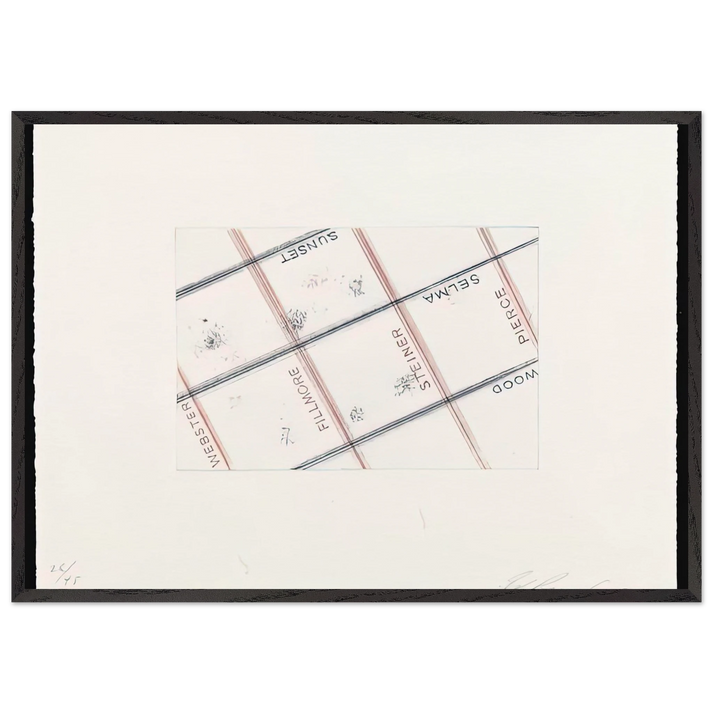
What is the historical significance of the 'Los Francisco San Angeles Portfolio'?
Created in the 1960s, this portfolio reflects Edward Ruscha's Pop Art focus on American signage and language, blending Los Angeles and San Francisco to critique urban identity and commercial culture.
Why did Edward Ruscha use the word 'PIERCE' in this artwork?
Ruscha often selected common words as visual subjects; 'PIERCE' may reference piercing through cultural norms or evoke industrial imagery, typical of his conceptual approach to typography and place.