
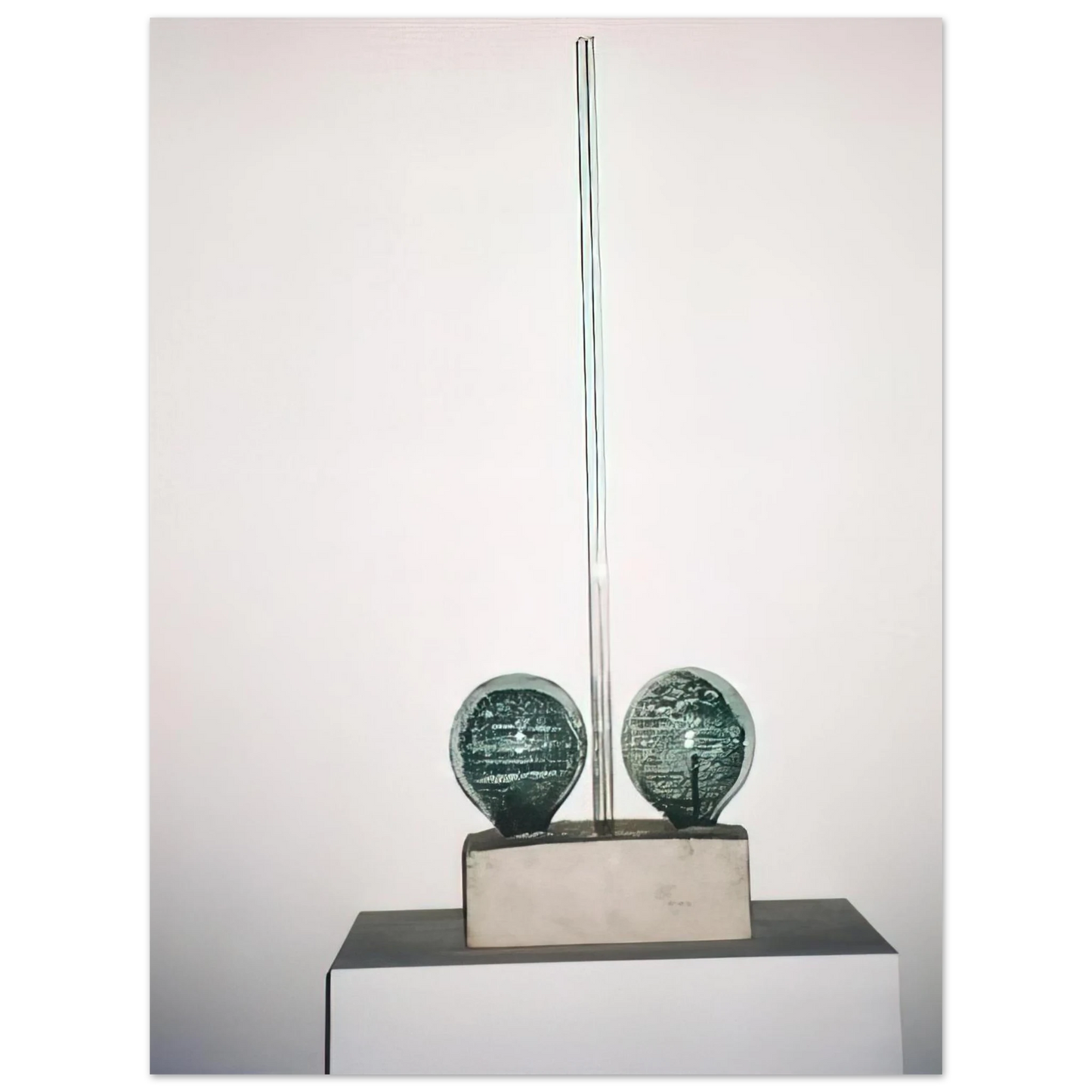
What is the historical significance of Robert Rauschenberg's THE MAN WITH TWO SOULS?
Created in 1950, this early work reflects Rauschenberg's transition from Abstract Expressionism to his pioneering Combines, blending painting and found objects to explore themes of duality and identity in post-war America.
How does this fine art print capture the details of the original artwork?
Our museum-quality reproduction uses high-resolution imaging to preserve the textures and contrasts of Rauschenberg's 1950 piece, ensuring an authentic representation on archival paper.
What are the specifications of the Master's Edition archival paper?
This acid-free paper features a matte, uncoated finish in natural white, with a weight of 250 gsm (110 lb) and thickness of 0.29 mm (11.4 mils), designed for longevity and a luxurious texture.
Is this print sustainable and how long will it last?
Yes, it's printed on FSC-certified paper with acid-free properties (pH above 7) to prevent yellowing, ensuring archival longevity for decades in your collection.
How is the print shipped and are there minimum order requirements?
We print and ship on demand with no minimum orders, offering convenient fulfillment for this 75x100 cm fine art poster directly to your door.
What techniques did Rauschenberg use in THE MAN WITH TWO SOULS?
Rauschenberg employed mixed media and gestural brushwork in this 1950 work, foreshadowing his later Combines by integrating abstract forms with symbolic elements to convey psychological depth.
Why is the matte finish ideal for this artwork?
The matte, uncoated finish reduces glare and enhances the natural textures of Rauschenberg's piece, providing a sophisticated, gallery-like presentation on archival paper.