

Discover Unlimited Art Possibilities
At RedKalion, you can find virtually any artwork from any artist, available in a wide range of sizes to perfectly match your space.
If you didn’t find what you’re looking for, contact us at support@redkalion.com . We will source any artwork and produce it in any size and format you need, including art prints, posters, canvas, framed pieces, framed canvas, and more.
For dedicated art enthusiasts, we also offer handcrafted replicas of any artwork, carefully painted by highly skilled artists using traditional techniques.
For custom requests, contact us at support@redkalion.com .
What are the dimensions and material of this Ernst Wilhelm Nay print?
This museum-quality reproduction measures 70x100 cm (28x40 inches) and is printed on brushed silver Aluminum DIBOND® with a 3mm thickness for a durable, rigid base and a dynamic metallic finish.
How does the printing process enhance the artwork's appearance?
The direct print on AluDibond ensures vivid colors and a matte, glare-free finish, with unprinted white areas revealing a striking metallic silver effect for optimal contrast in this fine art print.
Is a hanging kit included with the aluminum print?
Yes, a hanging kit is included for easy installation; specific components may vary by fulfillment country to ensure secure display of your Ernst Wilhelm Nay reproduction.
What makes this print archival and long-lasting?
Using fade-resistant inks and premium Aluminum DIBOND®, this print is designed for archival longevity, maintaining its vibrant colors and metallic finish for years as a durable art piece.
How does the brushed aluminum finish affect the artwork's look?
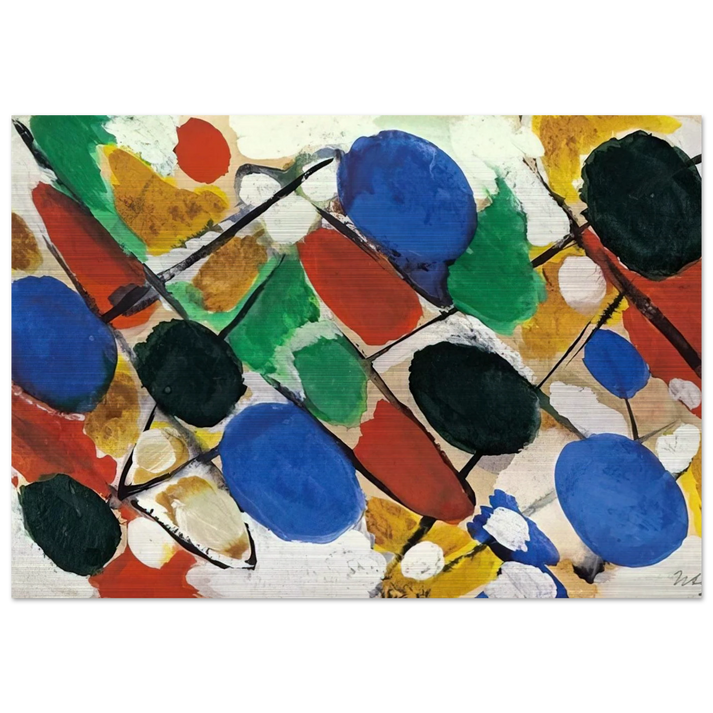
The horizontal grain and metallic finish add a dynamic, modern texture that complements Nay's abstract forms, enhancing the matte finish and black-and-white elements with a subtle shimmer.
What is the historical significance of Nay's Scheiben (1955) painting?
Scheiben (1955) is part of Nay's iconic "Scheibenbilder" series, where he used disc shapes to explore color interactions and optical rhythms, marking a key development in post-war abstract art and German modernism.
How did Ernst Wilhelm Nay's techniques influence this artwork?
Nay's technique involved layering vibrant discs to create movement and harmony, influenced by natural light studies; this print captures his innovative approach to abstract expressionism and color theory.