
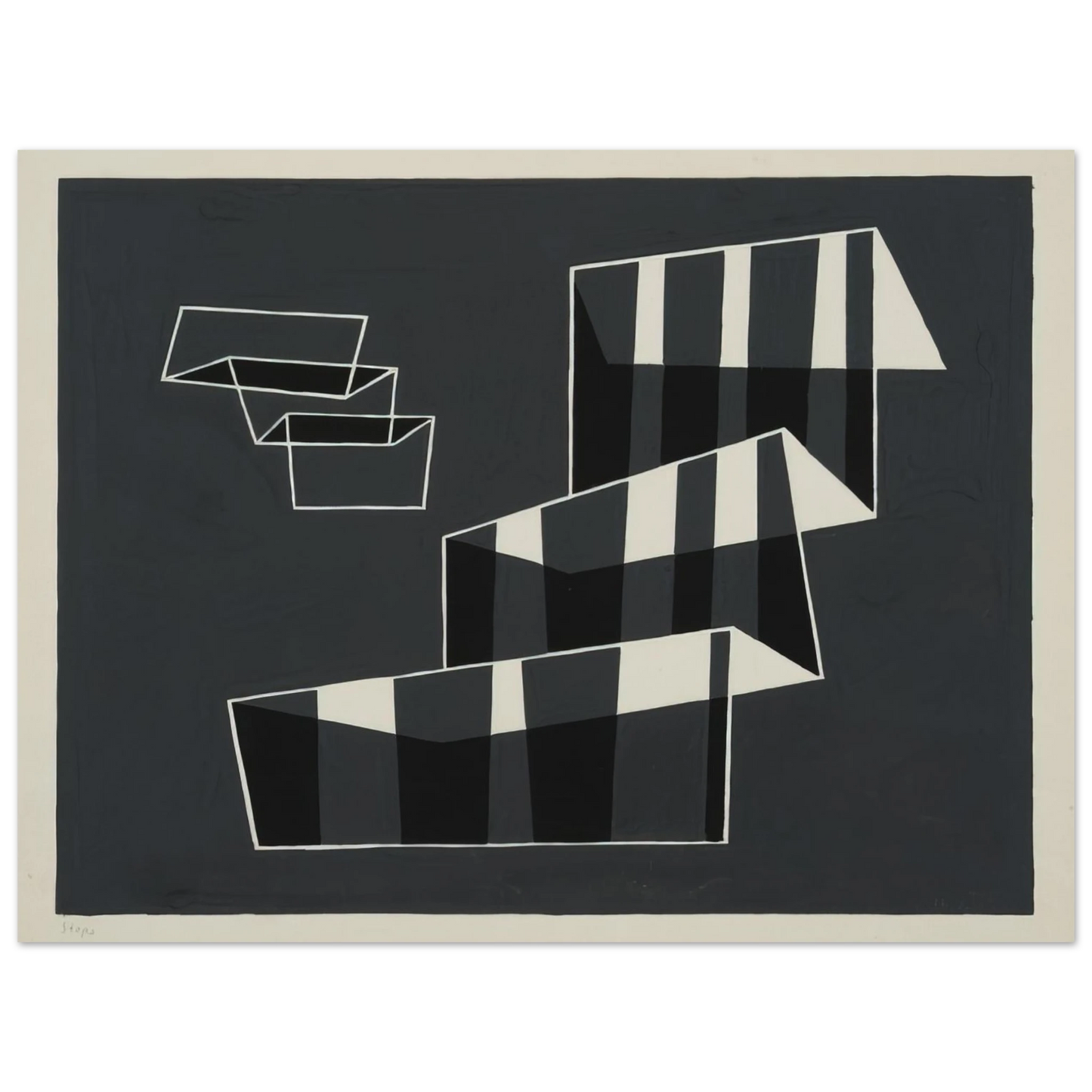
What is the historical significance of Josef Albers' "STEPS" (1932)?
"STEPS" (1932) is a key work from Josef Albers' Bauhaus period, showcasing his pioneering use of geometric abstraction and color theory to explore spatial relationships and visual perception in modern art.
How does the color and composition in "STEPS" reflect Albers' artistic techniques?
Albers employed interlocking rectangles and squares with precise color contrasts to create rhythmic progression, demonstrating his focus on harmony and balance through minimalist geometric forms.
What are the specifications of the paper used for this fine art print?
This museum-quality reproduction is printed on Master's Edition archival paper: matte, uncoated, natural white finish, 250 gsm (110 lb) weight, 0.29 mm thickness, acid-free (pH above 7), and FSC-certified for sustainability.
How is this print shipped and are there minimum order requirements?
We offer no minimum orders; each print is produced on-demand and shipped directly to you, ensuring fresh, high-quality fulfillment for your Josef Albers artwork.
What makes this print archival and long-lasting?
Made from acid-free materials (pH above 7) and heavyweight 250 gsm paper, this print resists yellowing and degradation, preserving the vibrant colors of Albers' geometric abstraction for decades.
Can I frame this print easily given its dimensions?
Yes, at 75x100 cm (30x40 inches), this fine art poster is a standard size compatible with many ready-made frames, making it simple to display in your home or office.
Why choose RedKalion for Josef Albers reproductions?
RedKalion combines expert art historical curation with premium archival materials, offering trusted, museum-quality prints like this Josef Albers piece for discerning collectors.