
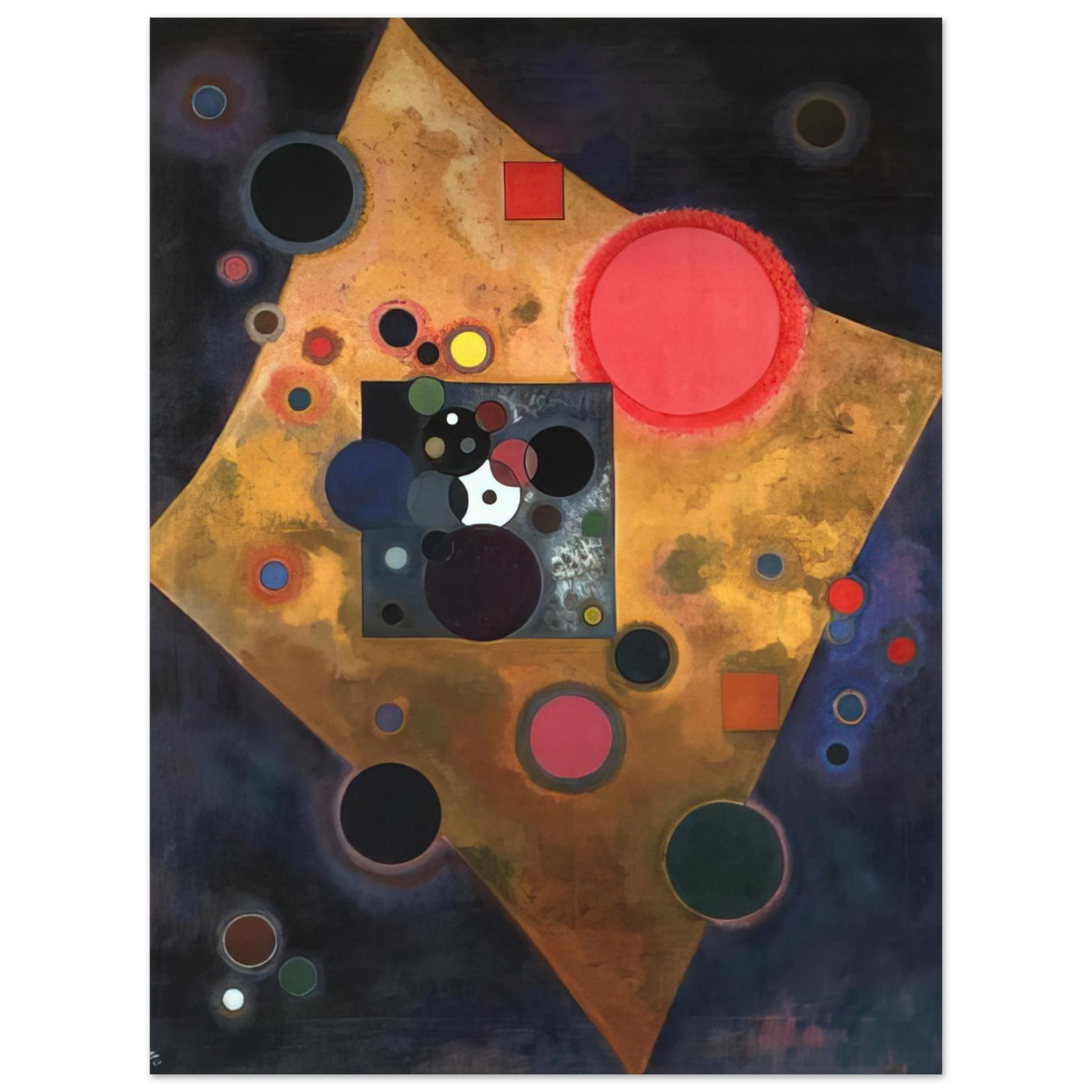
What is the historical significance of Wassily Kandinsky's ACCENT ON ROSE (1926)?
ACCENT ON ROSE (1926) is a key work from Kandinsky's Bauhaus period, showcasing his transition to geometric abstraction and use of color to express spiritual themes, making it a landmark in abstract expressionism fine art prints.
How does the paper quality ensure this is a museum-quality reproduction?
Our Master's Edition archival paper is acid-free (pH above 7) to prevent yellowing, with a matte, uncoated finish and natural white texture, providing a luxurious feel akin to original artworks for premium art posters.
What are the exact dimensions and paper specifications for this fine art print?
This print measures 75x100 cm (30x40 inches) on 250 gsm (110 lb) paper with 0.29 mm thickness, ensuring a durable and high-quality display for your Kandinsky artwork.
How is shipping handled for this on-demand print?
We print and ship on demand with no minimum orders, offering efficient fulfillment to deliver your archival reproduction directly to your door.
Is this print environmentally sustainable?
Yes, it uses FSC-certified paper, aligning with eco-friendly practices for sustainable fine art reproductions from RedKalion.
What techniques did Kandinsky use in ACCENT ON ROSE to create its abstract effects?
Kandinsky employed geometric shapes and bold color contrasts, particularly the accent on rose, to evoke emotional and spiritual responses, characteristic of his abstract expressionist style.
Why is the matte finish preferred for this type of artwork?
The matte, uncoated finish reduces glare and enhances the texture, allowing the colors and details of Kandinsky's ACCENT ON ROSE to stand out authentically in museum-quality prints.