
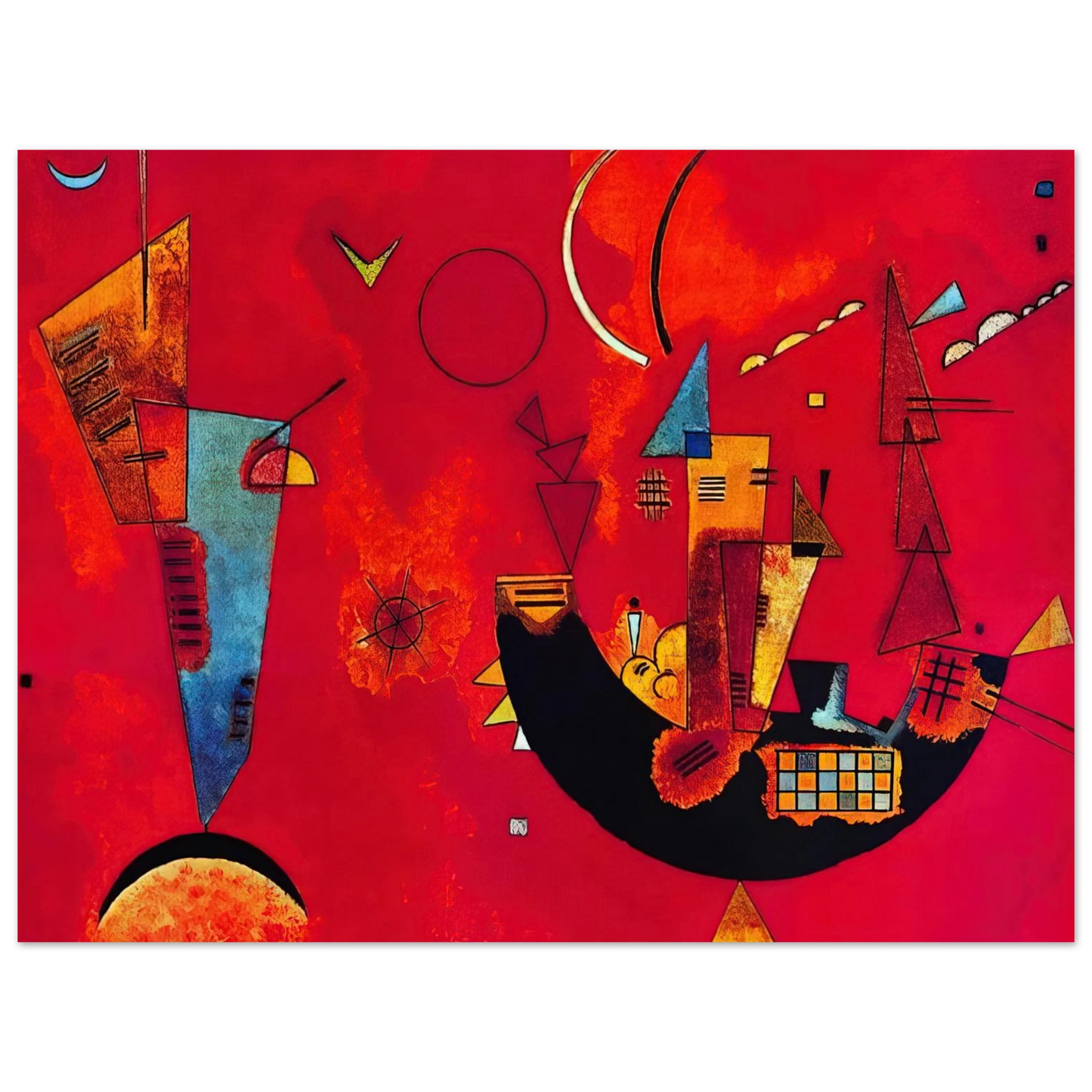
What is the historical significance of Wassily Kandinsky's "Mit und Gegen" (1929)?
"Mit und Gegen" (1929) is a key work from Kandinsky's Bauhaus period, showcasing his shift toward geometric abstraction and exploration of spiritual harmony through dynamic shapes and colors, reflecting his theories on art and music.
How does this print capture the details of Kandinsky's original artwork?
Our museum-quality reproduction uses high-resolution imaging and Master's Edition archival paper to ensure precise color accuracy and sharp geometric forms, preserving the essence of Kandinsky's 1929 composition.
What are the specifications of the paper used for this fine art print?
This print features Master's Edition archival paper: matte, uncoated, natural white (off-white) with a weight of 250 gsm (110 lb), thickness of 0.29 mm (11.4 mils), acid-free for longevity, and FSC-certified for sustainability.
How is this print shipped and are there minimum order requirements?
We offer no minimum orders; each print is produced on demand and shipped securely to ensure your museum-quality poster arrives in pristine condition, ready for display.
What makes this print archival and long-lasting?
Made from acid-free paper (pH above 7), this fine art print resists yellowing over time, ensuring your Kandinsky reproduction maintains its vibrant colors and quality for generations as an archival masterpiece.
What inspired Kandinsky's use of geometric forms in "Mit und Gegen"?
Inspired by his Bauhaus teachings and spiritual beliefs, Kandinsky used geometric shapes like circles and triangles in "Mit und Gegen" to create visual rhythms that evoke emotional and musical harmonies, advancing abstract art.
How does the matte finish enhance the viewing experience of this print?
The matte, uncoated finish on natural white paper reduces glare, providing a luxurious texture that highlights Kandinsky's bold colors and geometric details, ideal for sophisticated home or office decor.