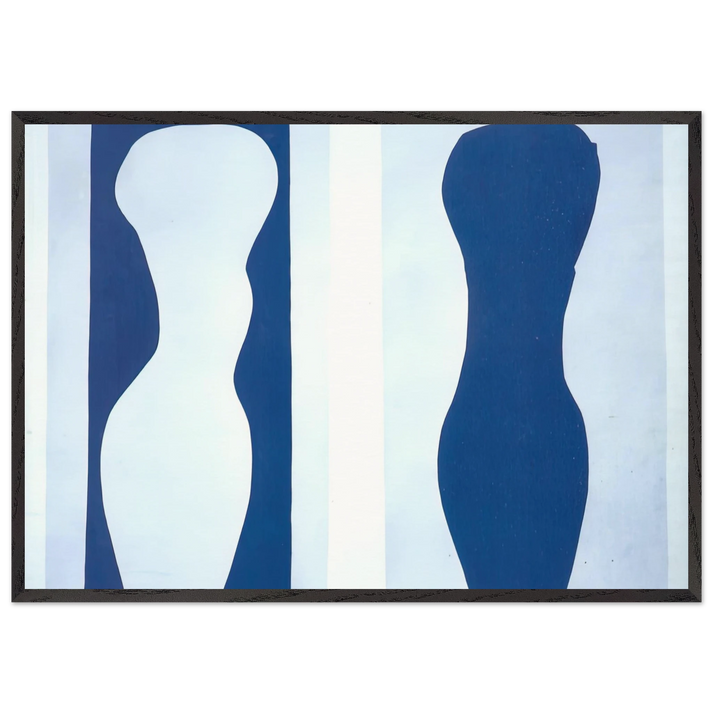

What is the historical significance of White Torso and Blue Torso 1944 by Henri Matisse?
Created in 1944, this work reflects Matisse's late-period shift towards abstraction and cut-outs, using simplified forms and bold colors to explore human anatomy with rhythmic harmony, marking a key moment in modernist art.
How does the color contrast in White Torso and Blue Torso enhance the artwork?
The contrast between white and blue torsos creates visual tension and balance, emphasizing Matisse's mastery of color theory to evoke emotion and depth without realistic detail.
What are the specifications of the paper used for this fine art print?
The print uses 250 gsm (110 lb) matte, uncoated, natural white archival museum-quality paper with a thickness of 0.29 mm (11.4 mils), ensuring durability and premium reproduction quality.
Is the framed art print ready to hang upon delivery?
Yes, it includes a hanging kit and is ready to hang directly on the wall, making installation quick and hassle-free for your home or office decor.
What materials are used in the black wooden frame?
The frame is made from responsibly sourced oak and ash wood, measuring 20mm (0.79") thick and wide, providing a sturdy, gallery-style presentation.
How does the shatterproof plexiglass protect the museum-quality reproduction?
Shatterproof plexiglass offers clear protection against impacts and UV light, preserving the print's colors and integrity while ensuring safety in display areas.
Is the paper sustainable for this archival print?
Yes, it uses FSC-certified materials or equivalent, supporting sustainable practices without compromising on the archival longevity of the fine art print.