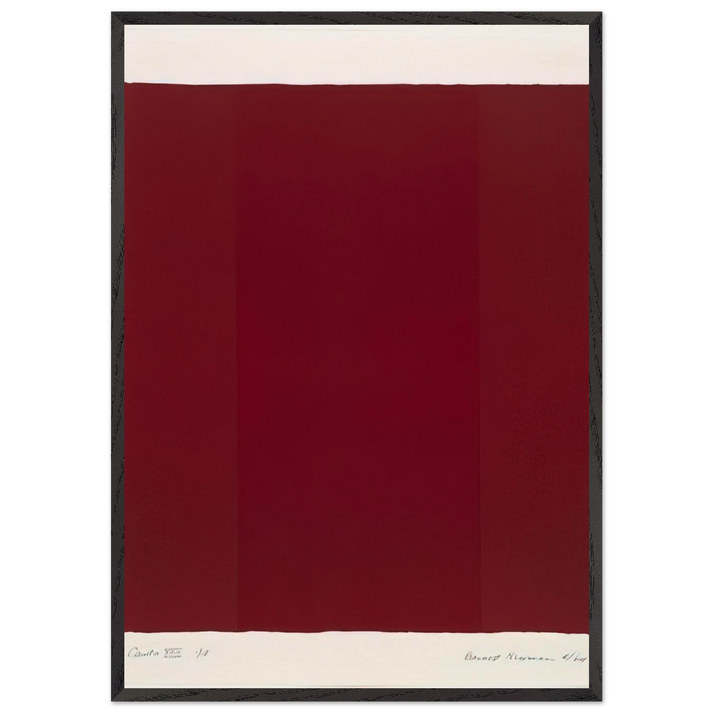

What defines the quality of this Barnett Newman print?
We use 250 gsm (110 lb) archival museum-quality paper. This natural white, matte, and uncoated paper ensures the Canto XVII reproduction remains vibrant and resistant to yellowing over time, providing a premium fine art experience.
How is the artwork framed and finished?
The print is housed in a 20mm thick frame made from solid, responsibly sourced oak and ash. We use shatterproof plexiglass to protect the artwork, offering a clear, safe, and gallery-standard presentation for your home.
Is the paper used for this print sustainable?
Yes, RedKalion is committed to sustainability. This Barnett Newman art print uses FSC-certified paper or equivalent certifications, ensuring that your high-end decor choice supports responsible forest management and environmental protection.
How will my framed art print arrive?
Your 70x100 cm print arrives ready-to-hang. We include a complete hanging kit with every order, ensuring a seamless installation process immediately upon delivery. The robust packaging prevents damage during transit.
What is the archival longevity of RedKalion prints?
Our prints are designed to last for decades. By combining acid-free 250 gsm paper with UV-protective plexiglass and archival inks, we ensure your Barnett Newman reproduction maintains its structural and visual integrity indefinitely.
What is the significance of the '18 Cantos' series?
Created between 1963 and 1964, the 18 Cantos marked Newman's first major foray into lithography. The series explores the relationship between the margins of the paper and the central 'zip,' reflecting a spiritual, musical rhythm.
Why did Barnett Newman use vertical lines called 'zips'?
Newman's 'zips' were intended to define the spatial structure of the painting while simultaneously unifying the composition. They represent a human presence within the infinite void, creating a sense of scale and profound emotional resonance.