
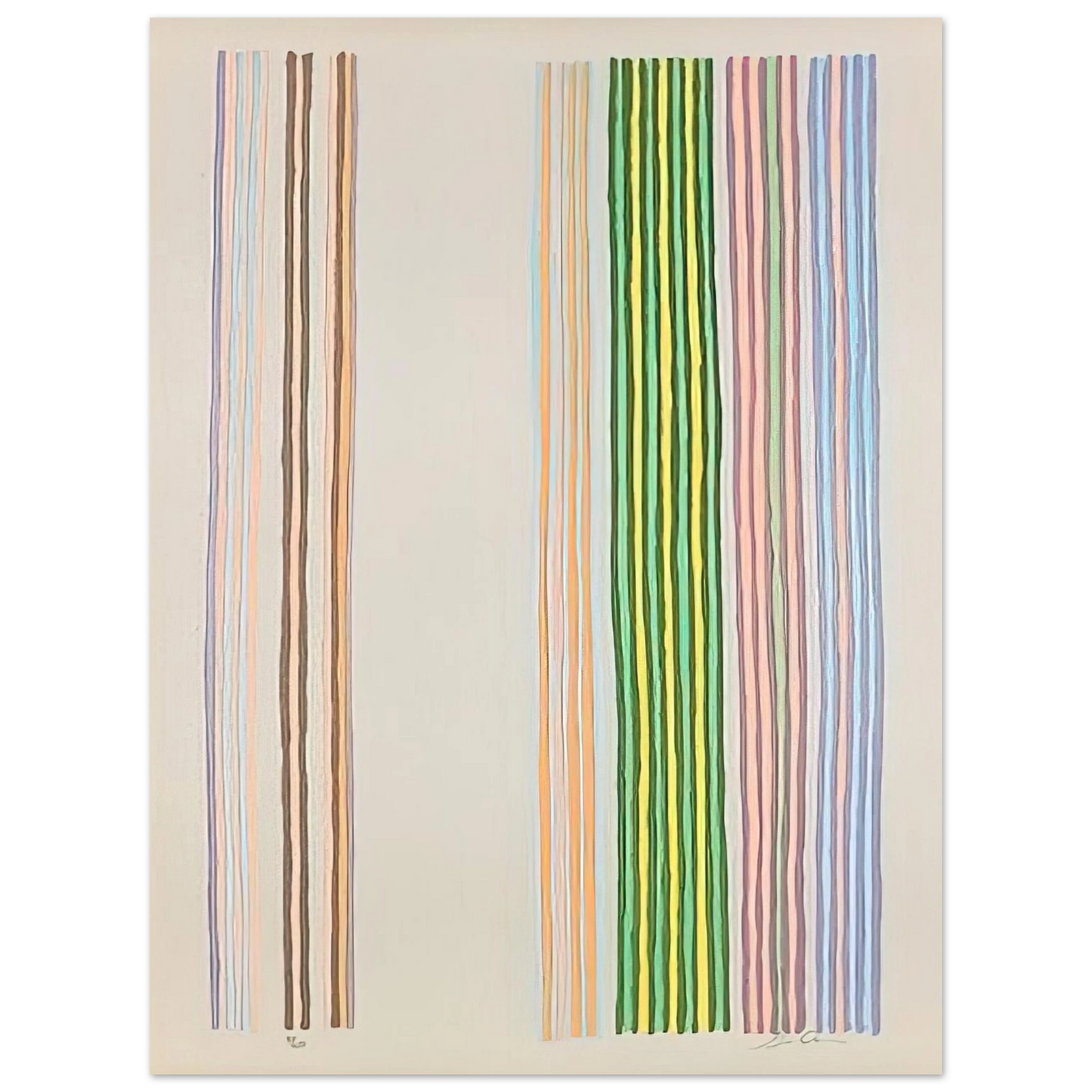
What is the historical significance of Gene Davis's "Royal Curtain"?
"Royal Curtain" (1980) is a key work by Gene Davis, a pioneer of the Color Field movement and Washington Color School, known for using vertical stripes to explore color's emotional and spatial impact in fine art prints.
How does the stripe technique in this artwork create its visual effect?
Davis applied stripes of varying widths and colors in "Royal Curtain" to generate rhythmic energy and optical vibration, making it a standout example of Color Field abstraction in museum-quality reproductions.
What are the specifications of the paper used for this fine art print?
This print uses Master's Edition archival paper: 250 gsm weight, 0.29 mm thickness, matte finish, natural white, acid-free for longevity, and FSC-certified for sustainability in premium reproductions.
How is the print shipped and is there a minimum order requirement?
We offer no minimum orders; prints are produced on-demand and shipped directly to you, ensuring fresh, high-quality fine art posters with careful packaging.
What makes this print archival and how long will it last?
With acid-free paper (pH above 7) and museum-quality materials, this print resists yellowing and degradation, offering lasting vibrancy for decades in home or gallery settings.
Can I customize the size or framing of this artwork?
This print is available in the standard 75x100 cm (30x40 inches) size as a fine art poster; contact us for potential custom options to match your decor needs.
Is the matte finish suitable for all lighting conditions?
Yes, the matte, uncoated finish reduces glare and enhances color depth, making "Royal Curtain" ideal for various lighting in spaces displaying archival art prints.