
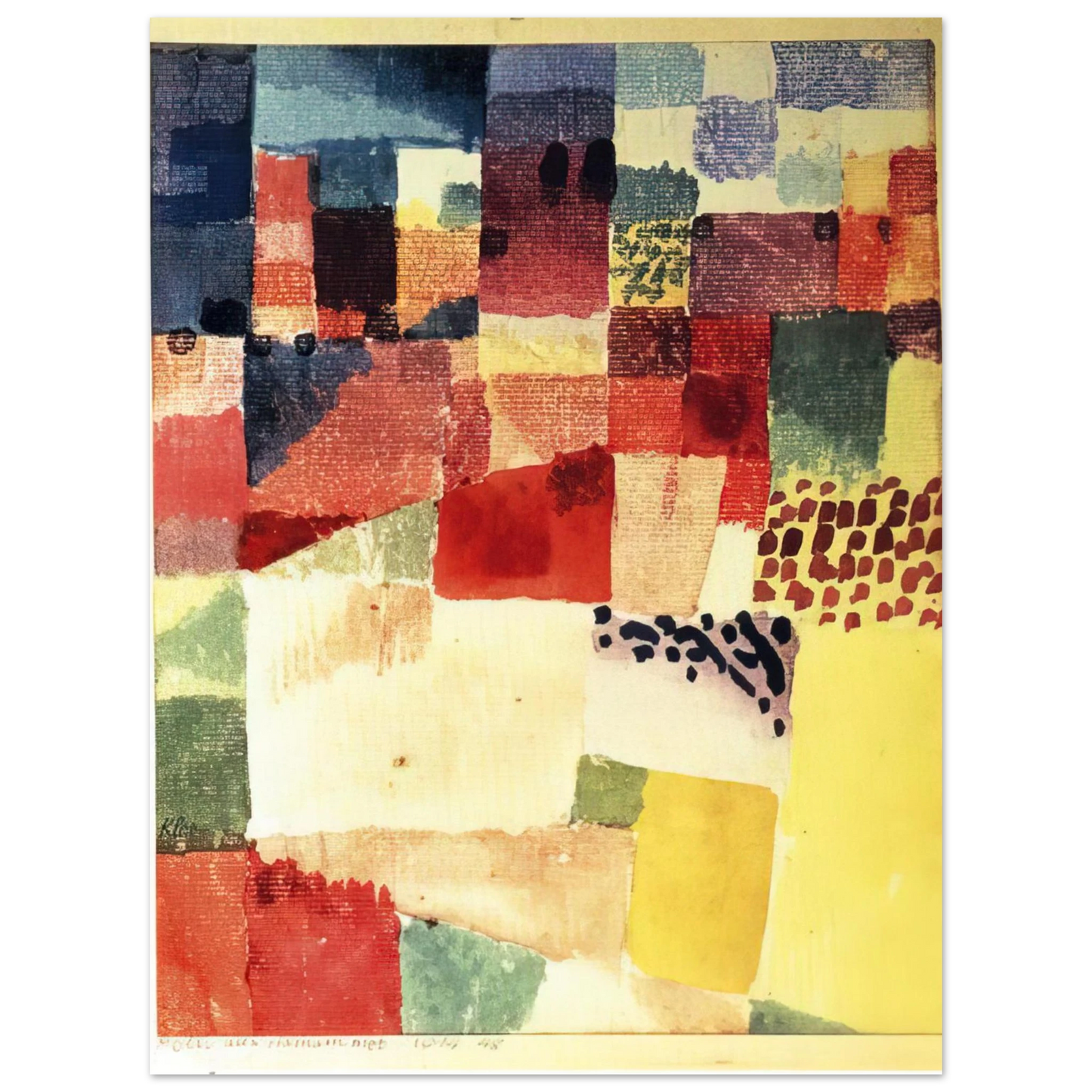
What is the historical significance of Paul Klee's HAMMAMET?
HAMMAMET was painted in 1914 during Klee's trip to Tunisia, a journey that profoundly influenced his use of color and abstraction, marking a key shift in modern art toward expressive geometric forms.
How does the Master's Edition archival paper ensure museum-quality reproduction?
Our Master's Edition paper uses acid-free, FSC-certified materials with a matte finish to capture Klee's subtle hues and textures, providing a durable fine art print that rivals original displays.
What are the exact dimensions and paper specifications for this print?
This fine art poster measures 75x100 cm (30x40 inches), printed on 250 gsm (110 lb) archival paper with a 0.29 mm thickness and natural white matte finish for optimal color fidelity.
How is the print shipped, and are there minimum order requirements?
We offer on-demand printing and shipping with no minimum orders, ensuring your Paul Klee reproduction arrives safely and promptly, ready for framing.
Will this archival print resist yellowing over time?
Yes, the acid-free paper (pH above 7) prevents yellowing, making this a long-lasting investment for your art collection that maintains its vibrant colors.
What inspired Klee's use of geometric shapes in HAMMAMET?
Klee was inspired by the architectural forms and intense light of Hammamet, blending Cubist techniques with his abstract style to create a harmonious, color-focused composition.
Is the matte finish suitable for framing without glare?
Absolutely, the uncoated matte finish reduces glare and enhances texture, making this museum-quality print ideal for framing in various lighting conditions.