
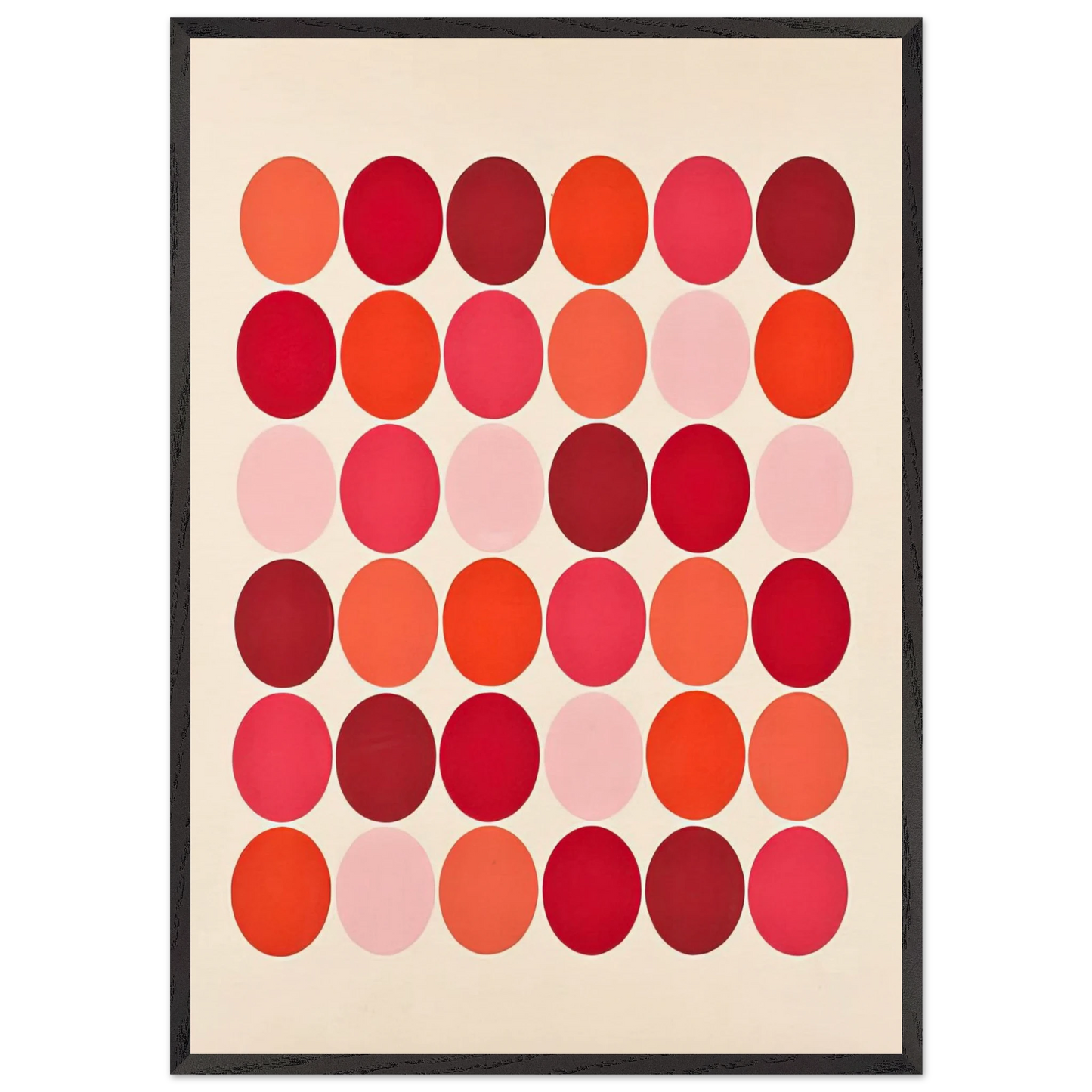
What is the historical significance of Thomas Downing's "Red" from 1966?
"Red" is a key work by Thomas Downing, a leading figure in the Washington Color School, known for its focus on color field painting and geometric abstraction in 1960s American art, using systematic dot patterns to explore optical effects.
How does the frame enhance this art print?
The black wooden frame, made from responsibly sourced oak and ash wood and measuring 20mm thick and wide, provides a substantial, gallery-quality border that complements the bold geometric design and ensures durability for your fine art print.
What are the specifications of the paper used for this print?
This museum-quality reproduction uses 250 gsm (110 lb) archival paper with a matte, uncoated finish, 0.29 mm (11.4 mils) thick, and natural white color, ideal for fine art prints to ensure vibrant colors and long-term preservation.
Is this framed art print ready to hang?
Yes, this framed art print includes a hanging kit and is ready-to-hang directly on your wall, making installation simple and immediate for your Thomas Downing reproduction.
How is the print protected within the frame?
The print is protected by shatterproof plexiglass, which safeguards the archival museum-quality paper from damage while maintaining clarity and enhancing the visual appeal of your geometric art piece.
What sustainable materials are used in this product?
We use FSC-certified or equivalent sustainable materials for the paper and responsibly sourced wood for the frame, aligning with eco-friendly practices for our fine art reproductions.
Can you describe the technique behind Downing's dot patterns in "Red"?
Thomas Downing employed a meticulous stencil technique to create uniform circular dots, arranging them in grid-like formations to achieve optical vibrancy and explore color interactions, characteristic of the Washington Color School's innovative methods.