
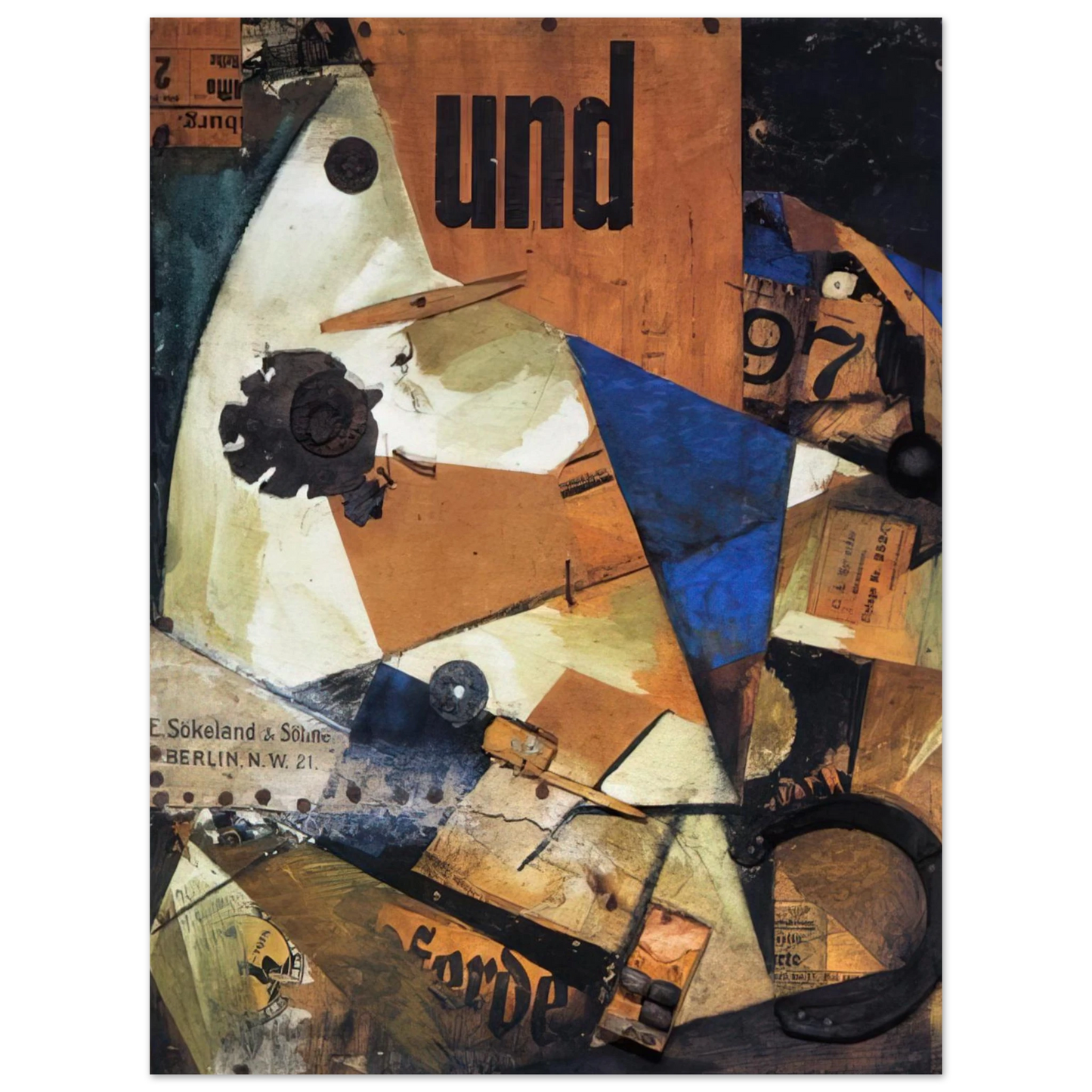
What is the historical significance of Kurt Schwitters' THE AND PICTURE 1919?
Created in 1919, this work is a key example of Schwitters' Merz technique within the Dada movement, using collage to critique post-war society and redefine art with found objects and typography.
What are the dimensions of this fine art print?
This museum-quality reproduction measures 75x100 cm, equivalent to 30x40 inches, making it an ideal size for display in homes or offices as a statement piece.
What type of paper is used for this archival print?
It is printed on Master's Edition archival paper, an acid-free, FSC-certified material with a matte finish and natural white color for superior longevity and texture.
How is this print shipped and are there minimum orders?
We offer on-demand printing and shipping with no minimum orders, ensuring fast fulfillment and reducing waste for this sustainable fine art poster.
How long will this archival print last without yellowing?
With acid-free paper (pH above 7), this reproduction resists yellowing for decades, maintaining its museum-quality appearance as a durable art investment.
What is the weight and thickness of the paper?
The paper has a premium weight of 250 gsm (110 lb) and a thickness of 0.29 mm (11.4 mils), providing a luxurious feel for this Dadaist masterpiece print.
Can you explain Schwitters' Merz technique in this artwork?
Schwitters' Merz technique involved assembling discarded materials like paper and text into collages, as seen in THE AND PICTURE, to create abstract compositions that challenged traditional art forms.