
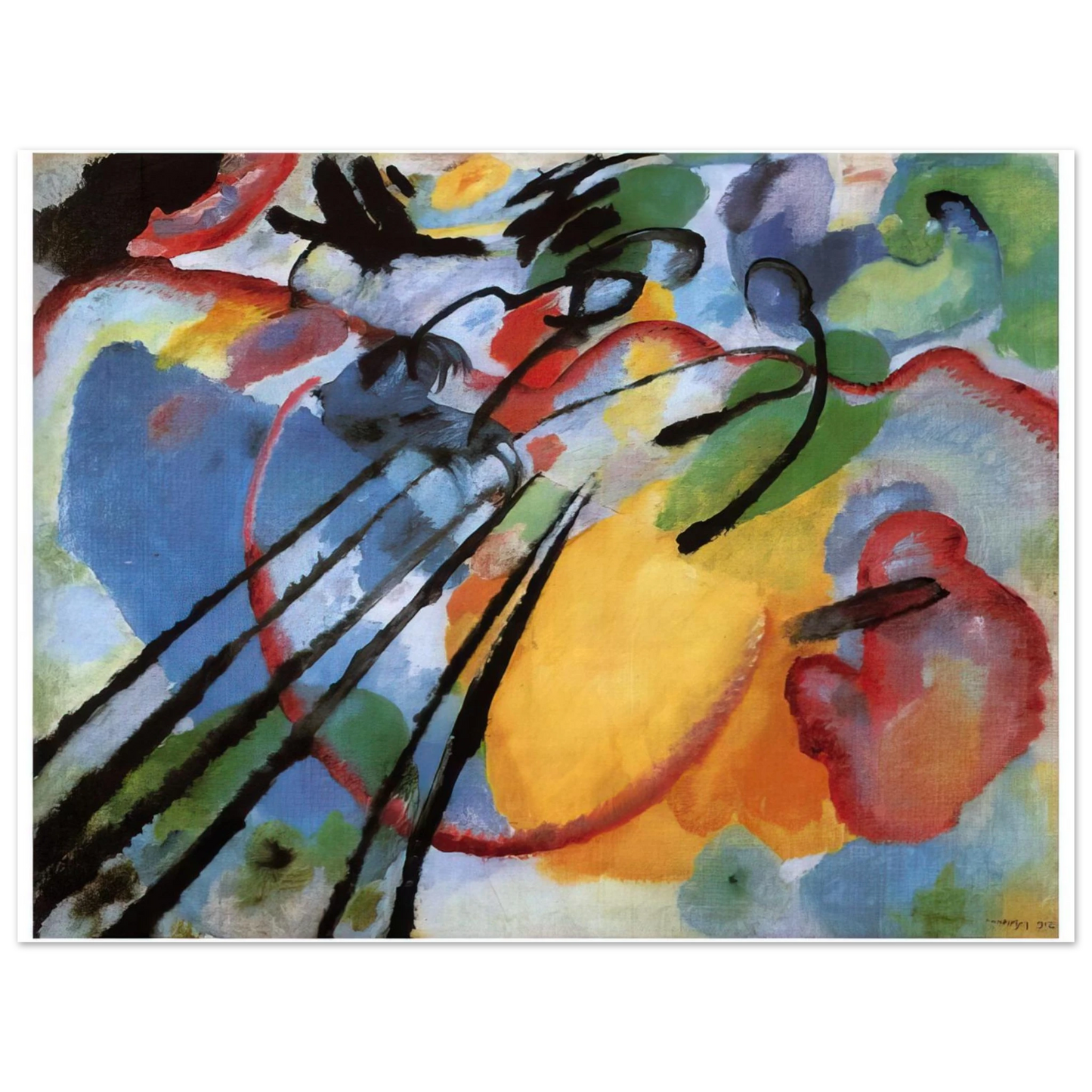
What is the historical significance of Wassily Kandinsky's IMPROVISATION 26 ROWING?
Created in 1912, this artwork is part of Kandinsky's groundbreaking Improvisation series, which marked his transition toward pure abstraction in the Expressionist movement, emphasizing emotional and spiritual expression through color and form.
How does the paper quality ensure this is a museum-quality reproduction?
Our Master's Edition archival paper features a matte, uncoated finish on natural white stock, with acid-free properties (pH above 7) to prevent yellowing, offering a luxurious texture akin to fine art originals.
What are the exact dimensions and materials of this fine art print?
This print measures 75x100 cm (30x40 inches) and is produced on FSC-certified, 250 gsm (110 lb) paper with a thickness of 0.29 mm (11.4 mils) for durability and premium feel.
How is the print shipped and is there a minimum order requirement?
We offer on-demand printing with no minimum orders, and each piece is carefully packaged and shipped directly to ensure it arrives in pristine condition for your home or office.
What makes this print archival and long-lasting?
Using acid-free, pH-balanced paper and sustainable FSC-certified materials, this reproduction is designed to resist fading and deterioration, preserving its vibrant colors for decades.
Can you explain the symbolism in IMPROVISATION 26 ROWING?
Kandinsky used geometric shapes and bold colors in this piece to symbolize rhythmic motion and spiritual harmony, drawing inspiration from music to create an abstract visual symphony.
Why did Kandinsky choose the title "IMPROVISATION 26 ROWING" for this artwork?
The title reflects Kandinsky's musical analogy, with "Improvisation" indicating spontaneous creation and "Rowing" suggesting fluid, repetitive movement, mirroring the compositional flow in his abstract style.