

Discover Unlimited Art Possibilities
At RedKalion, you can find virtually any artwork from any artist, available in a wide range of sizes to perfectly match your space.
If you didn’t find what you’re looking for, contact us at support@redkalion.com . We will source any artwork and produce it in any size and format you need, including art prints, posters, canvas, framed pieces, framed canvas, and more.
For dedicated art enthusiasts, we also offer handcrafted replicas of any artwork, carefully painted by highly skilled artists using traditional techniques.
For custom requests, contact us at support@redkalion.com .
What material is used for this Edward Hopper print?
The artwork is printed on 4mm (0.15") thick acrylic. This material provides a vibrant, depth-filled finish that enhances the light and shadow details of Hopper's work while offering high durability and UV protection.
How do I hang the acrylic wall art?
Each print includes a professional hanging kit with screws. Pre-drilled holes are located at each corner (14mm from the edge), featuring 15mm screw heads for a secure, modern installation.
How is the artwork protected during shipping?
RedKalion uses specialized archival packaging to ensure your Edward Hopper reproduction arrives in pristine condition. We prioritize secure, shock-resistant materials to protect the acrylic surface and corners.
Will the colors in the print fade over time?
No. Our museum-quality reproductions utilize archival-grade inks and UV-resistant acrylic, ensuring the colors remain as vivid and accurate as the day you received them for decades to come.
Why is the background of the print white?
To ensure the highest visual impact and color accuracy of Edward Hopper's palette, any transparent or white areas in the original composition are backed by a solid white layer on the acrylic.
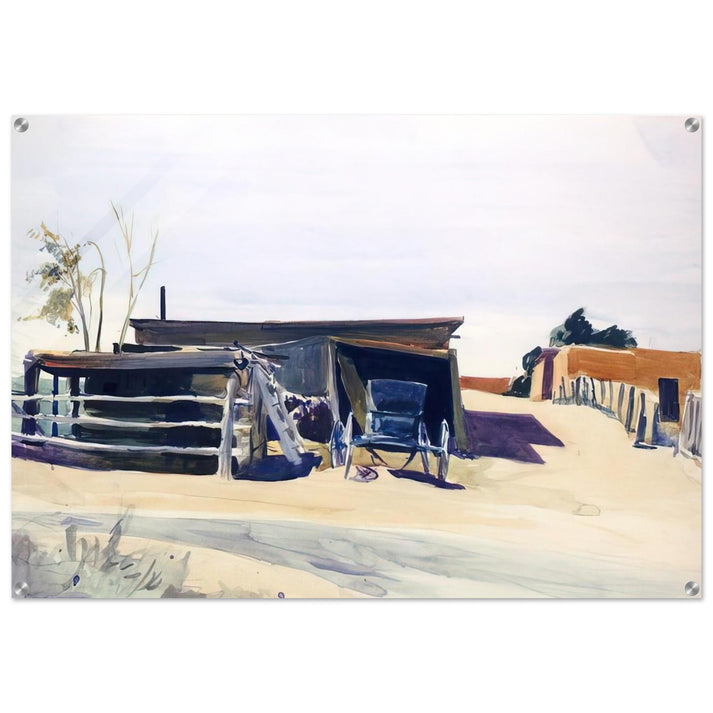
When did Edward Hopper paint Adobes and Shed, New Mexico?
Hopper painted this piece in 1925 during a trip to Santa Fe. It represents his fascination with the clean lines and stark lighting of the Southwest, distinct from his urban themes.
What artistic style does this piece represent?
This work is a quintessential example of American Realism. Hopper uses minimalist architecture and sharp shadows to evoke a sense of quietude and the immense scale of the New Mexican landscape.