

RedKalion
Blue Pot and Bottle of Wine - Paul Cézanne Brushed Aluminum Print - 70x100 cm / 28x40 inches | Paul Cézanne Aluminum Print | Paul Cézanne Prints
Blue Pot and Bottle of Wine - Paul Cézanne Brushed Aluminum Print - 70x100 cm / 28x40 inches | Paul Cézanne Aluminum Print | Paul Cézanne Prints
Couldn't load pickup availability
Elevate Your Space with Cézanne’s Structural Masterpiece
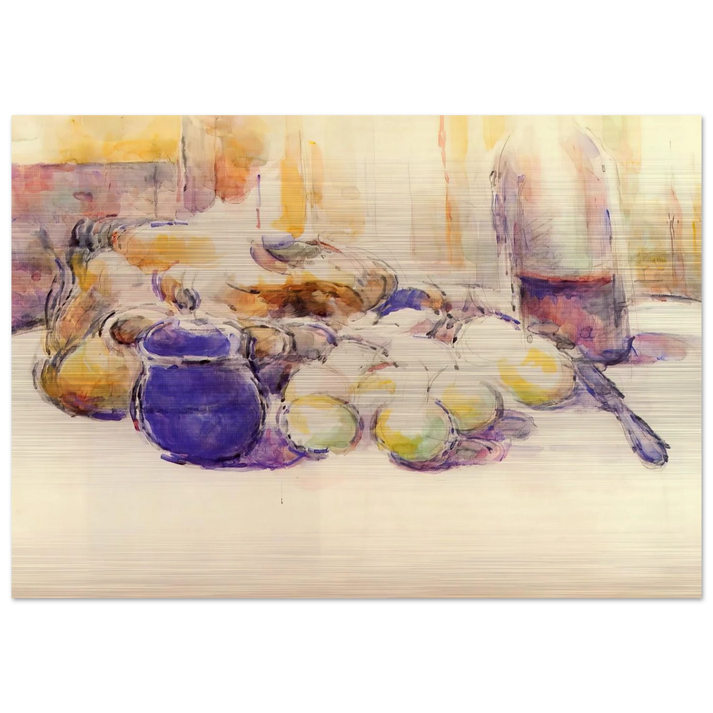
Paul Cézanne’s Blue Pot and Bottle of Wine (Nature morte au pot bleu) stands as a definitive example of Post-Impressionist mastery. This archival fine art print captures the artist's revolutionary approach to still life, where common household objects are transformed into a rigorous study of form and color. By utilizing a museum-quality reproduction process on contemporary media, RedKalion invites you to experience the transition from traditional impressionism to the dawn of modern cubism.
The Artistic Legacy of Paul Cézanne
Often cited as the 'father of modern art,' Cézanne sought to 'treat nature by means of the cylinder, the sphere, the cone.' In this composition, the interplay between the deep cerulean of the pot and the vertical stability of the wine bottle demonstrates his obsession with perspective and structural integrity. This Paul Cézanne print reflects his unique technique of building form through modulated color strokes, a method that would later inspire giants like Picasso and Matisse.
Museum-Grade Materials: Brushed Aluminum DIBOND®
RedKalion brings this historical work into the modern era using Brushed Silver Aluminum DIBOND®. This premium 3mm (0.12") substrate provides a rigid, durable base that complements the industrial elegance of contemporary interiors. The horizontal grain of the aluminum adds a dynamic, shimmering quality to the piece, while the unprinted white areas reveal a sophisticated metallic silver effect that breathes new life into Cézanne’s color palette.
- Matte Finish: A glare-free surface that ensures optimal visibility under any lighting condition.
- Direct Print Technology: High-fidelity reproduction for vivid, lasting colors.
- Sophisticated Aesthetic: The unique metallic texture is particularly striking for the structural shadows and highlights of Cézanne's work.
- Ready to Display: Each print includes a hanging kit tailored to your region for a seamless installation.
By choosing this Paul Cézanne aluminum print, you are investing in an archival-grade reproduction curated by RedKalion, where historical significance meets modern material innovation.


Discover Unlimited Art Possibilities
At RedKalion, you can find virtually any artwork from any artist, available in a wide range of sizes to perfectly match your space.
If you didn’t find what you’re looking for, contact us at support@redkalion.com . We will source any artwork and produce it in any size and format you need, including art prints, posters, canvas, framed pieces, framed canvas, and more.
For dedicated art enthusiasts, we also offer handcrafted replicas of any artwork, carefully painted by highly skilled artists using traditional techniques.
For custom requests, contact us at support@redkalion.com .
What materials are used for this Paul Cézanne print?
This reproduction is printed on 3mm Brushed Silver Aluminum DIBOND®. It features a horizontal grain and a metallic finish that enhances the visual depth of the artwork.
Is the finish of the aluminum print reflective?
The print features a matte, glare-free finish. However, unprinted areas reveal the brushed metallic silver of the aluminum, creating a sophisticated play of light without distracting reflections.
How do I hang my 70x100 cm aluminum print?
Each RedKalion print arrives with an included hanging kit. The specific mounting hardware varies depending on the fulfillment country to ensure the most secure display for your region.
How long will the print last without fading?
Our direct-to-substrate printing process uses archival inks designed for longevity. The durable AluDibond base is highly resistant to environmental factors, ensuring a museum-quality appearance for decades.
What is the shipping process for large-scale art?
We use specialized protective packaging to ensure your 70x100 cm print arrives in pristine condition. Shipping logistics are optimized locally to provide efficient and safe delivery.
What is the historical significance of the 'Blue Pot' in Cézanne's work?
The blue enamel pot was a recurring motif in Cézanne’s studio. It served as a vehicle for his exploration of geometric forms and how light interacts with rounded, industrial surfaces.
Why is Cézanne considered the bridge to Modern Art?
Cézanne rejected traditional single-point perspective, instead using multiple viewpoints and structural color patches. This revolutionary approach directly paved the way for the development of 20th-century Cubism.