RedKalion
18 Colors Cincinnati - Ellsworth Kelly 70x100 cm / 28x40 inches Framed Art Print – Black Wooden Frame
18 Colors Cincinnati - Ellsworth Kelly 70x100 cm / 28x40 inches Framed Art Print – Black Wooden Frame
Couldn't load pickup availability
Elevate Your Space with Ellsworth Kelly’s Geometric Mastery
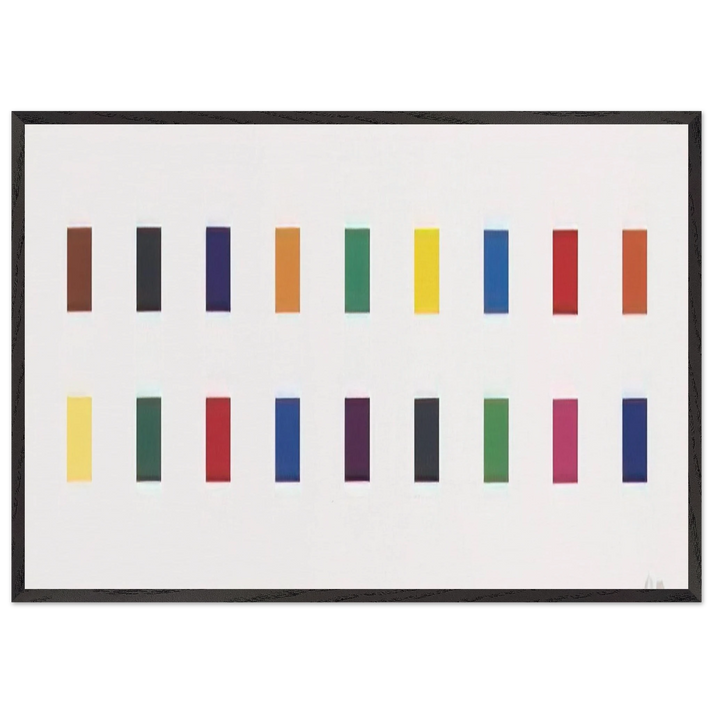
Experience the vibrant precision of 18 Colors Cincinnati, a quintessential representation of Ellsworth Kelly’s contribution to the Hard-edge painting movement. This museum-quality reproduction captures the chromatic rhythm and spatial purity that Kelly mastered throughout his career. Each color panel is presented with absolute clarity, transforming a wall into a dynamic exploration of form and hue.
The Significance of 18 Colors Cincinnati
Originally conceived as a study of color relationships and architectural scale, Kelly’s work often sought to remove the hand of the artist, focusing instead on the 'painting as object.' In this piece, the 18 distinct shades interact to create a sense of movement and balance without a focal point, a hallmark of mid-century minimalist theory. RedKalion is proud to curate this archival-grade Ellsworth Kelly art print, ensuring the integrity of the original spectrum is preserved for the discerning collector.
Premium Craftsmanship and Materials
At RedKalion, we believe fine art deserves a presentation of equal caliber. This 70x100 cm framed print is produced on 250 gsm (110 lb) archival museum-quality paper. The natural white, uncoated matte finish provides a sophisticated, non-reflective surface that enhances color depth without the glare of standard photographic prints. The artwork is housed in a 20mm (0.79") thick frame, crafted from responsibly sourced oak and ash wood, providing a substantial and elegant profile compared to standard retail frames.
- Archival Quality: Printed on FSC-certified, acid-free paper designed to last for generations.
- Robust Framing: A 20mm thick black wooden frame provides a contemporary, high-end gallery aesthetic.
- Protective Glazing: Shatterproof plexiglass ensures the print remains pristine and safe during display.
- Ready-to-Hang: Arrives with a premium hanging kit, allowing for immediate installation.

Discover Unlimited Art Possibilities
At RedKalion, you can find virtually any artwork from any artist, available in a wide range of sizes to perfectly match your space.
If you didn’t find what you’re looking for, contact us at support@redkalion.com . We will source any artwork and produce it in any size and format you need, including art prints, posters, canvas, framed pieces, framed canvas, and more.
For dedicated art enthusiasts, we also offer handcrafted replicas of any artwork, carefully painted by highly skilled artists using traditional techniques.
For custom requests, contact us at support@redkalion.com .
What is the paper quality of the 18 Colors Cincinnati print?
We use 250 gsm (110 lb) archival-grade museum paper. It is a natural white, uncoated, and matte paper with a thickness of 0.29 mm, ensuring high durability and a premium fine-art feel.
Is the frame ready to hang upon delivery?
Yes, each framed art print includes a high-quality hanging kit. The artwork arrives fully assembled in its 20mm oak or ash wood frame, ready to be displayed immediately.
What materials are used for the frame?
Our frames are constructed from responsibly sourced oak and ash wood. They are 20mm (0.79") wide and thick, offering a sturdier and more premium look than traditional 14mm frames.
How is the artwork protected from damage?
Each print is protected by shatterproof, transparent plexiglass. This provides a clear view of the artwork while protecting it from dust, moisture, and accidental impact.
Are the materials used by RedKalion sustainable?
Yes, we prioritize the environment by using FSC-certified paper and wood or equivalent sustainable certifications, ensuring your art collection supports responsible forestry practices.
What does the "18 Colors" represent in Kelly's work?
It represents Kelly’s exploration of the spectrum as a physical object. By organizing 18 precise hues, he removes hierarchy, allowing the viewer to experience color as a pure, autonomous form.
When did Ellsworth Kelly create this series?
This composition is based on Kelly's late-20th-century explorations of color grids, specifically related to his large-scale public commissions that translated geometric abstraction into architectural environments.