

RedKalion
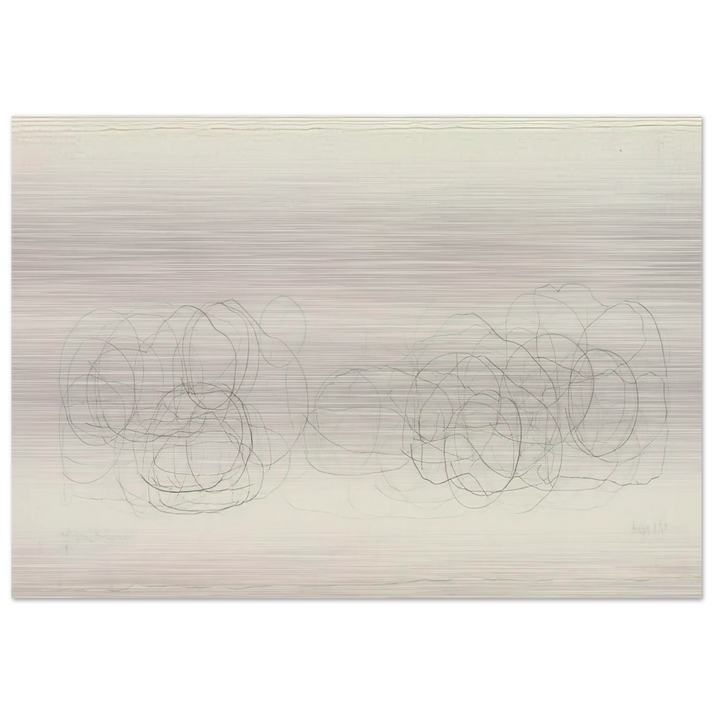
7R15 Where R=Ryoanji - 1983 - John Cage Brushed Aluminum Print - 70x100 cm / 28x40 inches | John Cage Aluminum Print | John Cage Prints
7R15 Where R=Ryoanji - 1983 - John Cage Brushed Aluminum Print - 70x100 cm / 28x40 inches | John Cage Aluminum Print | John Cage Prints
Couldn't load pickup availability
The Convergence of Chance and Zen: John Cage’s 7R15 Where R=Ryoanji
In 1983, the legendary avant-garde composer and philosopher John Cage translated his fascination with Zen Buddhism into the visual realm with the 'Where R=Ryoanji' series. This profound work, 7R15 Where R=Ryoanji, is a meticulous exploration of space, silence, and the beauty of chance. Inspired by the famous rock garden at the Ryoanji Temple in Kyoto, Cage used fifteen stones to trace delicate, overlapping paths across the paper, utilizing the I Ching (the Book of Changes) to determine the placement and orientation of each stroke.
Mastering Minimalism on Brushed Aluminum
This John Cage aluminum print offers a contemporary interpretation of Cage’s minimalist aesthetic. At RedKalion, we believe that high-concept art deserves a high-performance medium. The brushed silver Aluminum DIBOND® substrate provides a sophisticated, rigid base that mirrors the intellectual depth of the original work. The horizontal grain of the metal adds a dynamic layer to the piece; as the light shifts, the unprinted white areas of the design reveal a shimmering metallic silver effect that breathes life into Cage’s sparse compositions.
Museum-Grade Specifications for the Discerning Collector
RedKalion’s archival-grade reproductions are designed to endure. This piece is printed using high-resolution direct printing techniques, ensuring vivid contrasts and a matte, glare-free finish that allows the intricacies of the 1983 series to shine without distraction. Elevate your space with an archival masterpiece that bridges the gap between historical significance and modern industrial design.
- Material: 3mm (0.12") Brushed silver Aluminum DIBOND® with a metallic finish.
- Texture: Distinct horizontal grain for a dynamic, refractive appearance.
- Durability: Highly rigid and durable, ideal for oversized display (70x100 cm).
- Finish: Matte, glare-free, and UV-resistant for long-term preservation.
- Mounting: A premium hanging kit is included, tailored to your fulfillment region.


Discover Unlimited Art Possibilities
At RedKalion, you can find virtually any artwork from any artist, available in a wide range of sizes to perfectly match your space.
If you didn’t find what you’re looking for, contact us at support@redkalion.com . We will source any artwork and produce it in any size and format you need, including art prints, posters, canvas, framed pieces, framed canvas, and more.
For dedicated art enthusiasts, we also offer handcrafted replicas of any artwork, carefully painted by highly skilled artists using traditional techniques.
For custom requests, contact us at support@redkalion.com .
What defines the 7R15 Where R=Ryoanji print quality?
RedKalion uses premium 3mm Aluminum DIBOND® for this John Cage reproduction. The direct-print method ensures vivid colors and a glare-free matte finish, capturing the fine-line detail of the 1983 series with museum-quality precision.
How does the brushed aluminum finish enhance John Cage's artwork?
The brushed silver aluminum grain creates a metallic effect in white areas. This complements Cage’s minimalist aesthetic, adding a sense of modern texture and light-play that traditional paper cannot replicate.
Is the hanging hardware included with my order?
Yes, every John Cage aluminum print comes with a specialized hanging kit. The specific hardware varies by country to ensure it meets local safety and installation standards for a 70x100 cm print.
How does RedKalion ensure the archival longevity of the print?
We use archival-grade inks and UV-resistant coatings on rigid Aluminum DIBOND®. This prevents warping, yellowing, or fading, ensuring your investment remains a centerpiece for decades.
What is the turnaround time for shipping to my location?
We utilize a global network of specialized art fulfillment centers. Most prints are produced within 3-5 business days and shipped via tracked premium couriers to ensure safe, timely arrival.
What is the significance of the title 'Where R=Ryoanji'?
The 'R' stands for Ryoanji, a Zen temple in Kyoto. Cage's title refers to his process of tracing 15 stones (the number of stones in the temple garden) using chance operations to determine their location.
How did John Cage use chance operations in this 1983 series?
Cage employed the I Ching to decide how many times a stone was traced and where it was placed on the paper, removing his ego from the artistic process to allow nature and chance to lead.