RedKalion
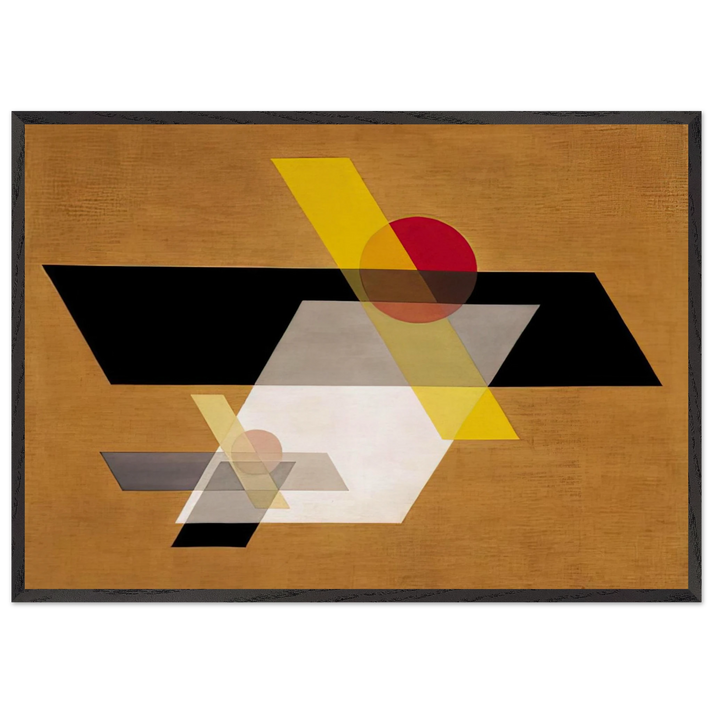
A II - Laszlo Moholy-Nagy 70x100 cm / 28x40 inches Framed Art Print – Black Wooden Frame
A II - Laszlo Moholy-Nagy 70x100 cm / 28x40 inches Framed Art Print – Black Wooden Frame
Couldn't load pickup availability
A II: Laszlo Moholy-Nagy's Bauhaus Masterpiece
Step into the avant-garde world of the Bauhaus with Laszlo Moholy-Nagy's 'A II' (1924). This seminal work of Constructivism explores the 'New Vision'—a philosophy where light, space, and transparency redefine our perception of the modern world. Moholy-Nagy, a visionary professor at the Bauhaus, utilized geometric precision and overlapping forms to create a sense of depth that was revolutionary for its time. This museum-quality reproduction captures the delicate balance of intersecting planes and industrial-inspired tones that characterize his most influential period.
Archival Quality for the Modern Collector
At RedKalion, we bridge the gap between historical significance and contemporary interior design. This framed fine art print is produced on 250 gsm (110 lb) natural white museum-quality paper. The archival, acid-free nature of the paper ensures that the subtle gradients and sharp edges of Moholy-Nagy’s geometry remain vibrant for generations. The matte, uncoated finish prevents glare, allowing the viewer to appreciate the intricate interplay of light and form from any angle.
Exquisite Craftsmanship & Sustainability
To complement this modernist icon, we have selected a premium black wooden frame made from responsibly sourced oak and ash. Measuring 20mm (0.79") wide and thick, this profile provides a more substantial and luxurious presence than standard gallery frames. Each piece is protected by shatterproof plexiglass, ensuring the safety of your investment while maintaining crystal-clear visibility. Your artwork arrives ready-to-hang with a professional hanging kit included, allowing you to elevate your space with a masterpiece of 20th-century design immediately upon delivery.

Discover Unlimited Art Possibilities
At RedKalion, you can find virtually any artwork from any artist, available in a wide range of sizes to perfectly match your space.
If you didn’t find what you’re looking for, contact us at support@redkalion.com . We will source any artwork and produce it in any size and format you need, including art prints, posters, canvas, framed pieces, framed canvas, and more.
For dedicated art enthusiasts, we also offer handcrafted replicas of any artwork, carefully painted by highly skilled artists using traditional techniques.
For custom requests, contact us at support@redkalion.com .
What materials are used for the frame of this Laszlo Moholy-Nagy print?
The frame is crafted from responsibly sourced, FSC-certified oak and ash wood. It features a sophisticated black finish and measures 20mm in width and thickness, providing a premium, durable border for the artwork.
Is the paper archival and museum-quality?
Yes. We use 250 gsm (110 lb) archival museum-quality paper. It is natural white, uncoated, and acid-free, ensuring the 'A II' print retains its color integrity and resists yellowing over time.
Will my artwork arrive ready to hang?
Absolutely. Every framed print from RedKalion includes a professional-grade hanging kit. The piece is fully assembled and ready to be mounted on your wall immediately upon arrival.
How is the fine art print protected during shipping and on the wall?
We use high-quality, shatterproof plexiglass to protect the print. This material provides the clarity of glass without the risk of breaking, ensuring your Laszlo Moholy-Nagy reproduction stays safe during transit and in your home.
Are the materials used in this product sustainable?
Yes. RedKalion is committed to sustainability. We use FSC-certified wood for our frames and paper that meets or exceeds equivalent environmental standards for responsible forestry.
What does the title 'A II' signify in Moholy-Nagy's work?
Moholy-Nagy used an alphanumeric system to title his abstract experiments. 'A' typically referred to his paintings on canvas, while the Roman numeral identified the specific study within his exploration of light and space.
How does this piece reflect the Bauhaus movement?
'A II' embodies the Bauhaus ethos of 'Art and Technology: A New Unity.' It emphasizes geometric abstraction, industrial aesthetics, and the use of transparency to create a sense of three-dimensional space on a flat surface.