

RedKalion
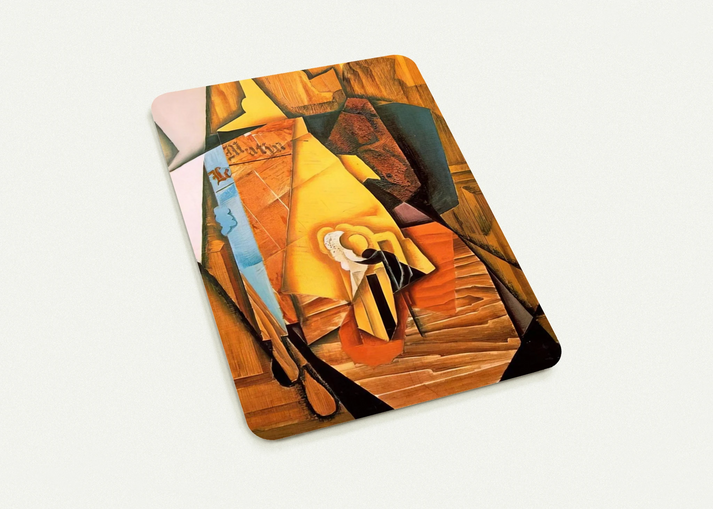
A MAN IN A CAFE 1914 By Juan Gris Pack of 10 Post Cards | Juan Gris Post Cards | A6 (10.5 x 14.8 cm) - 4.1 x 5.8 inches
A MAN IN A CAFE 1914 By Juan Gris Pack of 10 Post Cards | Juan Gris Post Cards | A6 (10.5 x 14.8 cm) - 4.1 x 5.8 inches
Couldn't load pickup availability
Elevate Your Correspondence with Juan Gris’s Cubist Masterpiece
Immerse your recipients in the intellectual rigor of Synthetic Cubism with this exclusive pack of 10 fine art postcards featuring A Man in a Café (1914) by Juan Gris. Known as the 'Third Musketeer' of Cubism alongside Picasso and Braque, Gris brought a unique mathematical precision and vibrant palette to the movement. This 1914 composition is a definitive example of his ability to deconstruct reality into a sophisticated architecture of form and texture.
At RedKalion, we believe that even the smallest formats deserve museum-quality execution. These premium postcards are produced using our state-of-the-art 12-color fine art printing technology. Unlike standard 4-color commercial prints, our process captures the subtle tonal shifts and intricate details of Gris’s original oil on canvas, ensuring that each card serves as a miniature archival reproduction.
Technical Excellence & Sustainable Luxury
Every postcard is printed on heavyweight 200 gsm (80 lb) FSC-certified paper, offering a substantial, premium feel that reflects our commitment to environmental responsibility. The smooth matte finish eliminates glare, allowing the complex geometric layers of the artwork to be appreciated under any lighting condition. Whether used for thoughtful personal notes or as a curated set of miniature wall art, these cards represent the pinnacle of archival-grade stationery.
- Artist: Juan Gris (1887–1927)
- Title: A Man in a Café (1914)
- Format: Flat Postcard Pack (10 units)
- Print Quality: Ultra-High-Definition 12-color pigment-based inks
- Paper: 200 gsm (80 lb) with a matte, non-reflective surface
- Sustainability: Printed on demand using FSC-certified materials


Discover Unlimited Art Possibilities
At RedKalion, you can find virtually any artwork from any artist, available in a wide range of sizes to perfectly match your space.
If you didn’t find what you’re looking for, contact us at support@redkalion.com . We will source any artwork and produce it in any size and format you need, including art prints, posters, canvas, framed pieces, framed canvas, and more.
For dedicated art enthusiasts, we also offer handcrafted replicas of any artwork, carefully painted by highly skilled artists using traditional techniques.
For custom requests, contact us at support@redkalion.com .
What makes the printing quality of these Juan Gris postcards unique?
We use 12-color fine art printing technology, which offers superior color vibrancy and depth compared to standard 4-color prints, accurately capturing the nuances of Gris's Cubist palette.
What type of paper is used for this postcard set?
These cards are printed on 200 gsm (80 lb) FSC-certified paper with a thickness of 0.26 mm, featuring a smooth matte finish for a sophisticated, glare-free display.
How long will these archival prints last without fading?
By utilizing pigment-based inks and archival-grade, acid-free paper, these postcards are designed to resist fading and maintain their integrity for decades when kept out of direct sunlight.
Is the packaging and paper environmentally friendly?
Yes, we use FSC-certified paper from responsibly managed forests and print every order on demand to minimize waste and reduce our environmental footprint.
What are the shipping logistics for these fine art postcards?
Orders are printed on demand and typically ship within 2-4 business days. We provide tracked shipping to ensure your museum-quality reproductions arrive in perfect condition.
Why is 'A Man in a Café (1914)' significant in art history?
Created at the height of Synthetic Cubism, this piece showcases Gris's 'mathematical' approach to art, using interlocking planes and textures to redefine the relationship between object and space.
How does Juan Gris’s style differ from Picasso’s Cubism?
While Picasso often focused on spontaneous deconstruction, Juan Gris was more systematic and architectural, often utilizing bolder colors and a more structured, 'crystalline' aesthetic in his compositions.