RedKalion
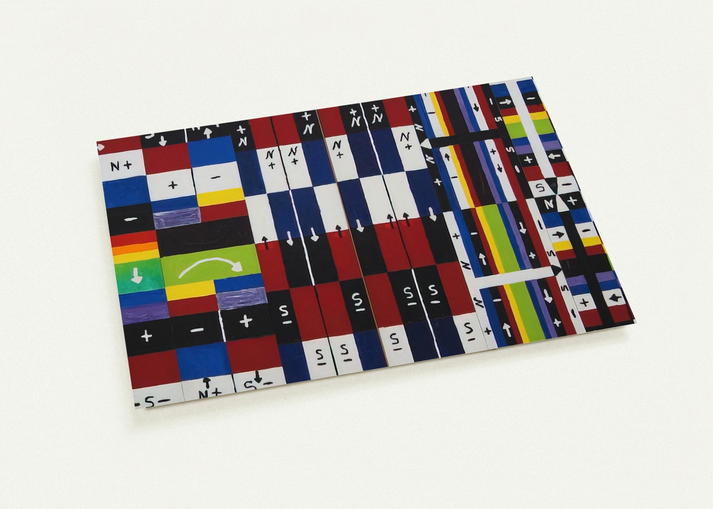
A World in Itself - 1961 By Alfred Jensen Pack of 10 Post Cards | Alfred Jensen Post Cards | A6 (10.5 x 14.8 cm) - 4.1 x 5.8 inches
A World in Itself - 1961 By Alfred Jensen Pack of 10 Post Cards | Alfred Jensen Post Cards | A6 (10.5 x 14.8 cm) - 4.1 x 5.8 inches
Couldn't load pickup availability
Elevate Your Correspondence with Alfred Jensen’s Visionary Geometry
Experience the profound intersection of mathematics, philosophy, and abstract expressionism with this exclusive pack of 10 post cards featuring A World in Itself (1961) by Alfred Jensen. A seminal figure in 20th-century conceptual art, Jensen’s work transcends traditional abstraction, utilizing complex numerical systems and ancient calendrical logic to map the cosmic order. A World in Itself is a masterclass in his 'Systemic Painting' style, where vibrant, impasto-inspired colors meet the rigid discipline of the grid.
Museum-Quality Reproductions for the Discerning Collector
At RedKalion, we believe fine art should be felt as much as seen. These A6 postcards are crafted using 12-color fine art printing technology, ensuring that Jensen’s specific palette—rooted in Goethe’s color theory—is rendered with breathtaking accuracy and depth. Unlike standard commercial printing, our process captures the intricate nuances and structural density of the original 1961 masterpiece.
- Exceptional Material: Printed on premium 200 gsm (80 lb) FSC-certified paper, providing a substantial, luxurious feel.
- Sophisticated Finish: A smooth matte coating eliminates glare, allowing the complex geometric patterns to remain visible from any angle.
- Archival Integrity: With a thickness of 0.26 mm (10.3 mils), these cards are designed to endure, whether they are sent through the mail or displayed in a curated gallery wall.
- Eco-Conscious Curation: Each pack is printed on demand, minimizing waste and supporting sustainable production practices.
Whether you are a scholar of the Abstract Expressionist movement or a collector of modernist aesthetics, these Alfred Jensen post cards offer a tactile connection to a world of mathematical beauty. Transform a simple message into a piece of art history that resonates with intellectual and visual power.

Discover Unlimited Art Possibilities
At RedKalion, you can find virtually any artwork from any artist, available in a wide range of sizes to perfectly match your space.
If you didn’t find what you’re looking for, contact us at support@redkalion.com . We will source any artwork and produce it in any size and format you need, including art prints, posters, canvas, framed pieces, framed canvas, and more.
For dedicated art enthusiasts, we also offer handcrafted replicas of any artwork, carefully painted by highly skilled artists using traditional techniques.
For custom requests, contact us at support@redkalion.com .
What are the dimensions of these Alfred Jensen postcards?
Each card in this pack of 10 is A6 size, measuring 10.5 x 14.8 cm (4.1 x 5.8 inches), making them perfect for standard mailing or small-format framing.
What type of printing technology is used for this fine art reproduction?
We utilize advanced 12-color fine art printing technology. This ensures superior color vibrancy and depth compared to the standard 4-color processes used in typical postcards.
Is the paper used for these postcards environmentally sustainable?
Yes, RedKalion uses FSC-certified paper, ensuring that your fine art prints are produced using responsibly sourced, environmentally conscious materials.
Can I use these postcards for framing as well as mailing?
Absolutely. Given the museum-quality 200 gsm paper and 12-color print depth, these cards serve as excellent miniature art prints for home or office decor.
How does the archival quality of these prints compare to standard postcards?
These cards feature archival-grade inks and a heavy 200 gsm weight, providing significantly higher durability and fade resistance than standard commercial postcards.
What is the significance of the mathematical grids in Alfred Jensen’s "A World in Itself"?
Jensen used grids to represent cosmic systems, integrating Mayan calendars and Pythagorean geometry to create a visual language that bridges ancient logic and modern abstraction.
Why is "A World in Itself" considered a cornerstone of Jensen's 1961 period?
1961 was a pivotal year where Jensen fully synthesized his numerical diagrams with bold color, marking his transition into the highly structured, systemic style he is famous for.