

RedKalion
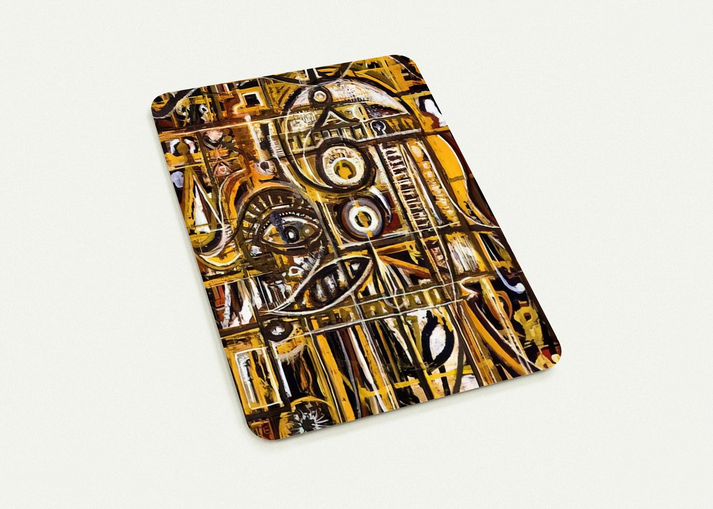
Abstract Eye - 1943 By Richard Pousette-Dart Pack of 10 Post Cards | Richard Pousette-Dart Post Cards | A6 (10.5 x 14.8 cm) - 4.1 x 5.8 inches
Abstract Eye - 1943 By Richard Pousette-Dart Pack of 10 Post Cards | Richard Pousette-Dart Post Cards | A6 (10.5 x 14.8 cm) - 4.1 x 5.8 inches
Couldn't load pickup availability
Richard Pousette-Dart: Abstract Eye (1943) — A Visionary Masterpiece in Miniature
Elevate your correspondence with this exclusive set of ten museum-quality postcards featuring Richard Pousette-Dart’s 'Abstract Eye' (1943). A founding member of the New York School, Pousette-Dart was a pioneer of Abstract Expressionism whose early works are celebrated for their intricate, biomorphic forms and spiritual depth. 'Abstract Eye' captures the artist's fascination with metaphysical vision, rendered here through RedKalion’s superior reproduction standards.
As a premier gallery, RedKalion ensures that each fine art print retains the integrity of the original canvas. While standard postcards use basic 4-color processes, our 12-color fine art printing technology captures the nuanced layers and complex textures of Pousette-Dart’s 1943 vision with stunning color vibrancy and depth. Printed on premium 200 gsm (80 lb) FSC-certified paper, these cards offer a substantial, professional feel with a sophisticated smooth matte finish that eliminates glare and enhances tactile quality.
Product Specifications & Artistry
- Museum-Quality Reproduction: Every pack contains 10 flat postcards (A6: 10.5 x 14.8 cm / 4.1 x 5.8 inches).
- Archival Durability: Printed on 0.26 mm (10.3 mils) thick paper, designed to endure as a keepsake or a framed miniature.
- Elite Printing Technology: We utilize advanced 12-color inkjet systems for unmatched tonal accuracy and archival longevity.
- Eco-Conscious Standards: Produced on demand using FSC-certified materials to minimize environmental impact.
By choosing a RedKalion reproduction, you are acquiring a piece curated by experts. Richard Pousette-Dart’s work often focused on the 'inner eye,' and this 1943 composition serves as a profound example of his early rhythmic layering. These postcards allow you to share a fragment of art history, transforming simple messages into an archival experience that resonates with sophistication and expertise.


Discover Unlimited Art Possibilities
At RedKalion, you can find virtually any artwork from any artist, available in a wide range of sizes to perfectly match your space.
If you didn’t find what you’re looking for, contact us at support@redkalion.com . We will source any artwork and produce it in any size and format you need, including art prints, posters, canvas, framed pieces, framed canvas, and more.
For dedicated art enthusiasts, we also offer handcrafted replicas of any artwork, carefully painted by highly skilled artists using traditional techniques.
For custom requests, contact us at support@redkalion.com .
What makes the print quality of these Richard Pousette-Dart postcards unique?
RedKalion uses 12-color fine art printing technology, which provides significantly greater color depth and tonal accuracy than standard 4-color prints. This ensures that 'Abstract Eye' (1943) is reproduced with museum-quality precision.
What are the physical dimensions and paper specifications of the postcards?
These A6 postcards measure 10.5 x 14.8 cm (4.1 x 5.8 inches). They are printed on 200 gsm (80 lb) FSC-certified paper with a thickness of 0.26 mm, featuring a smooth matte finish.
Is the paper used for these art prints environmentally sustainable?
Yes, all our prints utilize FSC-certified paper, ensuring that the materials are sourced from responsibly managed forests. Our print-on-demand model further reduces waste by eliminating overproduction.
How durable are these postcards for shipping or framing?
Designed as archival-grade reproductions, the 200 gsm paper weight provides excellent rigidity. The 12-color inks are resistant to fading, making them suitable for both traditional mailing and long-term display in frames.
Can I order these postcards individually or in different sizes?
This specific set comes as a pack of 10 postcards. However, RedKalion offers the 'Abstract Eye' (1943) in various larger fine art print sizes to suit your specific interior design needs.
What is the historical significance of the 'eye' motif in Pousette-Dart's 1943 work?
In 1943, Pousette-Dart used the eye to symbolize 'the inner eye' or metaphysical vision. It represents a transition in Abstract Expressionism toward exploring spiritual consciousness and cosmic interconnectedness through biomorphic shapes.
How does Pousette-Dart’s technique differ from other Abstract Expressionists?
Unlike the 'action painting' of Pollock, Pousette-Dart focused on dense, obsessive layering and intricate detail. His work often possesses a tactile, jewel-like quality that explores the relationship between light and solid form.