RedKalion
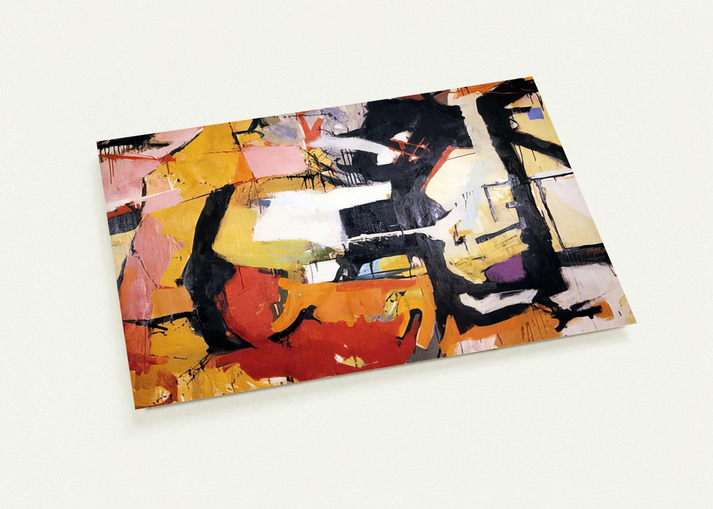
ABSTRACT FORCE HOMAGE TO FRANZ KLINE 1952 By Audrey Flack Pack of 10 Post Cards | Audrey Flack Post Cards | A6 (10.5 x 14.8 cm) - 4.1 x 5.8 inches
ABSTRACT FORCE HOMAGE TO FRANZ KLINE 1952 By Audrey Flack Pack of 10 Post Cards | Audrey Flack Post Cards | A6 (10.5 x 14.8 cm) - 4.1 x 5.8 inches
Couldn't load pickup availability
Abstract Force: Homage to Franz Kline (1952) by Audrey Flack – A Masterpiece in Miniature
Experience the raw, gestural energy of the New York School with this exquisite pack of 10 postcards featuring Audrey Flack's 'Abstract Force: Homage to Franz Kline' (1952). Before becoming a pioneer of Photorealism, Flack was a formidable voice in the Abstract Expressionist movement. This specific work serves as a powerful dialogue with Franz Kline’s monumental style, capturing the tension between stark forms and emotional velocity.
Museum-Quality Reproductions for the Discerning Collector
At RedKalion, we believe that fine art should be accessible without compromising on technical excellence. These A6 flat postcards are produced using our proprietary 12-color fine art printing technology. Unlike standard 4-color commercial prints, our process ensures that the deep blacks and subtle tonal shifts of Flack’s brushwork are rendered with stunning depth and accuracy.
Premium Material Specifications
Each card in this set is crafted to endure, meeting archival standards that satisfy both the aesthetic and tactile senses:
- Paper Weight: A substantial 200 gsm (80 lb) stock, providing a premium, rigid feel.
- Finishing: A sophisticated smooth matte finish that eliminates glare, allowing the abstract composition to be viewed clearly from any angle.
- Sustainability: Printed on FSC-certified paper, reflecting our commitment to environmental responsibility.
- Dimensions: Standard A6 size (10.5 x 14.8 cm), perfect for framing as a mini-gallery or sending a sophisticated sentiment.
Whether you are a scholar of mid-century American art or a collector of contemporary masterpieces, this Audrey Flack set offers a rare glimpse into the formative years of a legend. Elevate your correspondence or your home office with a curation of archival-grade reproductions that embody the spirit of the avant-garde.

Discover Unlimited Art Possibilities
At RedKalion, you can find virtually any artwork from any artist, available in a wide range of sizes to perfectly match your space.
If you didn’t find what you’re looking for, contact us at support@redkalion.com . We will source any artwork and produce it in any size and format you need, including art prints, posters, canvas, framed pieces, framed canvas, and more.
For dedicated art enthusiasts, we also offer handcrafted replicas of any artwork, carefully painted by highly skilled artists using traditional techniques.
For custom requests, contact us at support@redkalion.com .
What makes the RedKalion Audrey Flack postcard set unique?
Our Audrey Flack postcards utilize 12-color fine art printing, capturing the nuanced textures and deep contrasts of 'Abstract Force' with far greater fidelity than standard commercial inkjet prints.
What are the technical specifications of the paper?
These postcards are printed on 200 gsm (80 lb) paper with a thickness of 0.26 mm. They feature a smooth matte finish for a sophisticated, glare-free display.
How does the 12-color printing process benefit abstract art?
Abstract art relies on tonal depth. Our 12-color technology provides a wider color gamut and smoother gradients, ensuring the energy of Flack’s brushstrokes is accurately preserved.
Is the paper used for these postcards environmentally friendly?
Yes. We use FSC-certified, environmentally conscious paper for all our fine art reproductions, ensuring your collection supports sustainable forestry practices.
What is the shipping policy for RedKalion fine art prints?
All our items are printed on demand to ensure maximum quality and minimize waste. There are no minimum orders, and we ship globally using protective, archival-safe packaging.
What was Audrey Flack’s inspiration for this 1952 work?
Created during her time at Yale under Josef Albers, this work is a direct tribute to Franz Kline’s gestural abstraction, emphasizing the physical act of painting and structural tension.
Why is this 'Abstract Force' period significant in Flack's career?
This 1952 period showcases Flack's mastery of the New York School style before her shift to Photorealism, making these cards a vital historical document of her artistic evolution.