RedKalion
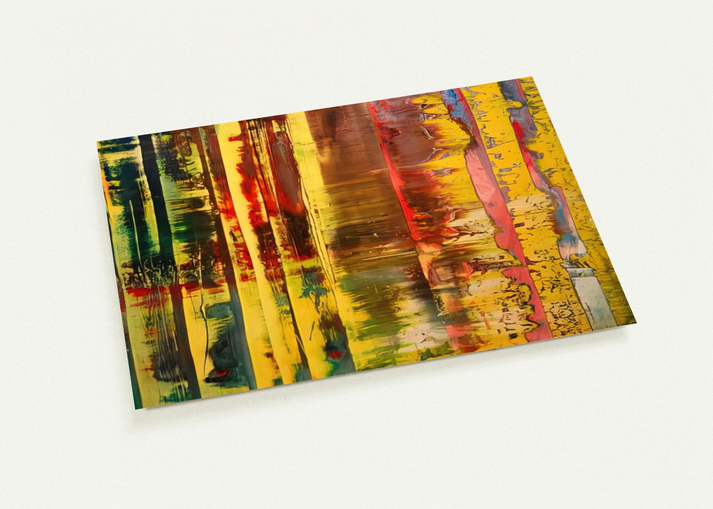
ABSTRACT PAINTING 780 1 1 By Gerhard Richter Pack of 10 Post Cards | Gerhard Richter Post Cards | A6 (10.5 x 14.8 cm) - 4.1 x 5.8 inches
ABSTRACT PAINTING 780 1 1 By Gerhard Richter Pack of 10 Post Cards | Gerhard Richter Post Cards | A6 (10.5 x 14.8 cm) - 4.1 x 5.8 inches
Couldn't load pickup availability
Elevate Your Correspondence with Gerhard Richter’s Abstract Painting 780-1
Experience the profound depth and rhythmic complexity of one of the 20th century’s most influential artists with this exquisite pack of 10 fine art postcards. Abstract Painting 780-1, a seminal work by Gerhard Richter, is reproduced here with uncompromising precision, capturing the vibrant interplay of color and texture that defines his legendary 'Abstraktes Bild' series.
The Mastery of the Squeegee Technique
Created during the pinnacle of his abstract period in the early 1990s, this piece showcases Richter’s revolutionary squeegee method. By layering bold pigments and then dragging a massive wooden squeegee across the surface, Richter creates a dialogue between intention and chance. The result is a multi-dimensional landscape of obscured layers and revealed histories, now captured in a portable, museum-quality format for the discerning collector.
Museum-Grade Technical Specifications
At RedKalion, we believe that even the smallest reproduction should mirror the integrity of the original canvas. These flat postcards are crafted using advanced 12-color fine art printing technology. Unlike standard 4-color commercial prints, our process ensures stunning color vibrancy and nuanced gradients that honor Richter’s complex palette.
- Paper Quality: Printed on substantial 200 gsm (80 lb) archival-grade paper with a thickness of 0.26 mm.
- Finish: A smooth matte finish provides a sophisticated, glare-free aesthetic, perfect for both framing and writing.
- Sustainability: Each card is printed on FSC-certified, environmentally conscious paper, reflecting our commitment to ethical curation.
- Dimensions: Classic A6 format (10.5 x 14.8 cm | 4.1 x 5.8 inches), ideal for personalized notes or a curated wall display.
Whether utilized as a refined sentiment for a fellow art lover or kept as a collective set of miniatures, these Gerhard Richter postcards serve as a testament to archival excellence. Transform a simple message into a lasting encounter with modern art history.

Discover Unlimited Art Possibilities
At RedKalion, you can find virtually any artwork from any artist, available in a wide range of sizes to perfectly match your space.
If you didn’t find what you’re looking for, contact us at support@redkalion.com . We will source any artwork and produce it in any size and format you need, including art prints, posters, canvas, framed pieces, framed canvas, and more.
For dedicated art enthusiasts, we also offer handcrafted replicas of any artwork, carefully painted by highly skilled artists using traditional techniques.
For custom requests, contact us at support@redkalion.com .
What makes the 12-color printing process superior for Richter’s work?
Our 12-color fine art technology captures the subtle tonal shifts and deep pigments of Abstract Painting 780-1. This provides far greater color accuracy and depth than standard 4-color inkjet printers, ensuring a museum-quality reproduction on every postcard.
What are the specific paper characteristics of these postcards?
Each card is printed on 200 gsm (80 lb) paper with a thickness of 0.26 mm. The smooth matte finish eliminates glare, providing a sophisticated texture that is durable and perfect for both archiving and correspondence.
Is the paper used for these art cards environmentally friendly?
Yes. RedKalion prioritizes sustainability by using FSC-certified paper. This ensures that your Gerhard Richter postcards are produced using responsibly sourced materials that meet strict environmental and social standards.
How are the postcards packaged and shipped?
Our postcards are printed on demand to reduce waste and ensure quality. They are carefully packaged as a set of 10 to ensure they arrive in pristine condition, ready for framing or gifting.
Will the colors fade over time?
These are archival-grade reproductions. When kept out of direct high-intensity UV light, our 12-color pigment inks and premium matte paper are designed to resist fading, maintaining their vibrancy for decades.
What is the significance of the '780' numbering in Richter’s work?
Richter uses a chronological numbering system for his oeuvre. '780-1' identifies this specific work within his catalog raisonné, marking it as a key entry in his exploration of systematic abstraction during the 1990s.
What was Richter’s intent with the squeegee technique seen here?
Richter sought to remove the 'artist's hand' from the work. By using a squeegee to scrape paint, he allowed chance, friction, and physical mechanics to create textures that human brushwork could never achieve naturally.