RedKalion
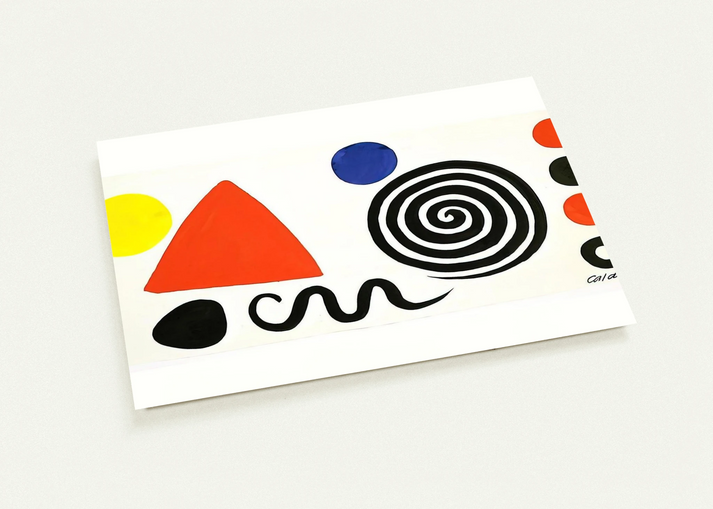
ABSTRACTION 1966 By Alexander Calder Pack of 10 Post Cards | Alexander Calder Post Cards | A6 (10.5 x 14.8 cm) - 4.1 x 5.8 inches
ABSTRACTION 1966 By Alexander Calder Pack of 10 Post Cards | Alexander Calder Post Cards | A6 (10.5 x 14.8 cm) - 4.1 x 5.8 inches
Couldn't load pickup availability
Elevate Your Correspondence with Alexander Calder's Modernist Vision
Experience the dynamic energy of one of the 20th century’s most influential artists with this exquisite pack of 10 postcards featuring Abstraction (1966) by Alexander Calder. This piece captures Calder at the height of his creative powers, translating the kinetic movement of his world-famous mobiles into a static yet vibrant two-dimensional form. At RedKalion, we believe that fine art should be a daily luxury, and these museum-quality reproductions allow you to share the sophisticated joy of mid-century modernism with friends, family, or as a curated addition to your own space.
The Artistry of Alexander Calder
By 1966, Alexander Calder had perfected his unique visual language—a synthesis of biomorphic shapes and bold, primary palettes. Abstraction is a testament to his ability to evoke balance and tension through geometric minimalism. Unlike the rigid structures of his contemporaries, Calder's forms feel organic, as if caught in a momentary pause. As an elite curator of fine art prints, RedKalion presents these postcards as a tribute to Calder’s legacy, ensuring every curve and color field is represented with historical accuracy.
Museum-Grade Specifications
To honor the integrity of Calder's work, we utilize state-of-the-art 12-color fine art printing technology. This process delivers a depth of color and accuracy that standard 4-color commercial prints simply cannot match. Each postcard is rendered on high-density 200 gsm (80 lb) paper with a thickness of 0.26 mm, providing a substantial, premium feel. The smooth matte finish ensures a glare-free viewing experience, allowing the viewer to appreciate the subtle nuances of the composition without distraction. Our commitment to sustainability is reflected in our use of FSC-certified, eco-friendly materials, ensuring your appreciation for art aligns with a respect for the environment.
- Artist: Alexander Calder
- Title: Abstraction (1966)
- Format: Pack of 10 Postcards (A6 - 10.5 x 14.8 cm)
- Finish: Non-reflective smooth matte
- Paper: 200 gsm archival-grade, FSC-certified
- Sustainability: Printed on demand to reduce waste

Discover Unlimited Art Possibilities
At RedKalion, you can find virtually any artwork from any artist, available in a wide range of sizes to perfectly match your space.
If you didn’t find what you’re looking for, contact us at support@redkalion.com . We will source any artwork and produce it in any size and format you need, including art prints, posters, canvas, framed pieces, framed canvas, and more.
For dedicated art enthusiasts, we also offer handcrafted replicas of any artwork, carefully painted by highly skilled artists using traditional techniques.
For custom requests, contact us at support@redkalion.com .
What makes the print quality of these Alexander Calder postcards superior?
RedKalion uses 12-color fine art printing technology rather than standard 4-color inkjet. This ensures incredible color vibrancy and depth, capturing the true essence of Calder’s primary palette in high resolution.
What are the specific physical dimensions and paper weight?
Each postcard is A6 size (10.5 x 14.8 cm / 4.1 x 5.8 inches). They are printed on 200 gsm (80 lb) paper with a thickness of 0.26 mm, offering a sturdy, premium feel.
Are these postcards suitable for framing as miniature art pieces?
Absolutely. The archival-grade 200 gsm paper and glare-free matte finish make them ideal for small frames, allowing you to create a gallery wall of Calder’s iconic 1966 abstractions.
How does RedKalion ensure the longevity of the prints?
We use archival-grade materials and museum-quality inks that resist fading. The FSC-certified paper is chosen for its durability and its ability to maintain color integrity over time.
Is the production process environmentally conscious?
Yes. Our postcards are printed on demand using FSC-certified, eco-friendly materials, which eliminates overproduction and significantly reduces our environmental footprint.
What influenced Alexander Calder's "Abstraction" in 1966?
Calder’s work in the 1960s was influenced by his stabiles—stationary sculptures that maintained the organic, energetic forms of his kinetic mobiles but expressed them through fixed, bold geometry.
Why are primary colors so prevalent in Calder's 1966 works?
Calder favored a palette of black, white, and primary colors to keep the focus on form and balance, preventing complex shading from distracting from the purity of the geometric composition.