


RedKalion
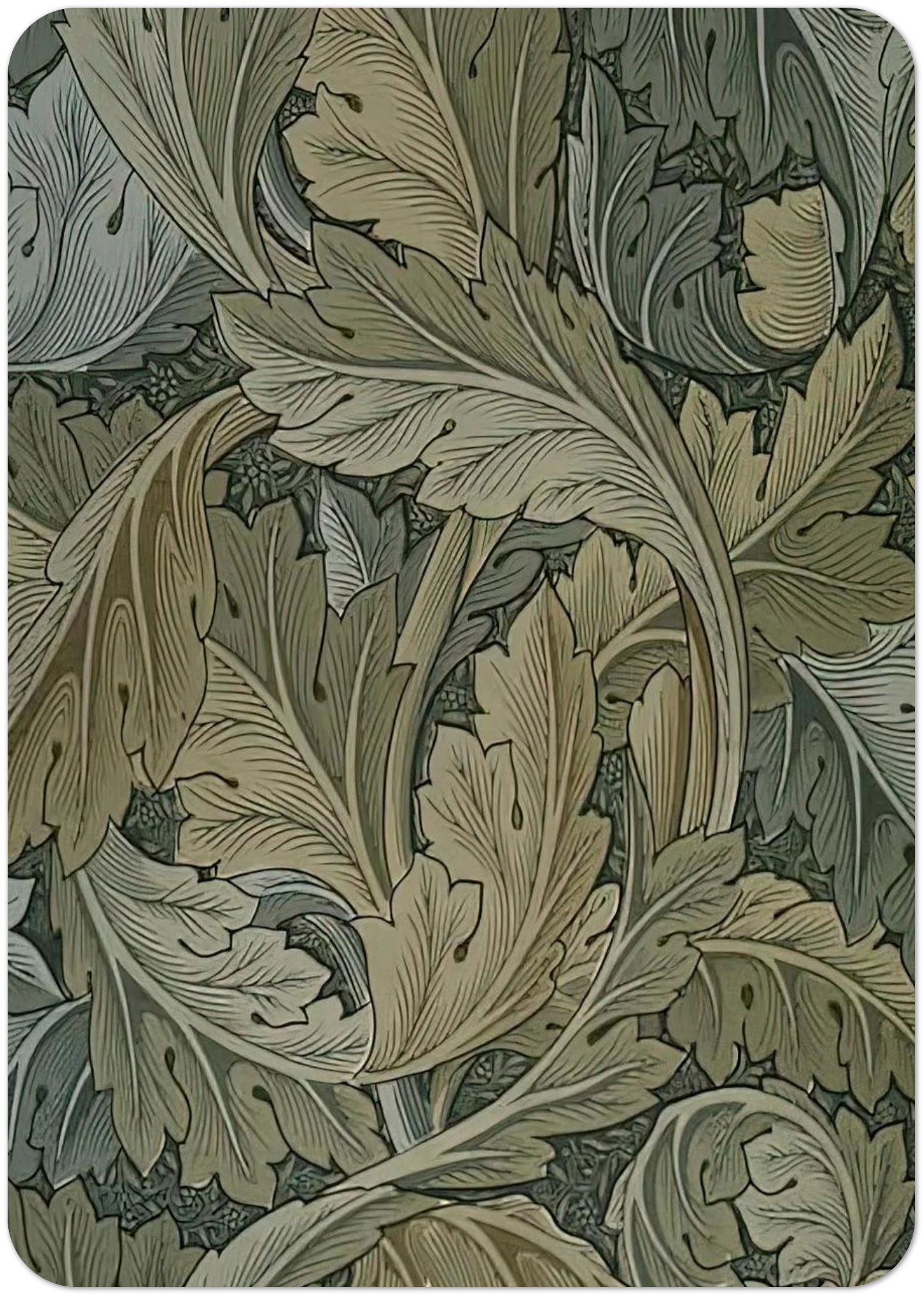
ACANTHUS WALLPAPER 1875 By William Morris Pack of 10 Post Cards | William Morris Post Cards | A6 (10.5 x 14.8 cm) - 4.1 x 5.8 inches
ACANTHUS WALLPAPER 1875 By William Morris Pack of 10 Post Cards | William Morris Post Cards | A6 (10.5 x 14.8 cm) - 4.1 x 5.8 inches
Couldn't load pickup availability
Elevate Your Correspondence with William Morris’s Acanthus Wallpaper (1875)
Experience the timeless elegance of the Arts and Crafts movement with this pack of 10 museum-quality postcards featuring William Morris’s iconic Acanthus Wallpaper (1875). As a cornerstone of Victorian design, the Acanthus pattern represents Morris's mastery of complex, layered botanical forms. These fine art prints capture the scrolling, rhythmic curves of the acanthus leaf—a motif Morris favored for its classic vitality and organic symmetry.
Museum-Grade Quality in Every Detail
At RedKalion, we believe that even the smallest stationery should reflect the integrity of the original masterpiece. Unlike standard commercial reproductions, our William Morris postcards are produced using sophisticated 12-color fine art printing technology. This process ensures a color gamut and depth far superior to common 4-color inkjet methods, preserving the subtle tonal shifts and intricate linework of Morris's 1875 original.
- Paper Weight: Substantial 200 gsm (80 lb) archival-grade stock.
- Paper Finishing: A sophisticated smooth matte finish that eliminates glare and enhances the rich, natural pigments.
- Dimensions: Standard A6 format (10.5 x 14.8 cm / 4.1 x 5.8 inches).
- Eco-Conscious Production: Printed on FSC-certified paper, ensuring your appreciation for beauty aligns with environmental responsibility.
A Legacy of Craftsmanship
William Morris famously advised, "Have nothing in your houses that you do not know to be useful, or believe to be beautiful." These postcards serve both purposes. Whether used for thoughtful correspondence or displayed as a miniature gallery wall, these archival-grade reproductions honor the legacy of RedKalion’s commitment to premium art curation. Each card is a testament to an era where art and utility coexisted in perfect harmony.


Discover Unlimited Art Possibilities
At RedKalion, you can find virtually any artwork from any artist, available in a wide range of sizes to perfectly match your space.
If you didn’t find what you’re looking for, contact us at support@redkalion.com . We will source any artwork and produce it in any size and format you need, including art prints, posters, canvas, framed pieces, framed canvas, and more.
For dedicated art enthusiasts, we also offer handcrafted replicas of any artwork, carefully painted by highly skilled artists using traditional techniques.
For custom requests, contact us at support@redkalion.com .
What printing technology is used for these William Morris postcards?
We utilize advanced 12-color fine art printing technology. This ensures vivid, accurate colors and stunning depth that far exceeds the quality of standard 4-color commercial inkjet printing.
What is the paper quality and finish?
Each card is printed on 200 gsm (80 lb) paper with a thickness of 0.26 mm. The smooth matte finish provides a clean, professional, glare-free surface.
Are these postcards eco-friendly?
Yes. All RedKalion postcards are printed on environmentally conscious, FSC-certified paper, supporting responsible forestry and sustainable production practices.
What is the size of each postcard in this pack?
Each of the 10 postcards is A6 size, measuring exactly 10.5 x 14.8 cm, which is approximately 4.1 x 5.8 inches.
Can I buy just one postcard or is there a minimum order?
This specific product is a curated pack of 10 postcards. We print on demand, ensuring premium quality with no excess waste.
What is the historical significance of the Acanthus design from 1875?
Acanthus is one of Morris’s most complex designs, requiring 30 woodblocks for printing. It represents the height of the Arts and Crafts movement's naturalistic philosophy.
Why did William Morris favor the Acanthus leaf in his designs?
Morris was inspired by the classical Greek motif, using its scrolling curves to create a sense of three-dimensional depth and organic growth within interior spaces.