

RedKalion
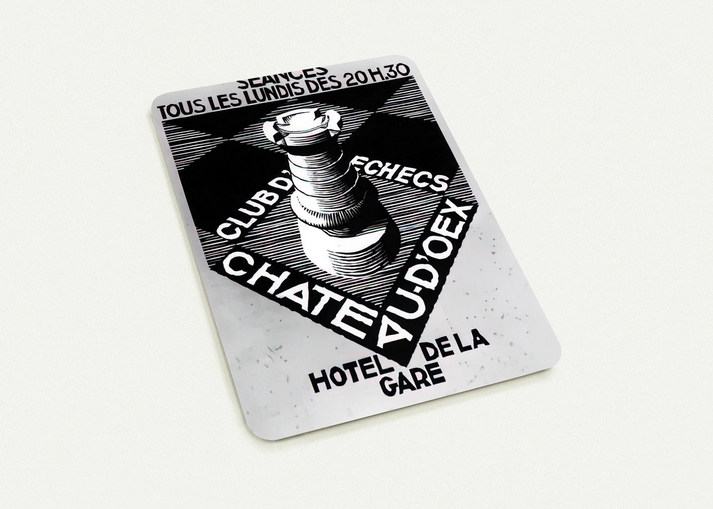
ADVERTISEMENT CHESS CLUB CHATEAU DOEX JULY 1936 1936 By MC Escher Pack of 10 Post Cards | MC Escher Post Cards | A6 (10.5 x 14.8 cm) - 4.1 x 5.8 inches
ADVERTISEMENT CHESS CLUB CHATEAU DOEX JULY 1936 1936 By MC Escher Pack of 10 Post Cards | MC Escher Post Cards | A6 (10.5 x 14.8 cm) - 4.1 x 5.8 inches
Couldn't load pickup availability
An Intersection of Intellect and Art: M.C. Escher’s 1936 Masterpiece
Experience the sophisticated graphic design of M.C. Escher with this exquisite pack of 10 postcards featuring the iconic Advertisement Chess Club Chateau Doex July 1936. Created during a pivotal transition in Escher's career, this work showcases his burgeoning fascination with geometric precision and thematic symmetry. Originally designed as a promotional piece for a chess tournament in the Swiss Alps, the artwork captures the cerebral nature of the game through Escher’s signature architectural clarity and atmospheric depth.
Museum-Quality Reproductions for the Discerning Collector
At RedKalion, we bridge the gap between historical significance and modern craftsmanship. These A6 postcards are not mere stationery; they are museum-quality reproductions printed using state-of-the-art 12-color fine art technology. Unlike standard commercial printing, our process ensures every subtle gradient and charcoal-like texture of Escher’s original vision is preserved with stunning accuracy.
Technical Specifications & Sustainability
- Elite Color Fidelity: Our 12-color printing process delivers a spectrum of depth and vibrancy that standard 4-color inkjets cannot replicate.
- Premium Paper Stock: Printed on heavy-weight 200 gsm (80 lb) paper with a thickness of 0.26 mm (10.3 mils) for a substantial, luxurious feel.
- Elegant Matte Finish: A smooth, glare-free surface ensures the intricate details of the Chess Club Chateau Doex remain the focal point.
- Eco-Conscious Curation: We utilize FSC-certified paper, ensuring your collection is as environmentally responsible as it is beautiful.
Whether you are a scholar of graphic arts or an admirer of mathematical beauty, this pack of 10 postcards allows you to share or display a piece of 20th-century history. Elevate your correspondence with an archival masterpiece that endures.


Discover Unlimited Art Possibilities
At RedKalion, you can find virtually any artwork from any artist, available in a wide range of sizes to perfectly match your space.
If you didn’t find what you’re looking for, contact us at support@redkalion.com . We will source any artwork and produce it in any size and format you need, including art prints, posters, canvas, framed pieces, framed canvas, and more.
For dedicated art enthusiasts, we also offer handcrafted replicas of any artwork, carefully painted by highly skilled artists using traditional techniques.
For custom requests, contact us at support@redkalion.com .
What makes the 12-color printing technology superior for these Escher postcards?
Our 12-color fine art printing provides significantly greater color depth and tonal accuracy compared to standard 4-color prints. This ensures that the complex shades and precise lines in M.C. Escher’s advertisement are reproduced with museum-level fidelity.
What are the exact dimensions and paper weight of this postcard set?
Each postcard is A6 size (10.5 x 14.8 cm / 4.1 x 5.8 inches). They are printed on premium 200 gsm (80 lb) FSC-certified paper with a 0.26 mm thickness, providing a durable, high-quality feel.
Is the paper finish suitable for framing or writing?
Yes. The smooth matte finish is glare-free, making it perfect for display in small frames. The high-quality 200 gsm surface is also ideal for writing, offering a clean, professional aesthetic for personal correspondence.
How does RedKalion handle the production of these fine art prints?
Every order is printed on demand to ensure the highest quality control. We avoid mass-production fatigue, treating every pack of 10 postcards as a bespoke art product for our RedKalion collectors.
Are the materials used for these postcards environmentally friendly?
Absolutely. RedKalion is committed to sustainability. We use FSC-certified paper, which supports responsible forest management, ensuring your fine art collection has a minimal environmental footprint.
What is the historical significance of the 'Chess Club Chateau Doex' piece?
Created in July 1936, this was a commissioned advertisement for a chess tournament in Switzerland. It marks a period where Escher began blending realistic landscapes with the formal, rhythmic structures of graphic design.
Why is this 1936 work important to M.C. Escher’s legacy?
This piece exemplifies Escher’s mastery of lithographic-style textures and his ability to elevate commercial art into the realm of fine art. It remains a coveted example of mid-century graphic intellectualism.