RedKalion
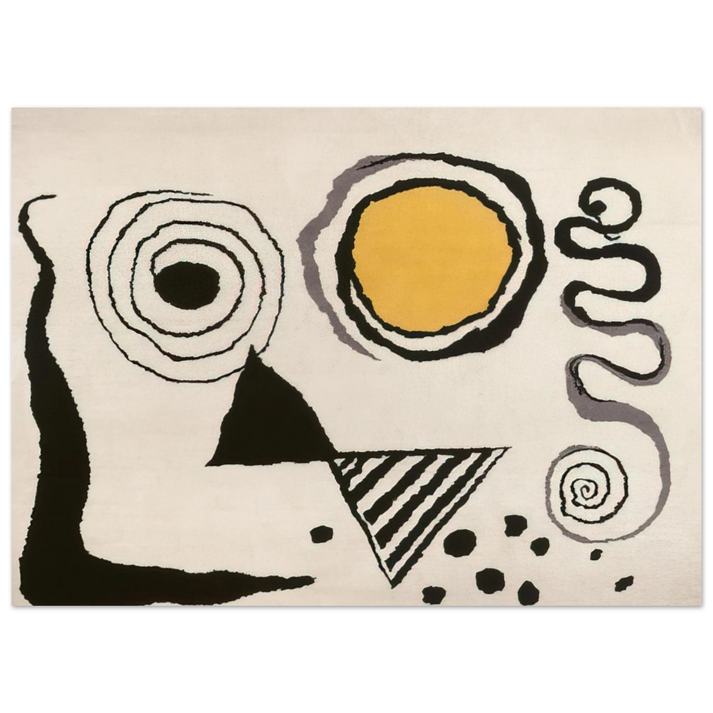
Alexander Calder - CERCLE JAUNE 1953 Fine Art Poster
Alexander Calder - CERCLE JAUNE 1953 Fine Art Poster
Couldn't load pickup availability
Elevate Your Space with Alexander Calder’s Cercle Jaune (1953)
Experience the vibrant energy of 20th-century modernism with this museum-quality reproduction of Alexander Calder’s "Cercle Jaune" (1953). Renowned as the father of kinetic art, Calder masterfully translated the weightless balance of his famous mobiles into two-dimensional form. This fine art poster captures the iconic yellow circle and minimalist geometry that defined Calder’s mid-century aesthetic, offering a timeless sense of movement and spatial harmony for your interior.
Master’s Edition Archival Excellence
At RedKalion, we curate only the finest archival-grade reproductions. This Alexander Calder print is produced on our signature Master’s Edition paper, meticulously chosen to honor the artist's original vision. The natural white (off-white) tone of the paper provides a sophisticated, non-reflective backdrop that allows the bold primary colors to resonate with depth and clarity.
- Paper Weight: Heavyweight 250 gsm (110 lb) for a premium, substantial feel.
- Texture & Finish: A luxurious matte, uncoated finish that eliminates glare and invites touch.
- Archival Longevity: Acid-free (pH above 7) composition to prevent yellowing and ensure the piece remains an enduring masterpiece.
- Sustainable Craftsmanship: Printed on FSC-certified paper, reflecting our commitment to environmental responsibility.
- Superior Thickness: 0.29 mm (11.4 mils) profile, consistent with museum-standard display prints.
Each piece is printed and shipped on demand with no minimum order, ensuring that your museum-quality reproduction arrives in pristine condition, ready to transform your home or office into a gallery of modernist history. Invest in an archival masterpiece that endures.


Discover Unlimited Art Possibilities
At RedKalion, you can find virtually any artwork from any artist, available in a wide range of sizes to perfectly match your space.
If you didn’t find what you’re looking for, contact us at support@redkalion.com . We will source any artwork and produce it in any size and format you need, including art prints, posters, canvas, framed pieces, framed canvas, and more.
For dedicated art enthusiasts, we also offer handcrafted replicas of any artwork, carefully painted by highly skilled artists using traditional techniques.
For custom requests, contact us at support@redkalion.com .
What are the specifications of the paper used for this Alexander Calder print?
We use Master's Edition archival paper, which is a 250 gsm (110 lb) museum-quality medium. It features a matte, uncoated, natural white finish that ensures a luxurious texture and eliminates glare, highlighting every nuance of Calder's 1953 masterpiece.
How long will this museum-quality reproduction last?
Our prints are designed to endure. Using acid-free paper with a pH above 7, the 'Cercle Jaune' fine art poster resists yellowing and degradation over time, maintaining its archival integrity for generations.
Does the print have a shiny or reflective surface?
No, this reproduction features a sophisticated matte finish. The uncoated, natural white paper provides a premium, non-reflective surface that elevates the bold primary colors of Alexander Calder’s work without the distraction of glossy highlights.
Is the production process for this fine art poster sustainable?
Yes, RedKalion is committed to sustainability. We use FSC-certified paper or equivalent certifications depending on regional availability, ensuring that your Alexander Calder print is produced with environmental responsibility in mind.
What is your shipping and order fulfillment process?
We offer on-demand fulfillment with no minimum order requirements. Each Alexander Calder poster is printed specifically for you and shipped in robust packaging to ensure it arrives in pristine, museum-ready condition.
What is the historical context of 'Cercle Jaune' (1953)?
Created in 1953, 'Cercle Jaune' reflects Alexander Calder’s mature exploration of spatial harmony. During this era, Calder translated the kinetic energy of his world-famous mobiles into two-dimensional forms, using primary colors to command visual attention.
Why is 1953 considered a significant year for Alexander Calder?
In 1953, Calder was at the height of his international fame, refining the 'Stabile' and 'Mobile' concepts. His graphic works from this year are prized for their distillation of movement into essential geometric and organic shapes.