
RedKalion
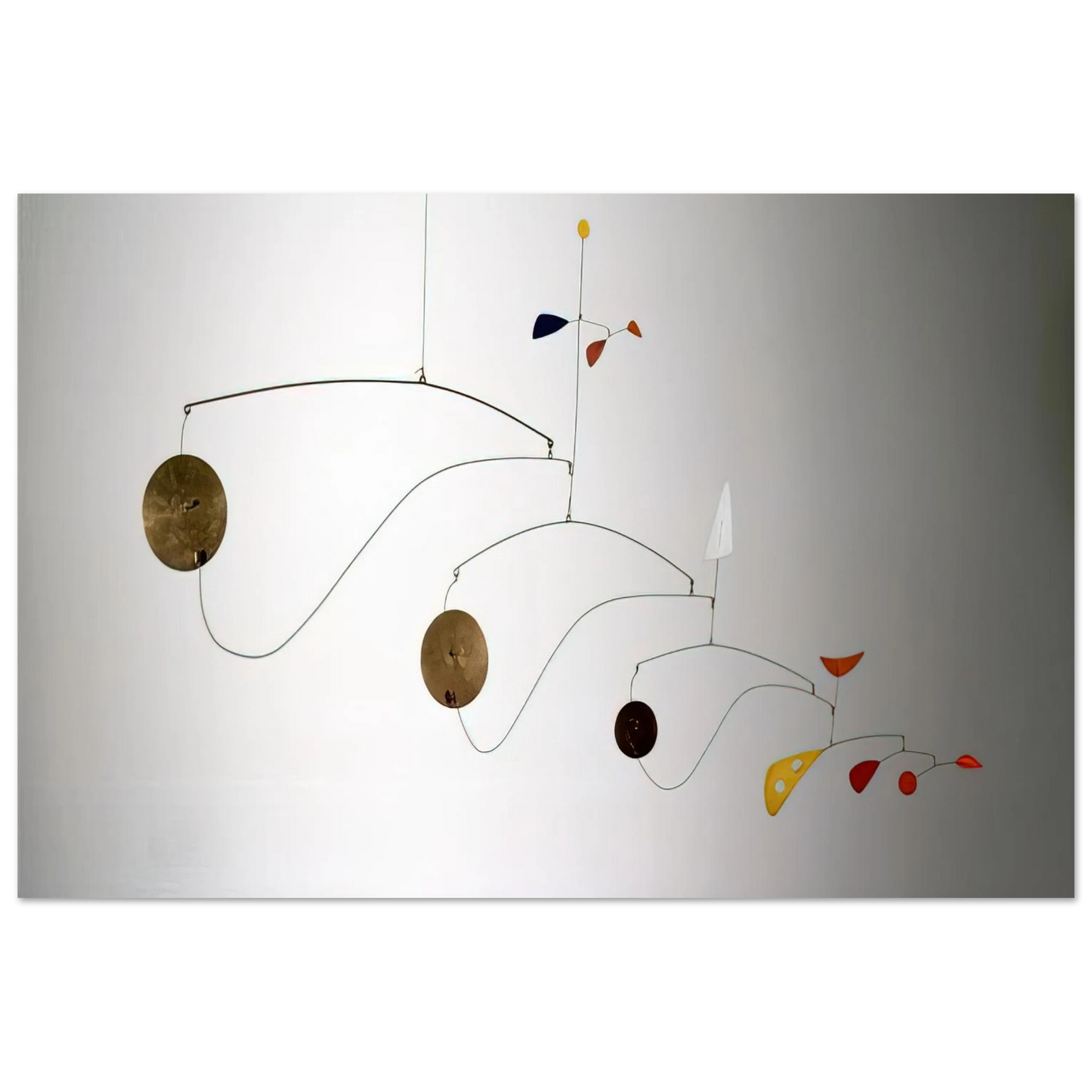
Alexander Calder - TRIPLE GONG 1948 Fine Art Poster
Alexander Calder - TRIPLE GONG 1948 Fine Art Poster
Couldn't load pickup availability
Kinetic Elegance: Alexander Calder’s "Triple Gong" (1948)
RedKalion is honored to present a museum-quality fine art reproduction of Alexander Calder’s "Triple Gong" (1948). This quintessential work from the pioneer of kinetic art captures the delicate balance between gravity and movement. Created during Calder's most prolific period in the late 1940s, Triple Gong exemplifies his mastery of suspended forms—often referred to as "mobiles" by Marcel Duchamp—where industrial materials are transformed into ethereal, organic compositions.
Our archival print honors Calder's vision by meticulously preserving the crisp silhouettes and rhythmic tension of the original piece. This is more than a fine art poster; it is a sophisticated study of space and silence, curated for the discerning collector who seeks to bring a touch of mid-century modernism into a contemporary interior.
The RedKalion Archival Standard
To ensure this masterpiece endures as a centerpiece in your collection, we utilize Master's Edition archival paper. This premium substrate offers a natural white (off-white) finish that avoids the harsh glare of synthetic papers, allowing the viewer to focus entirely on the artwork's formal qualities. The texture is luxurious to the touch, providing a depth that standard prints cannot replicate.
- Paper Quality: 250 gsm (110 lb) museum-grade thickness for a robust, premium feel.
- Surface Finish: Matte and uncoated to prevent reflections and preserve the integrity of Calder’s shapes.
- Archival Longevity: Acid-free (pH above 7) chemistry prevents yellowing or degradation over time.
- Sustainability: Printed on FSC-certified paper, reflecting a commitment to ethical curation.
- Exclusivity: Printed on-demand with no minimum order requirements, ensuring your piece is handled with individual care.
Elevate your environment with an archival-grade reproduction that bridges the gap between engineering and poetry. RedKalion invites you to experience the enduring legacy of Alexander Calder through a print designed to last a lifetime.


Discover Unlimited Art Possibilities
At RedKalion, you can find virtually any artwork from any artist, available in a wide range of sizes to perfectly match your space.
If you didn’t find what you’re looking for, contact us at support@redkalion.com . We will source any artwork and produce it in any size and format you need, including art prints, posters, canvas, framed pieces, framed canvas, and more.
For dedicated art enthusiasts, we also offer handcrafted replicas of any artwork, carefully painted by highly skilled artists using traditional techniques.
For custom requests, contact us at support@redkalion.com .
What specific paper is used for the Alexander Calder Triple Gong print?
We use Master's Edition archival paper. It is a 250 gsm (110 lb) museum-quality substrate with a matte, uncoated, natural white finish, providing a luxurious feel and exceptional durability for this fine art reproduction.
Will the colors of this 1948 reproduction fade over time?
No. Our prints are produced on acid-free paper with a pH above 7. This archival-grade material prevents yellowing and ensures the visual integrity of the artwork remains vibrant for generations.
Is the paper used for this print environmentally friendly?
Yes. RedKalion is committed to sustainability. The paper used for the Alexander Calder Triple Gong print is FSC-certified, ensuring it comes from responsibly managed forests.
How is the artwork packaged for shipping?
Each fine art print is printed and shipped on demand using protective, high-quality packaging to ensure it arrives at your door in pristine, museum-ready condition. There are no minimum order requirements.
What are the physical dimensions and thickness of the print?
The Master's Edition paper has a thickness of 0.29 mm (11.4 mils). The 250 gsm weight ensures the poster remains flat and resists creasing, making it ideal for high-end framing.
What is the historical significance of Calder’s "Triple Gong"?
Created in 1948, "Triple Gong" represents the peak of Calder's kinetic exploration. It demonstrates his ability to balance biomorphic shapes through mathematical precision, defining the transition from static sculpture to dynamic, moving art.
Does this print capture the kinetic nature of the original mobile?
While a 2D print is static, our high-resolution reproduction captures the perceived motion and spatial harmony of the original 1948 mobile, making it a perfect educational and aesthetic piece for art enthusiasts.