RedKalion
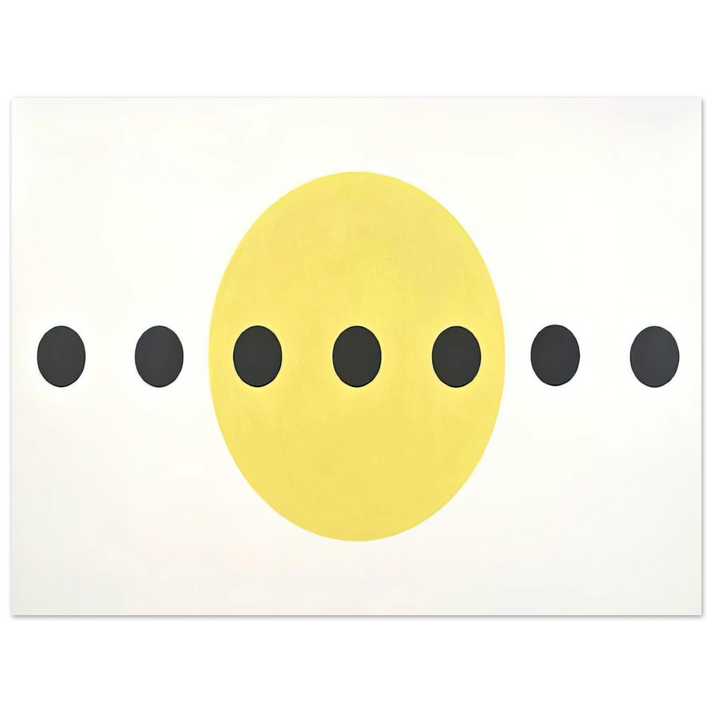
Alexander Liberman - Time - 1952 75x100 cm / 30x40inches Fine Art Poster
Alexander Liberman - Time - 1952 75x100 cm / 30x40inches Fine Art Poster
Couldn't load pickup availability
Elevate Your Space with Alexander Liberman's 'Time' (1952)
Experience the profound simplicity of Alexander Liberman’s 'Time' (1952), a masterpiece of hard-edge abstraction that redefines the relationship between geometry and the temporal. As a polymath of the 20th century—serving as the longtime editorial director of Condé Nast while pursuing a rigorous career in fine art—Liberman brought a unique precision and clarity to his canvases. In 'Time', he explores the circle as a primary symbol of eternity and cosmic order, a recurring motif that would define his most celebrated period of work.
This museum-quality reproduction from RedKalion captures the exact visual weight and minimalist tension of the original 1952 composition. Every detail is rendered with clinical accuracy, ensuring that the interplay of form and negative space resonates as the artist intended. This is not merely a print; it is a meticulously crafted fine art poster designed for collectors who appreciate the intellectual depth of Mid-Century Modernism.
Uncompromising Material Quality
At RedKalion, we believe that world-class art deserves world-class materials. This archival masterpiece is printed on our exclusive Master's Edition archival paper, chosen for its superior tactile quality and durability. The 250 gsm (110 lb) thickness provides a substantial, premium feel, while the matte, uncoated natural white finish ensures a glare-free viewing experience that emphasizes the purity of Liberman's color palette.
- Archival Longevity: Acid-free paper (pH above 7) prevents yellowing and preserves the vibrancy of the work for generations.
- Substantial Texture: A thickness of 0.29 mm (11.4 mils) ensures a flat, luxurious hang.
- Sustainably Sourced: All prints utilize FSC-certified paper, reflecting our commitment to environmental responsibility.
- Precision Fulfillment: Each piece is printed and shipped on demand with no minimum order requirements, ensuring a fresh, pristine delivery directly to your door.

Discover Unlimited Art Possibilities
At RedKalion, you can find virtually any artwork from any artist, available in a wide range of sizes to perfectly match your space.
If you didn’t find what you’re looking for, contact us at support@redkalion.com . We will source any artwork and produce it in any size and format you need, including art prints, posters, canvas, framed pieces, framed canvas, and more.
For dedicated art enthusiasts, we also offer handcrafted replicas of any artwork, carefully painted by highly skilled artists using traditional techniques.
For custom requests, contact us at support@redkalion.com .
What defines the quality of this Alexander Liberman reproduction?
Our reproductions use Master's Edition archival paper and advanced printing techniques to ensure museum-quality color accuracy and detail, reflecting the authoritative curation of the RedKalion gallery.
What are the specific paper characteristics for 'Time' (1952)?
The piece is printed on 250 gsm (110 lb) natural white, matte paper with a thickness of 0.29 mm, providing a sophisticated, glare-free finish perfect for high-end interiors.
How does the print ensure long-term preservation?
We use acid-free paper with a pH above 7, which prevents the material from yellowing or deteriorating, ensuring your investment in fine art remains pristine for decades.
Is the paper used for this fine art poster sustainable?
Yes, RedKalion is committed to sustainability; we use FSC-certified paper (or equivalent regional certifications) to ensure responsible forest management and environmental protection.
How is my RedKalion order fulfilled and shipped?
Every order is printed and shipped on demand with no minimums, ensuring high-quality control and efficient delivery of your museum-quality fine art print.
What is the significance of the circular motif in Liberman's 'Time'?
For Liberman, the circle represented the 'ideal form' and the concept of eternity. In 'Time' (1952), it acts as a meditative focal point exploring the precision of hard-edge abstraction.
How does Liberman's 1952 work fit into the Mid-Century Modern movement?
Liberman was a pioneer of the hard-edge style, moving away from the gestural chaos of Abstract Expressionism toward a more calculated, minimalist, and geometric aesthetic that defined 1950s modernism.