RedKalion
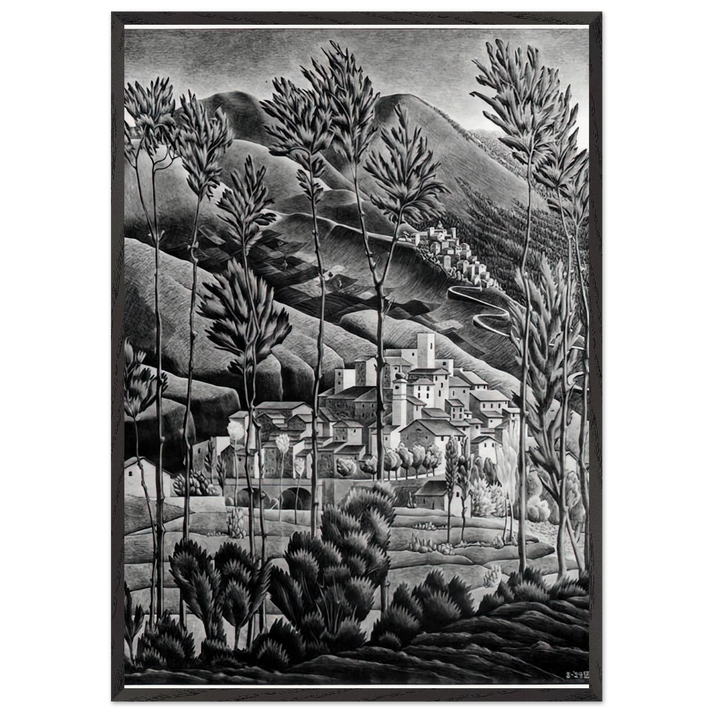
ALFEDENA ABRUZZI - MC Escher 70x100 cm / 28x40 inches Framed Art Print – Black Wooden Frame | Maurits Cornelis Escher Prints
ALFEDENA ABRUZZI - MC Escher 70x100 cm / 28x40 inches Framed Art Print – Black Wooden Frame | Maurits Cornelis Escher Prints
Couldn't load pickup availability
Elevate Your Space with M.C. Escher’s Alfedena, Abruzzi
Experience the architectural mastery of Maurits Cornelis Escher with this stunning reproduction of Alfedena, Abruzzi. Created during his prolific Italian period in 1929, this work captures the rhythmic beauty of a hillside town in the Abruzzo region. Before Escher transitioned into the surreal 'impossible constructions' for which he is world-renowned, he spent years refining his technique through the study of Italian landscapes, focusing on the interplay of light, shadow, and geometric structure.
This museum-quality fine art print is curated by RedKalion to ensure every detail of Escher’s precise linework is preserved. Printed on 250 gsm (110 lb) archival paper with a natural white, matte finish, the print offers a sophisticated, glare-free appearance that highlights the stark contrasts characteristic of Escher’s lithographic style.
Premium Craftsmanship and Sustainable Materials
- High-Density Paper: 250 gsm (110 lb) uncoated archival paper ensures longevity and a premium tactile feel.
- Solid Wood Frame: Responsibly sourced, FSC-certified black ash wood frame, measuring 20mm (0.79") in width and thickness for a substantial, gallery-grade presence.
- Shatterproof Protection: Each print is secured behind transparent, shatterproof plexiglass to protect against UV damage and environmental wear.
- Ready to Hang: Your 70x100 cm (28x40") framed art print arrives fully assembled with a specialized hanging kit included.
By choosing a RedKalion reproduction, you are investing in an archival-grade masterpiece that honors the legacy of M.C. Escher while utilizing sustainable, environmentally conscious manufacturing processes.

Discover Unlimited Art Possibilities
At RedKalion, you can find virtually any artwork from any artist, available in a wide range of sizes to perfectly match your space.
If you didn’t find what you’re looking for, contact us at support@redkalion.com . We will source any artwork and produce it in any size and format you need, including art prints, posters, canvas, framed pieces, framed canvas, and more.
For dedicated art enthusiasts, we also offer handcrafted replicas of any artwork, carefully painted by highly skilled artists using traditional techniques.
For custom requests, contact us at support@redkalion.com .
What defines the quality of this M.C. Escher print?
We use 250 gsm museum-quality, archival paper that is uncoated and natural white. This ensures the Alfedena Abruzzi print maintains its structural integrity and color depth for decades without yellowing or fading.
How is the frame constructed for this piece?
The print is housed in a premium 20mm black frame made from responsibly sourced ash wood. This frame is wider than industry standards, providing enhanced durability and a sophisticated gallery aesthetic.
Is the artwork protected during shipping and display?
Yes, each framed print features shatterproof plexiglass for ultimate protection. For shipping, we use robust, protective packaging to ensure your M.C. Escher artwork arrives in pristine condition.
Are the materials used for this print sustainable?
RedKalion is committed to sustainability. We use FSC-certified paper and wood, or local equivalents, ensuring that your fine art reproduction supports responsible forest management practices.
Does the frame come ready for wall mounting?
Absolutely. Every framed art print includes a high-quality hanging kit, allowing you to mount your 70x100 cm Escher piece immediately upon arrival.
What is the historical significance of Alfedena, Abruzzi?
This 1929 work belongs to Escher’s early Italian period. It demonstrates his fascination with the 'organic geometry' of Italian hill towns, serving as a foundational precursor to his later mathematical and tessellated artworks.
How does this piece differ from Escher’s later surrealist works?
Unlike his 'impossible' perspectives, Alfedena, Abruzzi is a study in realism and architectural rhythm. It showcases Escher's mastery of landscape lithography and his ability to find complex patterns in the natural world.