
RedKalion
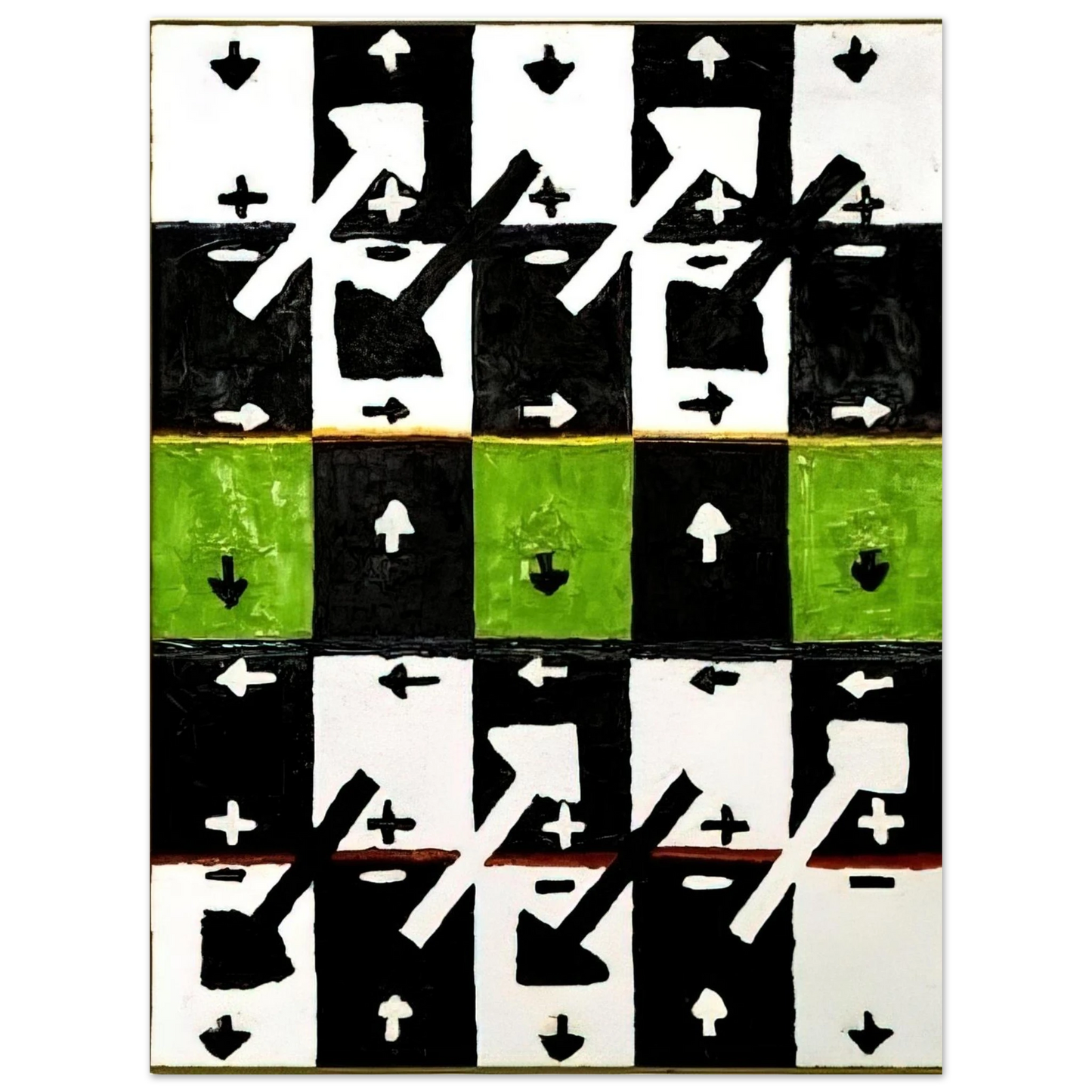
Alfred Jensen - An Influence of the Earth's Motion on Optical Phenomena - 1961 75x100 cm / 30x40inches Fine Art Poster
Alfred Jensen - An Influence of the Earth's Motion on Optical Phenomena - 1961 75x100 cm / 30x40inches Fine Art Poster
Couldn't load pickup availability
Alfred Jensen: An Influence of the Earth's Motion on Optical Phenomena (1961)
Step into the intersection of mathematics and abstract expressionism with Alfred Jensen’s 1961 masterpiece, An Influence of the Earth's Motion on Optical Phenomena. As a central figure in the mid-century avant-garde, Jensen defied traditional artistic categories, instead creating a visual language rooted in complex scientific systems, ancient calendars, and physics. This specific work captures his fascination with the cosmic order, rendering scientific theory into a vibrant, rhythmic grid of color and geometry.
At RedKalion, we curate only the finest museum-quality reproductions. This 75x100 cm (30x40 inches) fine art poster is meticulously produced on our Master's Edition archival paper. With a weight of 250 gsm (110 lb) and a thickness of 0.29 mm, this paper provides a luxurious, heavy-duty feel that honors the tactile legacy of Jensen’s original impasto technique. The matte, uncoated natural white finish ensures that the intricate details and bold color contrasts are visible from every angle without distracting glare.
Our commitment to excellence extends to the longevity of your acquisition. This print is acid-free (pH above 7), ensuring the paper remains pristine and resists yellowing for decades. Sustainably produced using FSC-certified paper, this archival masterpiece allows you to elevate your space with a work that is as ethically responsible as it is aesthetically profound. Experience the intellectual depth of Alfred Jensen through a print designed to endure for generations.
- Artist: Alfred Jensen (1961)
- Paper Type: Museum-quality Master's Edition
- Finish: Matte, natural white (off-white)
- Archival Quality: Acid-free, pH-buffered for maximum longevity
- Sustainability: FSC-certified material
Discover Unlimited Art Possibilities
At RedKalion, you can find virtually any artwork from any artist, available in a wide range of sizes to perfectly match your space.
If you didn’t find what you’re looking for, contact us at support@redkalion.com . We will source any artwork and produce it in any size and format you need, including art prints, posters, canvas, framed pieces, framed canvas, and more.
For dedicated art enthusiasts, we also offer handcrafted replicas of any artwork, carefully painted by highly skilled artists using traditional techniques.
For custom requests, contact us at support@redkalion.com .
What are the physical specifications of the Alfred Jensen fine art print?
This print uses 250 gsm (110 lb) Master's Edition archival paper. It features a matte, uncoated natural white finish with a thickness of 0.29 mm (11.4 mils), providing a premium, museum-quality texture for your space.
How does the archival quality ensure the longevity of the artwork?
Our prints are acid-free with a pH level above 7. This prevents the paper from yellowing or becoming brittle over time, ensuring the Alfred Jensen reproduction remains in gallery condition for decades.
Is the paper sustainably sourced for these reproductions?
Yes, RedKalion prioritizes environmental responsibility. The paper used for the Alfred Jensen fine art poster is FSC-certified, ensuring it comes from responsibly managed forests that provide environmental, social, and economic benefits.
What are the shipping and fulfillment details for my order?
We operate with a commitment to efficiency and sustainability. There are no minimum orders, and each Alfred Jensen print is produced and shipped on demand to ensure the highest quality control and reduced waste.
Does the print feature a glossy or matte finish?
This reproduction features a luxurious matte, uncoated finish. This natural white (off-white) surface eliminates glare and provides a sophisticated texture that highlights the complex geometric patterns of Jensen’s 1961 work.
What inspired Alfred Jensen to create 'An Influence of the Earth's Motion on Optical Phenomena'?
Alfred Jensen was deeply influenced by physics and Goethe’s color theory. This 1961 piece explores scientific diagrams and the mechanics of light, translating mathematical logic into a visionary grid-based aesthetic.
How does this 1961 masterpiece reflect the artist's unique style?
Jensen’s style is characterized by a "diagrammatic" approach. This work showcases his signature use of color-coded systems and mathematical sequences to represent the underlying structures of the physical and optical world.