
RedKalion
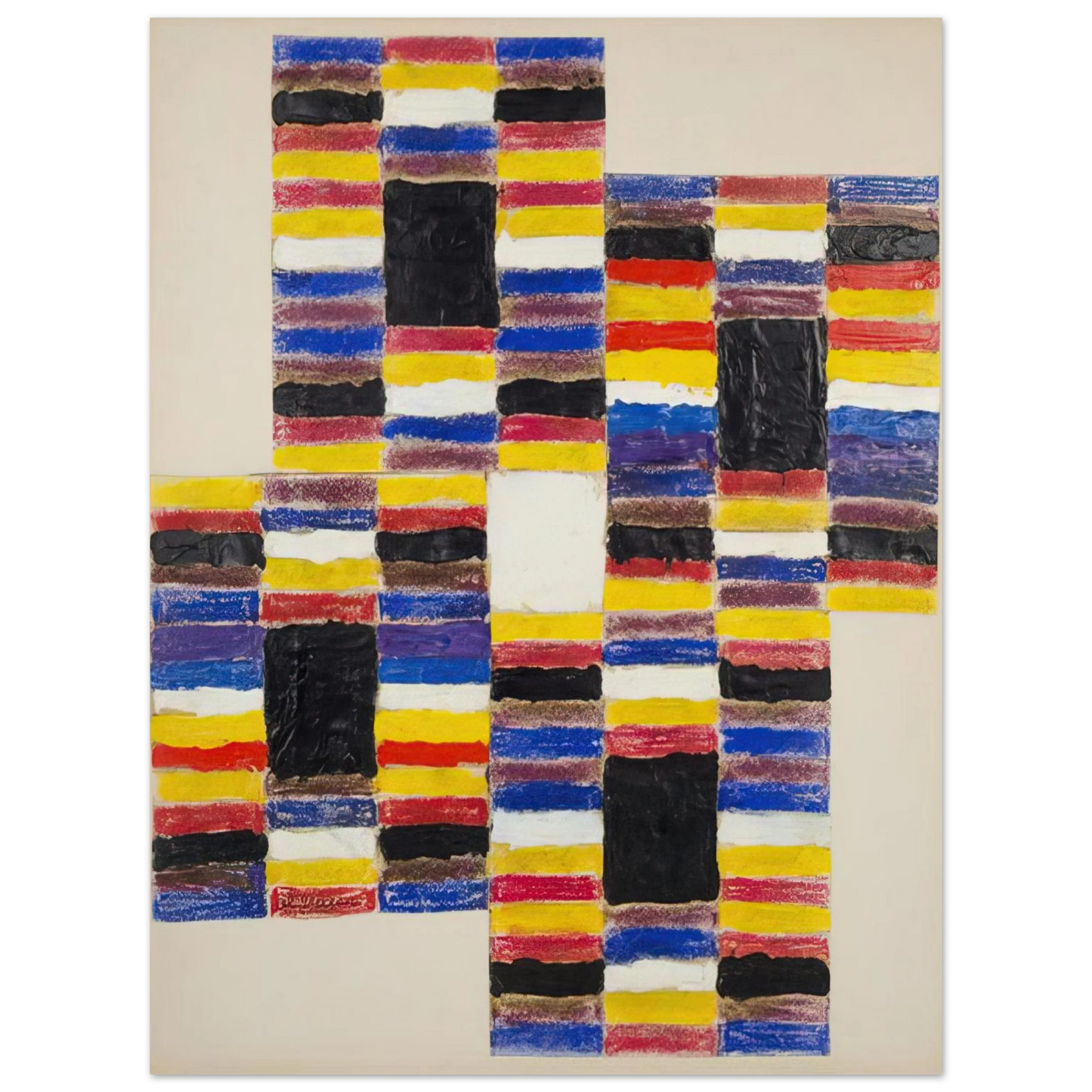
Alfred Jensen - Ascending I - 1958 75x100 cm / 30x40inches Fine Art Poster
Alfred Jensen - Ascending I - 1958 75x100 cm / 30x40inches Fine Art Poster
Couldn't load pickup availability
Elevate Your Collection with Alfred Jensen’s 'Ascending I' (1958)
Experience the intellectual rigor and vibrant energy of Alfred Jensen’s 'Ascending I' (1958), a seminal work that bridges the gap between Abstract Expressionism and the early seeds of Conceptual Art. This 75x100 cm (30x40 inches) fine art poster captures Jensen’s unique preoccupation with mathematical sequences, ancient calendars, and color theory. Known for his dense, grid-based compositions, Jensen transformed complex numerical systems into visual symphonies of color and form.
Museum-Quality Reproduction for the Discerning Curator
At RedKalion, we believe a masterpiece deserves a medium of equal stature. Our reproduction of 'Ascending I' is printed on our Master's Edition archival paper, offering an unparalleled tactile experience. The 250 gsm (110 lb) weight provides a substantial, premium feel, while the matte, natural white finish ensures that Jensen’s intricate geometric patterns and bold hues are presented without distracting glare.
- Historical Significance: 1958 marked a transformative period for Jensen, as he moved away from traditional landscapes toward the 'diagrammatic' abstractions that would define his legacy.
- Archival Longevity: This acid-free print (pH above 7) is engineered to prevent yellowing, preserving the integrity of the artwork for generations.
- Sophisticated Texture: The uncoated, 0.29 mm thick paper offers a luxurious, museum-quality feel that elevates any interior space.
- Sustainable Excellence: Produced on FSC-certified paper, reflecting our commitment to both fine art and environmental stewardship.
By choosing this Alfred Jensen fine art print from RedKalion, you are not merely purchasing a poster; you are investing in a meticulously crafted archival piece that honors the complexity of Jensen’s vision while adding a layer of historical authority to your home or office.
Discover Unlimited Art Possibilities
At RedKalion, you can find virtually any artwork from any artist, available in a wide range of sizes to perfectly match your space.
If you didn’t find what you’re looking for, contact us at support@redkalion.com . We will source any artwork and produce it in any size and format you need, including art prints, posters, canvas, framed pieces, framed canvas, and more.
For dedicated art enthusiasts, we also offer handcrafted replicas of any artwork, carefully painted by highly skilled artists using traditional techniques.
For custom requests, contact us at support@redkalion.com .
What are the paper specifications for this Alfred Jensen print?
We use Master's Edition archival paper, which is 250 gsm (110 lb) and 0.29 mm thick. It features a matte, uncoated, natural white finish for a luxurious, glare-free appearance.
Is this artwork printed with archival-grade materials?
Yes. The paper is acid-free with a pH above 7, which prevents yellowing and ensures the print's longevity, making it a true museum-quality reproduction.
How is the shipping handled for large format prints?
Our prints are fulfilled on-demand with no minimum orders. They are carefully packaged and shipped to ensure they arrive in pristine condition at your doorstep.
Is the paper used for 'Ascending I' sustainably sourced?
Absolutely. RedKalion utilizes FSC-certified paper (or equivalent certifications), ensuring that your fine art print meets high environmental and social standards.
Does the print come with a frame?
This listing is for the fine art poster only. The matte, off-white texture of the 250 gsm paper provides a stunning visual even before custom framing.
Who was Alfred Jensen and why is 'Ascending I' important?
Alfred Jensen was a visionary artist who used mathematical systems and ancient theories to create grids. 'Ascending I' (1958) is a prime example of his transition into complex, symbolic abstraction.
What is the significance of the 1958 date for this piece?
1958 was a breakthrough year for Jensen, characterized by his move toward the heavy impasto and mathematical diagrams that influenced both Minimalist and Conceptual artists.