
RedKalion
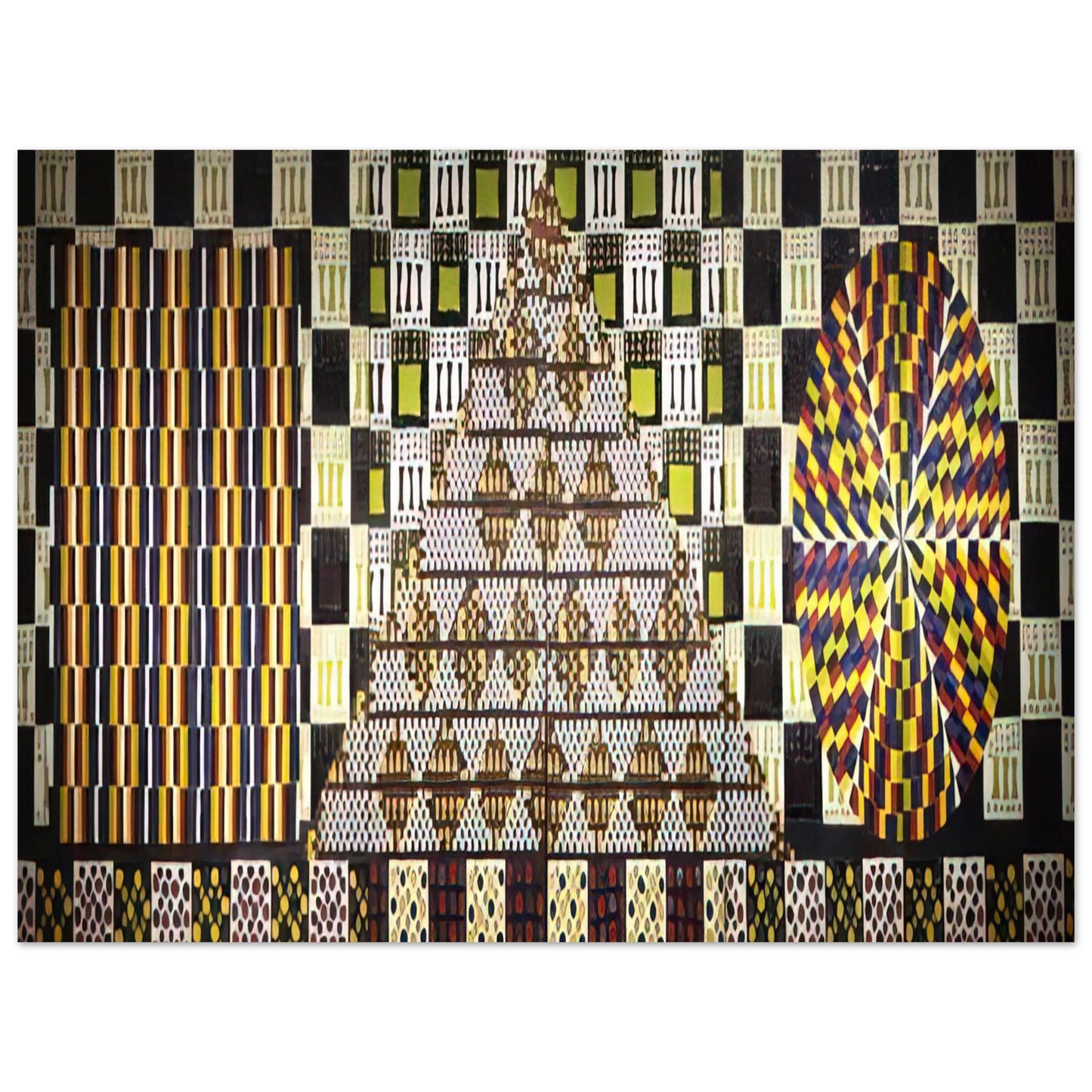
Alfred Jensen - Honor Pythagoras, Per I--Per VI - 1964 75x100 cm / 30x40inches Fine Art Poster
Alfred Jensen - Honor Pythagoras, Per I--Per VI - 1964 75x100 cm / 30x40inches Fine Art Poster
Couldn't load pickup availability
A Masterpiece of Mathematical Geometry: Honor Pythagoras, Per I--Per VI
Experience the intellectual depth and visual vibrance of Alfred Jensen’s 1964 masterwork, Honor Pythagoras, Per I--Per VI. A pivotal figure in mid-century conceptual abstraction, Jensen transcended the boundaries of traditional painting by weaving complex mathematical systems, ancient philosophies, and color theories into a singular visual language. This specific series pays homage to the Pythagorean belief in numbers as the fundamental essence of the universe, translated through Jensen's signature grid-based compositions and rhythmic color palettes.
Museum-Grade Reproduction for the Discerning Collector
At RedKalion, we curate our prints to meet the exacting standards of galleries and museums. This fine art poster is rendered on our Master's Edition archival paper, providing a sophisticated, tactile experience that mirrors the gravity of the original work. The matte, natural white (off-white) finish ensures that the vibrant, high-contrast colors of Jensen's geometric patterns are displayed without glare, allowing the intricate details of the 1964 sequence to resonate in any lighting condition.
Uncompromising Quality and Longevity
To preserve the historical integrity of this work, each reproduction is crafted using acid-free technology (pH above 7). This prevents the yellowing and degradation common in standard prints, ensuring your Alfred Jensen piece remains a centerpiece for generations. Key specifications include:
- Weight: 250 gsm (110 lb) for a premium, heavy-duty feel.
- Thickness: 0.29 mm (11.4 mils) of archival-grade material.
- Sustainability: Printed on FSC-certified paper, supporting responsible forest management.
- Texture: Uncoated finish for a luxurious, non-reflective surface.
By choosing a RedKalion print, you are not merely purchasing a poster; you are acquiring an archival-grade artifact that celebrates the intersection of art and science. Elevate your interior with a piece that invites contemplation and endures as a testament to Alfred Jensen's visionary genius.
Discover Unlimited Art Possibilities
At RedKalion, you can find virtually any artwork from any artist, available in a wide range of sizes to perfectly match your space.
If you didn’t find what you’re looking for, contact us at support@redkalion.com . We will source any artwork and produce it in any size and format you need, including art prints, posters, canvas, framed pieces, framed canvas, and more.
For dedicated art enthusiasts, we also offer handcrafted replicas of any artwork, carefully painted by highly skilled artists using traditional techniques.
For custom requests, contact us at support@redkalion.com .
What defines the paper quality of this Alfred Jensen print?
We use Master's Edition archival paper, weighing 250 gsm (110 lb). This premium, museum-quality paper is acid-free and features a natural white, matte finish that provides a luxurious feel and prevents light reflection.
How does the archival nature of the print prevent aging?
The paper is acid-free with a pH level above 7, which chemically prevents the material from yellowing or becoming brittle over time. This ensures the 1964 color palette remains vibrant for decades.
Is the paper used for this reproduction sustainably sourced?
Yes, all prints are produced on FSC-certified paper (Forest Stewardship Council). This certification guarantees that the materials are sourced from responsibly managed forests that provide environmental, social, and economic benefits.
How is my fine art poster order fulfilled and shipped?
RedKalion operates on a print-on-demand basis with no minimum orders. Each Alfred Jensen print is produced specifically for you and shipped in protective packaging to ensure it arrives in pristine gallery condition.
Does this print accurately capture the texture of Jensen's original work?
While this is a flat fine art reproduction, our high-resolution printing process and the 0.29 mm thick matte paper capture the visual depth and rhythmic complexity of Jensen's grid-based mathematical compositions.
What is the significance of the "Honor Pythagoras" series?
Created in 1964, this series explores Alfred Jensen's fascination with Pythagorean mathematics. It visualizes the harmony of the universe through numerical sequences and geometric symmetry, bridging the gap between ancient philosophy and modern abstraction.
Why does Jensen use these specific grid patterns and colors?
Jensen used grids to map out mathematical systems, often influenced by the I Ching, Mayan calendars, and Greek philosophy. The colors represent numerical values, creating a structural logic that dictates the entire visual composition.