RedKalion
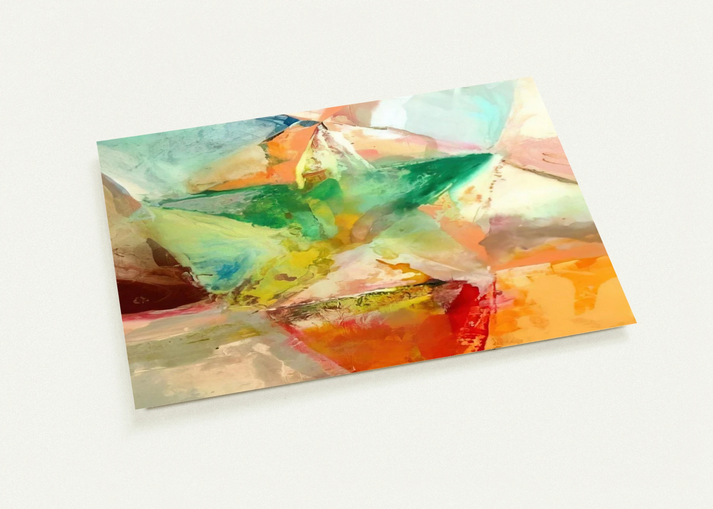
Allstar Galilee - 1970 By Stephen Mueller Pack of 10 Post Cards | Stephen Mueller Post Cards | A6 (10.5 x 14.8 cm) - 4.1 x 5.8 inches
Allstar Galilee - 1970 By Stephen Mueller Pack of 10 Post Cards | Stephen Mueller Post Cards | A6 (10.5 x 14.8 cm) - 4.1 x 5.8 inches
Couldn't load pickup availability
Elevate Your Correspondence with Stephen Mueller's 'Allstar Galilee' (1970)
Experience the luminous abstraction of the late 20th century with this exclusive set of ten postcards featuring Stephen Mueller's 'Allstar Galilee' (1970). Mueller, a central figure in the evolution of Lyrical Abstraction, was renowned for his ability to synthesize Color Field sensibilities with a deeply personal, often spiritual, visual language. 'Allstar Galilee' serves as a profound example of his early mastery, where ethereal forms and vibrant pigments evoke a sense of both topographical depth and celestial wonder.
Museum-Quality Reproductions on Your Desk
At RedKalion, we believe that fine art should be a tactile experience. These A6 postcards are not mere stationary; they are miniature museum-quality reproductions. Utilizing our advanced 12-color fine art printing technology, we achieve a color vibrancy and depth that traditional 4-color inkjet processes simply cannot replicate. Every subtle hue and gestural nuance of Mueller's original 1970 masterpiece is preserved with stunning accuracy.
Archival Materials for the Discerning Collector
Each card in this 10-pack is printed on premium 200 gsm (80 lb) FSC-certified paper, ensuring a substantial feel and a commitment to environmental responsibility. The smooth matte finish eliminates glare, allowing the complex color relationships within the artwork to remain the focal point. With a thickness of 0.26 mm, these cards offer the structural integrity required for both mailing and framing.
- Artist: Stephen Mueller (1947–2011)
- Title: Allstar Galilee (1970)
- Format: Pack of 10 Flat Postcards
- Size: A6 (10.5 x 14.8 cm / 4.1 x 5.8 inches)
- Sustainability: Environmentally conscious, FSC-certified materials
Whether used for sophisticated personal correspondence or displayed as a curated series of mini-prints, these Stephen Mueller postcards bring the prestige of a premier gallery into your daily life. RedKalion remains the definitive source for archival-grade reproductions that honor the legacy of modern art.

Discover Unlimited Art Possibilities
At RedKalion, you can find virtually any artwork from any artist, available in a wide range of sizes to perfectly match your space.
If you didn’t find what you’re looking for, contact us at support@redkalion.com . We will source any artwork and produce it in any size and format you need, including art prints, posters, canvas, framed pieces, framed canvas, and more.
For dedicated art enthusiasts, we also offer handcrafted replicas of any artwork, carefully painted by highly skilled artists using traditional techniques.
For custom requests, contact us at support@redkalion.com .
What makes the printing quality of these postcards unique?
We use 12-color fine art printing technology, which provides superior color depth and vibrancy compared to standard 4-color prints, ensuring each Stephen Mueller reproduction is gallery-accurate.
What type of paper and finish is used for the Allstar Galilee set?
The cards are printed on 200 gsm (80 lb) FSC-certified paper with a thickness of 0.26 mm. They feature a smooth matte finish for a sophisticated, glare-free appearance.
Are these postcards suitable for framing or mailing?
Yes, the archival-grade 200 gsm paper and museum-quality inks make them perfect for both high-end correspondence and display as small-scale art prints.
How does RedKalion approach environmental sustainability?
We utilize FSC-certified paper and print-on-demand technology to minimize waste, ensuring your fine art prints are as eco-friendly as they are beautiful.
Is there a minimum order requirement for these postcards?
No, all our products are printed on demand with no minimum order requirements, allowing you to curate your collection at your own pace.
Who was Stephen Mueller and what is his artistic significance?
Stephen Mueller was a prominent American painter associated with Lyrical Abstraction. His work is celebrated for its spiritual resonance and sophisticated use of color and shape.
What is the thematic inspiration behind 'Allstar Galilee' (1970)?
'Allstar Galilee' represents Mueller’s exploration of abstract landscapes, blending topographical references with celestial, dream-like forms typical of early 1970s abstraction.