

RedKalion
An Influence of the Earth's Motion on Optical Phenomena - 1961 By Alfred Jensen Pack of 10 Post Cards | Alfred Jensen Post Cards | A6 (10.5 x 14.8 cm) - 4.1 x 5.8 inches
An Influence of the Earth's Motion on Optical Phenomena - 1961 By Alfred Jensen Pack of 10 Post Cards | Alfred Jensen Post Cards | A6 (10.5 x 14.8 cm) - 4.1 x 5.8 inches
Couldn't load pickup availability
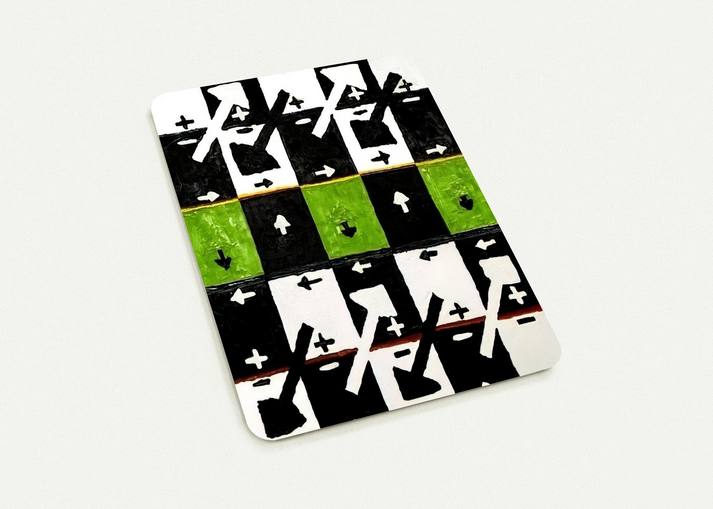
An Influence of the Earth's Motion on Optical Phenomena (1961) by Alfred Jensen
Immerse yourself in the cerebral and vibrant world of Alfred Jensen with this exclusive set of ten museum-quality postcards. Created in 1961, 'An Influence of the Earth's Motion on Optical Phenomena' represents a pinnacle of Jensen’s transition from Abstract Expressionism into a unique, diagrammatic style that synthesizes physics, mathematics, and ancient cosmology. This particular work reflects his deep fascination with the theories of Michael Faraday and James Clerk Maxwell, translating complex scientific concepts into a tactile, grid-based visual language.
At RedKalion, we honor Jensen’s legacy by utilizing 12-color fine art printing technology. Unlike standard 4-color digital prints, our process captures the intricate nuances and high-contrast color relationships essential to Jensen’s mathematical compositions. Each card is printed on 200 gsm (80 lb) FSC-certified paper, ensuring a substantial feel and a smooth matte finish that eliminates glare while maintaining stunning color depth.
Product Specifications & Quality Features:
- Pack Size: 10 premium flat postcards (A6 format).
- Historical Context: Authentic reproduction of Alfred Jensen’s 1961 masterpiece exploring optical physics.
- Archival Quality: Printed with archival-grade inks to ensure longevity and resistance to fading.
- Eco-Conscious: Produced on environmentally responsible, FSC-certified paper stock.
- Dimensions: 10.5 x 14.8 cm (4.1 x 5.8 inches), ideal for correspondence or miniature gallery displays.
Whether utilized for sophisticated personal notes or displayed as a collective series, these postcards elevate any space with an archival masterpiece that endures. Experience the rigorous beauty of Jensen’s cosmic diagrams with the precision that only RedKalion’s curatorial standards can provide.


Discover Unlimited Art Possibilities
At RedKalion, you can find virtually any artwork from any artist, available in a wide range of sizes to perfectly match your space.
If you didn’t find what you’re looking for, contact us at support@redkalion.com . We will source any artwork and produce it in any size and format you need, including art prints, posters, canvas, framed pieces, framed canvas, and more.
For dedicated art enthusiasts, we also offer handcrafted replicas of any artwork, carefully painted by highly skilled artists using traditional techniques.
For custom requests, contact us at support@redkalion.com .
What printing technology is used for these Alfred Jensen postcards?
We use advanced 12-color fine art printing technology. This ensures superior color vibrancy and accuracy, capturing the complex hues of Jensen's 1961 work far better than standard 4-color inkjet processes.
What are the paper specifications for this postcard set?
The cards are printed on 200 gsm (80 lb) FSC-certified paper with a thickness of 0.26 mm. They feature a smooth matte finish for a sophisticated, glare-free display.
How are the postcards packaged and shipped?
Each pack of 10 is printed on demand and carefully packaged to ensure they arrive in pristine condition. We offer global shipping with no minimum order requirements.
Will the colors fade over time?
No. By using archival-grade inks and premium matte paper, these reproductions are designed for longevity, preserving the intellectual and visual intensity of Jensen's palette for years.
Are these postcards suitable for framing?
Yes. The high-resolution 12-color print quality makes them perfect for small-scale framing, allowing you to create a curated wall arrangement of Jensen’s mathematical art.
What inspired Jensen's 'An Influence of the Earth's Motion on Optical Phenomena'?
This 1961 piece was inspired by Jensen's study of physics and electromagnetic theories, specifically how light and motion interact within the structure of the universe.
Why is Alfred Jensen considered a pioneer of the diagrammatic style?
Jensen pioneered a synthesis of art and science, using mathematical grids and color theories to visualize complex cosmic and physical laws, predating many conceptual art movements.